
CSG Becomes MDA Space’s Largest Shareholder: Why Defence Companies Are Moving Into Space
- October 14, 2026
- Posted by: admin
- Category: Uncategorized
One of Europe’s major defence groups has just made its first significant move into space.
On October 13, Czech industrial and defence group CSG announced the acquisition of a 9.5% stake in Canada’s MDA Space, making it the company’s largest shareholder. CSG says the investment could lead to deeper cooperation, including manufacturing ventures in Europe and further acquisitions.
The deal is important beyond the two companies involved. It reflects a broader transformation of the space economy: space is increasingly becoming part of the core infrastructure of defence, security and industrial strategy.
Why Would a Defence Company Invest in a Space Company?
Modern defence systems depend heavily on capabilities delivered from orbit.
Satellites provide communications, Earth observation, navigation, positioning and increasingly sophisticated forms of surveillance and situational awareness. A military operating without reliable access to space-based services would therefore lose access to information that has become essential for operations on Earth.
This is one reason why the line between the space industry and the defence industry is becoming increasingly difficult to draw.
Many space technologies are also described as dual-use. This simply means that the same underlying technology can serve both civilian and security applications.
A satellite communications network, for example, can connect businesses and remote communities but also support military communications. Earth-observation satellites can monitor agriculture or natural disasters while also providing strategic intelligence.
For established defence companies, entering space can therefore be less about moving into an entirely new industry and more about extending capabilities they already sell to governments.
Why MDA Space?
MDA Space illustrates why established industrial groups are becoming interested in space companies.
The Canadian company operates across three major areas: satellite systems, space robotics and geointelligence.
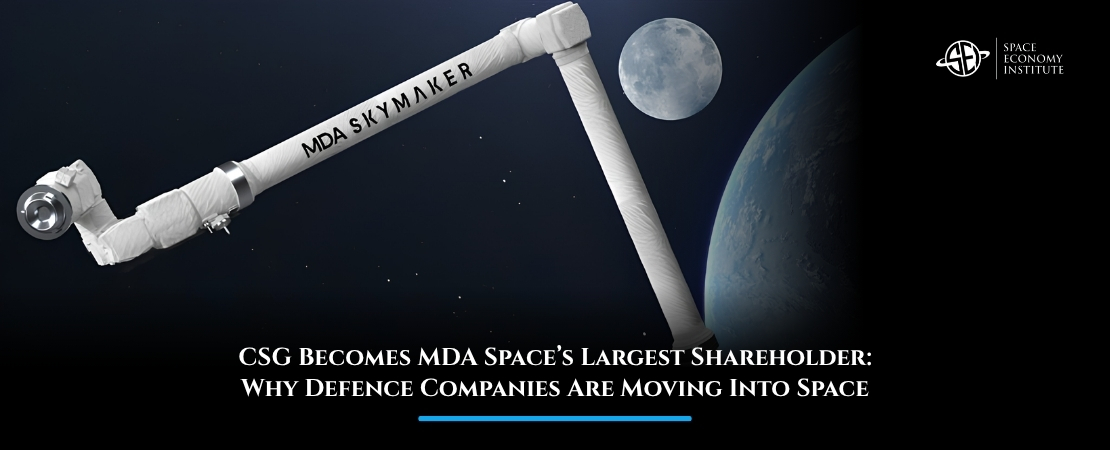
Its technologies include satellite platforms and components, robotics for space operations and Earth-observation capabilities. It is also involved in major programmes such as Telesat Lightspeed and Canadarm3, the robotic system being developed for the lunar Gateway programme.
And this is not a small speculative startup.
MDA Space reported C$498.6 million in revenue in the second quarter of 2026, up 33.6% from the same period a year earlier, while its backlog stood at approximately C$4 billion. Satellite systems represented the largest part of its business.
For CSG, acquiring a strategic position in a company with existing technologies, customers and large contracts provides a faster route into the space sector than developing an entire space division internally from zero.
This is a classic example of how companies enter rapidly growing industries: not only through internal innovation, but through strategic investment, partnerships and acquisitions.
Space Is Becoming Strategic Infrastructure
The wider trend is already visible across Europe.
Swedish defence group Saab, for example, recently announced new partnerships with SSC Space, OHB Sweden and Ericsson as it seeks a larger role in integrated space systems. Saab specifically pointed to increasing demand for space-based communications, navigation, surveillance and early-warning capabilities.
Governments are moving in the same direction.
Space infrastructure is increasingly discussed alongside energy networks, semiconductor production, telecommunications and cyber infrastructure because modern economies—and their defence systems—depend on it.
This also explains growing interest in space sovereignty: the ability of a country or region to access critical satellite services without excessive dependence on foreign providers.
For Europe, that can mean developing domestic capabilities across satellites, launch, communications, Earth observation and ground infrastructure.
An investment such as CSG’s could therefore have consequences beyond financial returns. The company has already indicated that cooperation with MDA could include new manufacturing facilities in Europe.
That could connect Canadian space technology with Europe’s expanding defence-industrial base.
Why More Non-Space Companies May Enter the Sector
There is also a broader economic reason for these moves.
Research by the World Economic Forum and McKinsey estimates that the global space economy could grow from $630 billion in 2023 to $1.8 trillion by 2035. Importantly, much of that growth is expected to come not simply from rockets and satellites, but from industries using space-enabled capabilities—including defence, communications, transportation and supply chains.
That distinction matters.
The future space economy may not be dominated exclusively by companies that identify themselves as “space companies.” Instead, aerospace groups, telecom operators, defence manufacturers, technology companies, logistics businesses and financial investors may increasingly treat space as another strategic layer of their existing businesses.
CSG’s investment in MDA Space is therefore part of a larger shift: space is moving from a specialist industry toward infrastructure that other industries need to control, integrate or access.
When Space Becomes Part of Corporate Strategy
The CSG–MDA deal shows how quickly the boundaries of the space economy are expanding.
For defence companies, governments and investors, space capabilities are increasingly becoming strategic assets rather than optional extensions of existing businesses. That is likely to drive more partnerships, acquisitions and cross-industry investment as companies position themselves for a market expected to grow substantially over the next decade.
If this transformation interests you, the Master in Space Economy by the Space Economy Institute explores how space technologies intersect with defence, industrial policy, investment, geopolitics and emerging business models. Discover more about the Master and learn how the expansion of the space economy is reshaping industries far beyond the traditional space sector.