
Saab Expands Into Space: Sweden Builds an Integrated Defence Space Ecosystem
- September 24, 2026
- Posted by: admin
- Category: Uncategorized
Sweden Is Connecting the Pieces of Its Space Industry
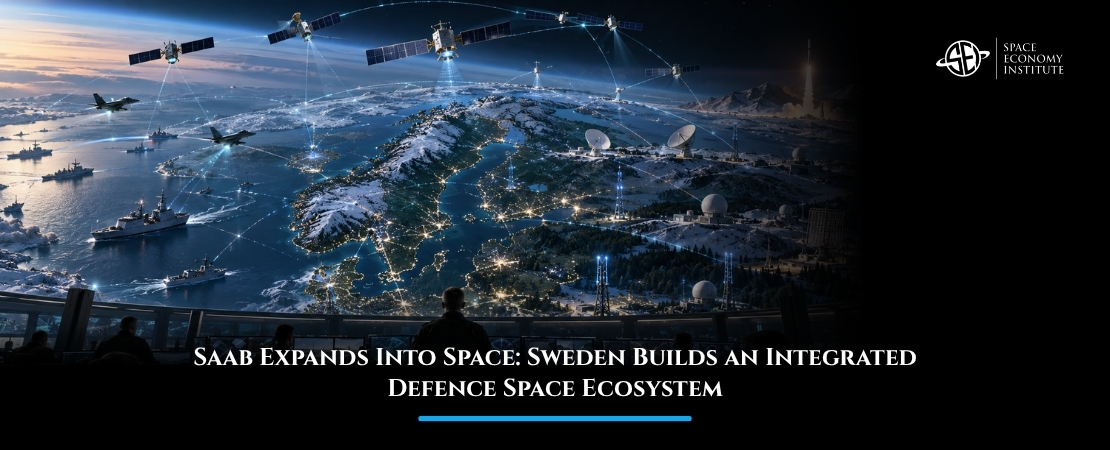
Europe’s defense-space market is becoming increasingly integrated. On September 24, Swedish defense group Saab announced Memorandums of Understanding with SSC Space, OHB Sweden and Ericsson, positioning itself for a broader role as a space systems integrator. Rather than trying to manufacture every component itself, Saab wants to combine satellites, launch infrastructure, ground systems, communications and defense technologies into operational capabilities for Sweden and Europe.
What Does a Space Systems Integrator Actually Do?
A systems integrator connects technologies developed by different suppliers into one functioning operational system.
That role is particularly important in space. A government may need much more than a satellite. It could require the spacecraft itself, secure communications, ground stations, launch services, mission control, sensors, data processing and integration with aircraft, ships and land-based defense systems.
Saab already has expertise in sensors, communications, command-and-control and advanced defense-system integration. The three new agreements would allow it to connect that expertise with capabilities elsewhere in Sweden’s space value chain.
With SSC Space, Saab will explore combining its integration capabilities with SSC’s ground-station network, mission engineering, high-altitude platform services and orbital launch infrastructure at Esrange Space Center in northern Sweden. SSC says the partnership could use Esrange for testing, demonstrations, launch and operations.
With OHB Sweden, the focus is on incorporating existing and future satellite platforms into Saab’s multi-domain systems. With Ericsson, Saab will explore how terrestrial and space-based communications can work together to create more resilient networks.
Together, the partnerships effectively connect several layers of the space economy.
From Individual Products to End-to-End Capability
The commercial significance lies in the business model.
A company does not necessarily need to manufacture rockets, satellites and ground stations itself to capture a central position in the space market. It can instead become the company that assembles those capabilities into a complete solution for the customer.
For defense ministries and other institutional buyers, that can be attractive. Instead of separately procuring a satellite, launch service, communications network and ground infrastructure—and then solving the integration problem themselves—they can increasingly seek end-to-end architectures.
Saab’s strategy mirrors a wider trend in the space economy: value is shifting from individual technologies toward integrated infrastructure and services.
This is especially relevant in defense, where satellite communications, navigation, surveillance and early warning increasingly need to connect directly with operations in the air, on land, at sea and in cyberspace. Saab describes this as Multi-Domain Operations, where information from different environments is integrated into a common operational picture.
Why Esrange Could Become Strategically Important
SSC Space’s participation adds another important piece: European launch and ground infrastructure.
Esrange has evolved from a research facility into a strategic space center with satellite ground services, testing capabilities and infrastructure being developed for orbital launches from mainland Europe. SSC and Saab specifically identified Esrange as a potential location for testing, demonstration, launch and operational activities under their cooperation.
This matters because sovereign space capability depends on more than owning satellites. Countries also need reliable access to orbit, ground infrastructure, secure communications and the ability to operate spacecraft without excessive dependence on external providers.
For Sweden, connecting those capabilities could create a more complete national industrial ecosystem. For Europe, it adds another potential source of sovereign space infrastructure at a time when governments are increasing spending on secure communications, Earth observation and defense-related satellite systems.
A Commercial Opportunity — But Not Yet a Contract
The announcement should also be interpreted carefully. These are Memorandums of Understanding, not confirmed procurement contracts, and the companies disclosed no financial value. Reuters reported that the agreements are intended to explore potential cooperation rather than announce specific programs already awarded.
Their importance is therefore strategic rather than financial—for now.
They show where Saab sees future demand: connecting space assets directly with defense and security systems rather than treating satellites as isolated infrastructure.
What Comes Next for the European Space Economy
Saab’s move matters to satellite manufacturers, telecom companies, launch providers, ground-segment operators, defense agencies and European suppliers. As space becomes more integrated with terrestrial infrastructure, companies capable of connecting different parts of the value chain may become increasingly important.
If this topic is of interest, you can learn more about space value chains, satellite systems, defense markets, European space sovereignty and commercial space strategy in the Master in Space Economy by the Space Economy Institute. Discover more about the Master and explore how integrated space infrastructure is reshaping the global space economy.