
ESA’s ACCESS Programme Turns One: How Europe Is Turning Space Innovation Into Business
- November 27, 2026
- Posted by: admin
- Category: Uncategorized
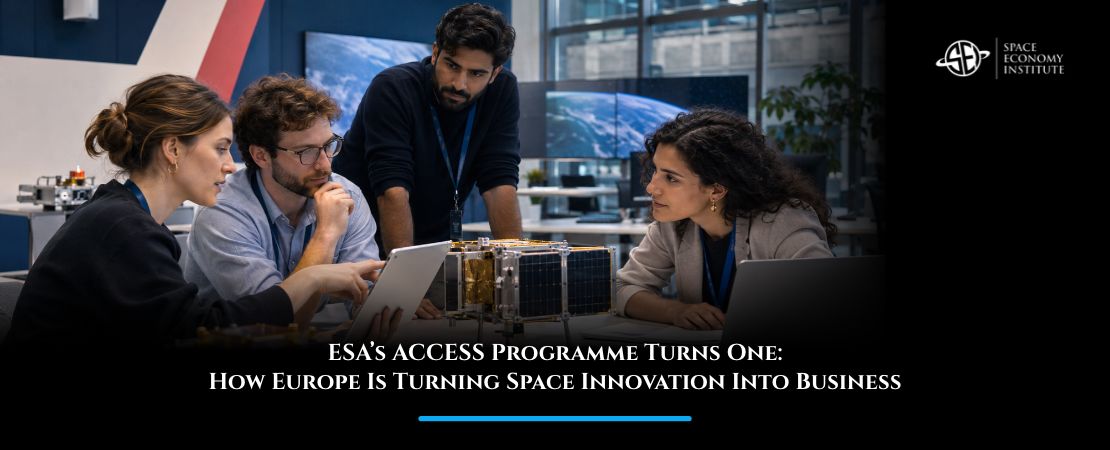
On November 27, the European Space Agency marked the first anniversary of ACCESS, its €380 million programme supporting the commercialisation of space technologies and services.
Approved by ESA Member States in November 2025, the initiative brings together financial support, business incubation and market-development activities. Its first-year update highlights a fundamental challenge for Europe’s space economy: developing advanced technologies is not enough. Companies must also turn those technologies into commercially sustainable businesses.
The Challenge of Commercialising Space Technology
Europe has an established aerospace industry, extensive research capabilities and a growing ecosystem of innovative startups.
However, transforming technological innovation into commercial success remains challenging.
Space companies often face substantial development costs, long testing cycles and complex regulatory requirements. Many must invest heavily in research before generating meaningful revenue.
This creates a gap between technical feasibility and commercial viability.
A company may develop an advanced satellite sensor, for example, without knowing whether enough customers will pay for the information it produces.
Similarly, a business using satellite data for agriculture, insurance or logistics must demonstrate that its service improves customers’ operations sufficiently to justify its price.
The central challenge is therefore not only developing technology, but identifying demand, securing investment and establishing a sustainable business model.
How ESA ACCESS Supports Commercial Development
The ACCESS programme addresses these challenges through two complementary components: ScaleUp and Business Applications and Space Solutions (BASS).
ScaleUp focuses on supporting entrepreneurial development through incubation, acceleration, technology transfer and connections with investors.
BASS helps companies develop commercial applications using space technologies, infrastructure and satellite data.
Its funding instruments support activities ranging from early feasibility assessments to pilot projects that demonstrate whether a service can meet customers’ operational requirements.
The distinction is important.
A research project demonstrates that a technology works. A commercial pilot must also establish whether potential customers need the solution and are prepared to adopt it.
ESA’s November 27 update reports that BASS is currently supporting more than 280 companies with tailored technical and business assistance.
The programme has also introduced funding opportunities targeting sectors such as Arctic operations, environmental protection and energy-grid resilience.
These initiatives illustrate how public support can connect space capabilities with established industries beyond aerospace.
From Incubation to Investment Readiness
ACCESS also aims to strengthen Europe’s entrepreneurial ecosystem.
Over the past year, ESA’s ScaleUp network has expanded through six additional Business Incubation Centres in Portugal, Spain and Slovenia, alongside further developments in technology transfer and innovation networks.
ESA Business Incubation Centres provide selected startups with business coaching, technical expertise, investor connections and typically €50,000 in equity-free funding.
Equity-free funding means that entrepreneurs receive financial support without surrendering an ownership stake in their company.
For early-stage businesses, this can be particularly valuable.
It allows founders to advance product development before seeking larger investments from venture capital funds or strategic partners.
However, financial support alone rarely determines whether a startup succeeds.
Access to potential customers, experienced industrial partners and commercial expertise can be equally important in helping companies move from laboratory development to market entry.
Public Funding as a Market-Development Tool
The economic significance of ACCESS extends beyond the funding allocated to individual companies.
Public programmes can help reduce the risks associated with early technological development, making emerging businesses more attractive to private investors.
They can also encourage collaboration between established industries and space companies.
This process can stimulate demand for satellite applications, generate opportunities for specialized suppliers and support the development of new commercial markets.
Nevertheless, public funding should not be confused with commercial success.
A company receiving institutional support must ultimately demonstrate customer demand, competitive pricing and the ability to generate sustainable revenue.
The €380 million committed to ACCESS represents resources allocated to support commercialisation, not evidence that participating businesses have already generated an equivalent amount in economic returns.
The programme’s longer-term effectiveness will depend on how successfully supported companies attract private capital, secure customers and expand internationally.
Building a More Competitive European Space Economy
ESA’s first-year ACCESS update illustrates an important evolution in European space policy.
Institutional support is increasingly focused not only on developing technologies, but on creating the commercial conditions in which innovative companies can grow.
For entrepreneurs, investors and established industries, the opportunity lies in connecting space capabilities with practical market needs.
The future competitiveness of Europe’s space economy will depend as much on commercial execution, access to finance and customer development as on technological innovation.
If this topic interests you, the Master in Space Economy by the Space Economy Institute explores how entrepreneurship, investment, public policy and emerging business models shape commercial opportunities across the space sector.
Discover more about the Master in Space Economy and the economic forces driving the growth of the global space industry.