
UK Publishes New Lunar Framework: Why Regulation Is Becoming Essential to the Moon Economy
- November 24, 2026
- Posted by: admin
- Category: Uncategorized
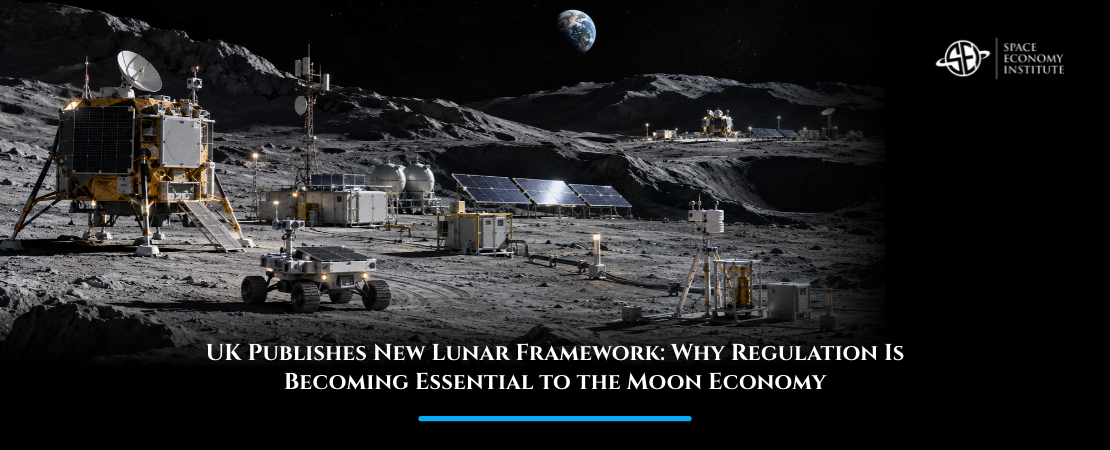
On November 23, the UK government published a new Technical Framework on Lunar Operations, clarifying how British companies should plan and conduct missions on and around the Moon.
The framework addresses spacecraft coordination, lunar debris, surface activities and regulatory responsibilities. It arrives as governments and private companies prepare for more sustained lunar operations.
The development highlights a fundamental challenge for the emerging lunar economy: commercial activity requires not only technology and investment, but also predictable rules.
From Space Treaties to Commercial Operations
The foundations of international space law were established decades before commercial lunar activities became realistic.
The Outer Space Treaty of 1967 establishes that no country can claim sovereignty over the Moon. It also requires governments to authorize and supervise their national space activities, including those conducted by private companies.
However, these principles do not provide detailed operational instructions for every emerging lunar activity.
The UK’s new framework helps address this gap.
It clarifies regulatory expectations for lunar landers, rovers, spacecraft orbiting the Moon and missions operating in cislunar space—the region extending between Earth and the Moon.
The document does not establish a new international legal regime or introduce new statutory requirements. Instead, it explains how existing UK law and international commitments will be considered when assessing lunar mission applications.
For commercial operators, this provides greater clarity during mission design and investment planning.
Managing an Increasingly Crowded Lunar Environment
As more missions reach the Moon, coordination will become increasingly important.
Imagine two companies planning operations near the lunar South Pole. One intends to deploy scientific equipment, while another plans to operate a robotic vehicle in the same region.
Without coordination, their activities could interfere with one another.
The UK framework addresses this through operational transparency, information sharing and temporary safety zones.
Such zones are not claims of territorial ownership. They identify areas where operators should coordinate activities to prevent harmful interference.
The framework also introduces expectations for post-mission disposal, requiring operators to plan how spacecraft will be safely retired.
This includes avoiding unnecessary interference with future missions, protecting historically or scientifically significant locations and reducing the risks associated with abandoned spacecraft.
These measures have economic implications: as lunar activity expands, poorly coordinated operations could damage infrastructure, interrupt services and increase costs for other operators.
Reducing Financial Barriers to Lunar Missions
The framework also connects with a significant change in UK space finance.
From December 1, new licensing arrangements will introduce more flexible liability and insurance requirements for certain space activities.
Under the government’s announced policy, qualifying lunar missions planned for launch before the end of 2030 can receive a £0 operator third-party liability limit for their licensed orbital operations, with the corresponding insurance requirement waived.
This does not eliminate every financial or legal responsibility associated with a mission. Launch-related liability and insurance obligations remain distinct, and other regulatory requirements continue to apply.
Nevertheless, the change could reduce an important financial barrier for emerging companies.
Space missions involve substantial technological uncertainty. Insurance obligations and potential liability exposure can increase upfront costs, making investment more difficult for companies developing technologies without an established commercial track record.
Reducing selected financial requirements could help smaller operators finance early lunar demonstrations and attract private capital.
The policy therefore illustrates how regulation can influence market entry, investment risk and commercial innovation.
Why Legal Certainty Has Economic Value
The commercial significance extends beyond individual licensing requirements.
Companies developing lunar communications, robotics, transportation or resource-related technologies must make investment decisions years before generating revenue.
Uncertainty over operating permissions, coordination obligations and legal responsibilities can complicate those decisions.
Clearer regulatory expectations help companies assess risks, design compliant systems and negotiate with investors and customers.
However, national frameworks cannot resolve every challenge.
The Moon remains an international environment, and commercial activity will require cooperation between countries whose regulatory approaches may differ.
The UK framework represents one national contribution to that process—not a comprehensive solution to global lunar governance.
Building the Institutional Foundations of a Lunar Economy
The UK’s latest framework illustrates how lunar commercialisation is moving beyond engineering challenges toward questions of governance, investment and operational responsibility.
For companies planning lunar missions, regulatory clarity can reduce uncertainty. For governments, the challenge is to encourage innovation while protecting the long-term accessibility of the lunar environment.
A sustainable lunar economy will ultimately depend on both commercially viable technologies and institutions capable of supporting their operation.
If this topic interests you, the Master in Space Economy by the Space Economy Institute explores how space law, international policy, investment and emerging business models interact to shape new markets.
Discover more about the Master in Space Economy and the economic and institutional forces shaping the future of lunar development.