
NTT and ispace Join Forces: Who Will Provide Communications Infrastructure on the Moon?
- November 17, 2026
- Posted by: admin
- Category: Uncategorized
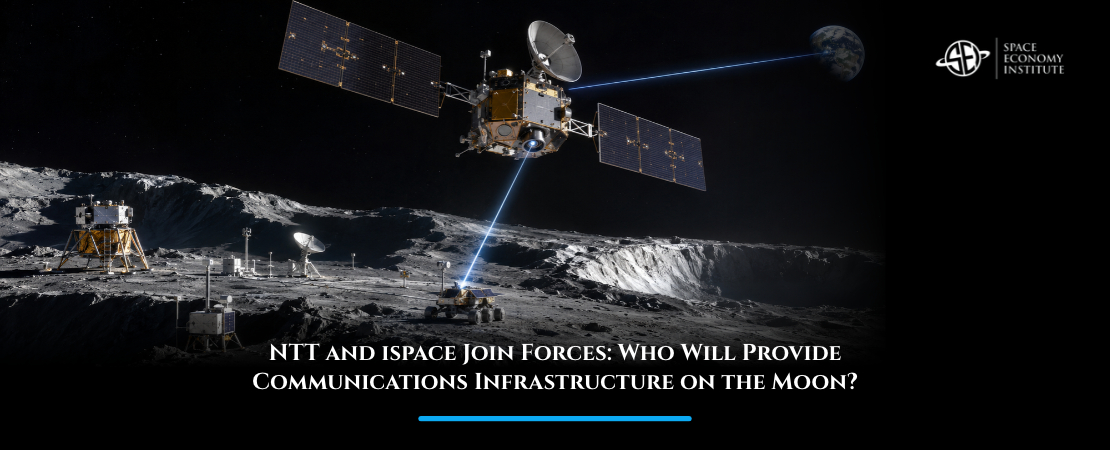
The next commercial opportunity on the Moon may not involve transporting astronauts or extracting resources. It could involve connecting them.
On November 16, Japanese telecommunications group NTT and lunar exploration company ispace announced a collaboration to investigate high-speed optical communications between Earth and the Moon, alongside technologies for transmitting power using lasers.
The agreement is still at the research and feasibility stage, but it raises a fundamental question for the emerging lunar economy: who will build the communications infrastructure, and who will pay to use it?
Why Lunar Exploration Needs Communications Infrastructure
Today, most lunar missions rely on communication systems developed specifically for individual spacecraft.
A lander must exchange commands and data with Earth, while rovers need reliable connections to transmit scientific observations and receive instructions.
However, communication becomes more difficult as missions move beyond locations with a clear view of Earth.
The Moon’s far side, for example, cannot communicate directly with terrestrial ground stations. Some polar regions also experience limited visibility because surrounding terrain can obstruct signals.
Lunar relay satellites offer a solution by receiving information from spacecraft on or near the Moon and forwarding it to Earth.
As lunar activity expands, building a dedicated communication system for every mission could become increasingly expensive and inefficient.
Shared networks could instead provide connectivity to multiple customers, much like telecommunications infrastructure does on Earth.
From Radio Signals to Optical Communications
The NTT–ispace collaboration focuses partly on optical communications, a technology that uses laser light rather than conventional radio waves to transmit information.
Its principal advantage is data capacity.
Laser communications can potentially transmit substantially more information than traditional radio systems using relatively compact equipment. This could become valuable as lunar missions generate increasing volumes of imagery, scientific measurements and operational data.
For example, autonomous rovers surveying the lunar surface may need to transmit detailed terrain information, while future construction equipment could require continuous monitoring from Earth.
However, optical communications introduce technical challenges.
Laser beams must be pointed with extreme precision across hundreds of thousands of kilometres. Atmospheric conditions, including clouds, can also interrupt connections with ground stations.
The technology must therefore demonstrate not only high performance, but also sufficient reliability for critical operations.
NTT intends to investigate how its optical networking expertise could support these requirements, combining terrestrial telecommunications capabilities with ispace’s experience in lunar missions.
The Emerging Business of Lunar Connectivity
The economic implications extend beyond the technology itself.
Rather than requiring every lunar mission to develop dedicated communications infrastructure, commercial operators could provide connectivity as a service.
Government agencies, research institutions and private companies could purchase access to data transmission, communication relays and positioning services according to their operational requirements.
ispace is already pursuing this direction through its planned Lunar Connect Service, which aims to use satellites orbiting the Moon to provide communications and positioning capabilities. Its first lunar-orbiting satellite is currently targeted for launch no earlier than 2027.
The company also announced an expanded collaboration with Japanese telecommunications operator KDDI on November 12, examining lunar networks, terrestrial ground stations and related services.
These developments suggest that telecommunications companies increasingly see lunar infrastructure as a potential extension of their existing business.
Europe is pursuing a comparable model through ESA’s Moonlight programme, which aims to establish commercial communications and navigation services for lunar missions.
The underlying opportunity is therefore not limited to one company or country.
Commercial Potential Depends on Customer Demand
The market remains at an early stage.
Developing lunar communications infrastructure requires substantial investment in spacecraft, ground stations, software and operations. However, the number of paying customers is still uncertain.
Government exploration programmes are likely to provide much of the initial demand.
Over time, commercial customers could include lunar transportation providers, scientific institutions, robotic operators and companies developing surface infrastructure.
The economic challenge will be to attract enough recurring customers to justify the network’s development and operating costs.
Technical capability alone will not establish a sustainable lunar telecommunications market. Operators must demonstrate that shared connectivity provides better value than mission-specific alternatives.
The NTT–ispace agreement does not yet establish an operational service or a confirmed revenue stream. Its immediate objective is to assess technical requirements, potential applications and future demonstrations.
Building the Foundations of a Lunar Economy
The November 16 agreement illustrates how the lunar economy is gradually expanding beyond transportation and exploration.
Communications infrastructure could become an essential service supporting scientific missions, autonomous operations and future commercial activities on the Moon.
For telecommunications companies, this could create an entirely new customer market. For lunar operators, shared networks could reduce duplication and improve operational capabilities.
If this topic interests you, the Master in Space Economy by the Space Economy Institute explores how infrastructure, investment, technology and emerging business models interact to create new space markets.
Discover more about the Master in Space Economy and the economic forces shaping the future of commercial lunar development.