
SpaceX Catches Starship After 14 Orbits: What Full Rocket Reusability Could Mean for the Space Economy
- November 16, 2026
- Posted by: admin
- Category: Uncategorized
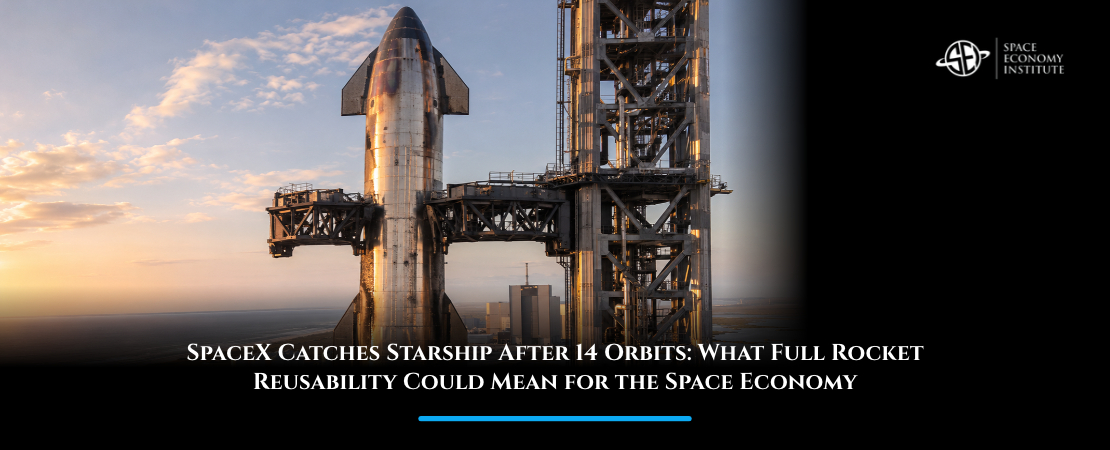
SpaceX has achieved a major milestone in its effort to make space transportation fully reusable.
On November 14, the company successfully recovered the Starship upper stage after 14 orbits around Earth, catching the spacecraft with the mechanical arms of its launch tower in Texas. The manoeuvre concluded a 22.5-hour mission launched the previous day, during which Starship also deployed 26 Starlink satellites.
Although the Super Heavy booster was lost, the successful recovery marks an important advance toward a potentially transformative objective: reusing both stages of an orbital rocket rather than manufacturing replacements after every launch.
From Reusable Boosters to Fully Reusable Rockets
SpaceX has already demonstrated the commercial advantages of rocket reusability through Falcon 9.
Unlike traditional launch vehicles, whose major components are generally discarded after use, Falcon 9 can recover and refly its first-stage booster.
However, its second stage—the part responsible for delivering payloads into orbit—is still expendable.
Starship is designed to overcome that limitation.
The system consists of two stages: Super Heavy, which provides the initial thrust, and Starship, which carries payloads into space and can operate as a spacecraft.
SpaceX ultimately intends to recover and reuse both.
Flight 15 demonstrated the recovery of Starship after an orbital mission for the first time. The original plan also included recovering Super Heavy, but a technical problem forced the booster to divert toward the Gulf of Mexico, where it was lost.
The mission therefore represents a significant step forward, rather than proof that complete reusability has already been achieved.
Why Full Reusability Could Change Launch Economics
The economic logic is similar to that of commercial aviation.
An airline does not manufacture a new aircraft for every flight. Instead, it operates the same vehicle repeatedly, spreading its acquisition cost across many journeys.
Rocket launches have historically followed a different model, with expensive hardware manufactured for individual missions.
Full rocket reusability could fundamentally change that cost structure.
If both stages can fly repeatedly, manufacturers could distribute production costs across multiple launches while reducing the need to build replacement vehicles.
This could lower the cost per mission and potentially make space transportation more accessible to satellite operators, governments and other commercial customers.
However, recovery alone does not guarantee lower costs.
A spacecraft returning from orbit experiences extreme temperatures during atmospheric reentry. Its heat shield, engines and structural components must be inspected and, when necessary, repaired.
If refurbishment remains expensive or time-consuming, the economic benefits of reuse become more limited.
The next challenge for SpaceX is therefore not simply recovering Starship, but demonstrating that the same spacecraft can return to service safely with limited refurbishment.
Starship Could Enable Larger Space Markets
The potential economic impact extends beyond the launch industry itself.
Starship is designed to transport substantially larger payloads than conventional launch vehicles, supporting the deployment of satellite constellations, large orbital infrastructure and future exploration missions.
Its latest flight demonstrated a practical application by deploying 26 next-generation Starlink satellites.
A transportation system capable of repeatedly delivering large payloads could reduce logistical constraints for companies developing communications networks, orbital manufacturing facilities and other space-based infrastructure.
NASA also has a major interest in Starship’s development.
The agency is working with SpaceX on a modified Starship Human Landing System intended to transport astronauts to the lunar surface under the Artemis programme.
That architecture requires additional capabilities, particularly orbital propellant transfer—the ability to transfer fuel between spacecraft in orbit before travelling toward the Moon.
NASA’s current plans include testing Starship docking operations during Artemis III in 2027, ahead of targeted crewed lunar landings in 2028.
Full reusability would therefore be valuable not only for commercial launches, but potentially for sustaining more complex transportation systems beyond Earth orbit.
The Remaining Gap Between Recovery and Reuse
Despite the progress, several technical and commercial uncertainties remain.
SpaceX has not yet recovered both Starship stages during a single mission or demonstrated the reflight of a recovered Starship upper stage.
Thermal protection remains particularly important. Starship’s heat shield must withstand atmospheric reentry without requiring extensive replacement or repairs after every flight.
The programme must also demonstrate that its recovery infrastructure and operational procedures can support repeated missions reliably.
These challenges distinguish technological feasibility from commercial scalability.
A successful recovery proves that a spacecraft can return intact. A sustainable reusable launch system must demonstrate that the process can be repeated reliably, economically and at scale.
Toward a New Economics of Access to Space
Starship’s successful recovery represents more than a spectacular engineering achievement.
It brings the industry closer to a transportation model in which major launch vehicles can be operated repeatedly rather than replaced after individual missions.
For satellite companies, governments and emerging space businesses, the implications could include lower transportation costs and greater flexibility in developing orbital infrastructure.
The decisive milestone, however, will be demonstrating repeated flights with economically sustainable refurbishment requirements.
If this transformation interests you, the Master in Space Economy by the Space Economy Institute explores launch economics, reusable technologies, commercial strategy and the business models shaping the global space industry.
Discover more about the Master in Space Economy and the forces transforming access to space.