
Enel and Leonardo Join Forces: How Satellites Could Protect Electricity Grids
- November 10, 2026
- Posted by: admin
- Category: Uncategorized
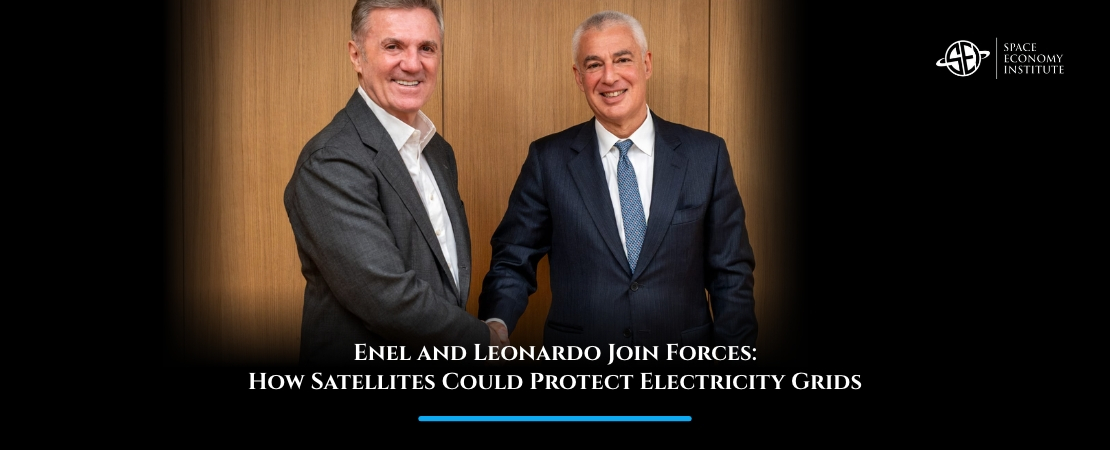
On November 9, Italian energy group Enel and aerospace company Leonardo signed an agreement to explore cooperation on infrastructure security, satellite-based monitoring and digital technologies.
Although the agreement does not yet establish specific operational projects, it highlights an emerging opportunity in the space economy: using satellite capabilities to improve the management and resilience of electricity networks.
As power grids become more complex and interconnected, space infrastructure could play an increasingly important role in keeping energy systems reliable.
Why Electricity Networks Need Better Monitoring
Electricity grids are among the most extensive and strategically important infrastructures in modern economies.
Transmission lines connect power plants, renewable energy facilities, industrial centres and cities, often crossing thousands of kilometres of remote or difficult terrain.
Maintaining these networks requires continuous attention.
Vegetation growing near power lines can create safety risks. Landslides and ground movement can damage transmission towers. Wildfires, floods and extreme weather can disrupt electricity supplies across entire regions.
Traditionally, utilities rely on field inspections, helicopters, drones and ground-based sensors to identify potential problems.
These methods remain essential but can be expensive and difficult to scale across large territories.
Satellite Earth observation offers a complementary approach, allowing operators to monitor extensive networks and identify areas requiring closer inspection.
How Space Technology Supports Energy Infrastructure
Different satellite technologies address different operational challenges.
Earth-observation satellites collect images and measurements of the planet’s surface. Optical imagery can reveal vegetation growth near transmission corridors, while radar satellites can detect subtle ground movements that may threaten electricity pylons.
Satellite communications provide another capability: maintaining connectivity with remote infrastructure and supporting emergency communications when terrestrial networks are disrupted.
Satellite navigation, meanwhile, enables precise positioning and timing, supporting asset management and the synchronization of digital infrastructure.
The European Space Agency has already supported commercial applications in this field.
One example is GridEyes, developed by Norwegian company StormGeo with ESA support. The platform combines satellite imagery and artificial intelligence to identify vegetation-related risks, monitor changes around electricity infrastructure and support emergency response.
Rather than replacing physical inspections, these technologies help utilities determine where intervention is most urgent.
Turning Satellite Information Into Commercial Services
The economic opportunity lies primarily in transforming satellite observations into actionable information.
An electricity operator does not necessarily need to purchase satellite imagery itself. It needs reliable answers to operational questions:
Which transmission lines face the greatest environmental risks? Where should maintenance teams intervene? Which infrastructure assets may be vulnerable after a major storm?
Specialized companies can process satellite data, combine it with other information and deliver risk assessments through software platforms.
This creates opportunities for subscription-based monitoring services, predictive maintenance applications and integrated infrastructure-management systems.
The financial logic is straightforward.
Better monitoring can reduce unnecessary inspections, help prioritize maintenance expenditure and potentially prevent costly infrastructure failures.
For satellite-data companies, electricity utilities represent a valuable customer segment because infrastructure monitoring is a recurring operational requirement rather than a one-time research activity.
However, the commercial case must be demonstrated. Image resolution, monitoring frequency, analytical accuracy and integration costs all influence whether a satellite-based service provides sufficient value.
From Technology Partnerships to New Markets
The Enel–Leonardo agreement reflects this convergence between established industries.
Enel brings expertise in energy management and access to electricity-sector customers. Leonardo contributes capabilities in satellite technologies, digital systems and security.
Their agreement identifies potential cooperation in satellite-based analysis, infrastructure protection, cybersecurity and energy-management services. Future binding contracts would be needed to turn these intentions into specific commercial projects.
The wider European market is also evolving.
ESA currently has an open call for Smart and Resilient Energy Systems, developed with Slovenian grid operator ELES, seeking applications that combine space technologies with electricity-grid monitoring, forecasting and operational resilience.
The call, open until November 27, illustrates a significant market-development principle: commercial opportunities become more tangible when satellite capabilities are connected to the operational requirements of established industries.
When Space Becomes Part of Energy Security
The Enel–Leonardo partnership demonstrates how the space economy is expanding beyond traditional aerospace markets.
For electricity utilities, satellite services could support more efficient maintenance and stronger infrastructure resilience. For space companies, energy networks represent a potential source of recurring commercial demand.
The broader opportunity is not simply to collect more information from orbit, but to turn space-generated data into measurable operational and economic value on Earth.
If this intersection between space technology, energy and industrial strategy interests you, the Master in Space Economy by the Space Economy Institute explores how satellite applications, investment and emerging business models create opportunities across industries. Discover more about the Master and the economic forces shaping the global space sector.