
Northwood’s $375 Million Investment: The Growing Business Behind Satellite Ground Networks
- November 5, 2026
- Posted by: admin
- Category: Uncategorized
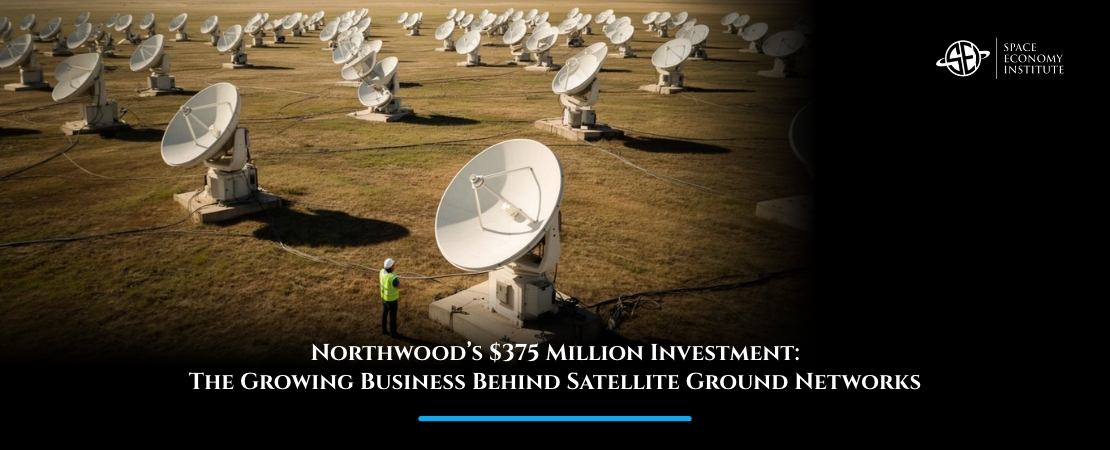
The space economy is expanding rapidly, but one of its most important infrastructure markets remains firmly on Earth.
On November 2, Northwood Space announced a $375 million funding round, bringing its valuation to approximately $2 billion. The investment will support the expansion of a global network of ground stations connecting satellites to operators and customers.
The announcement highlights an increasingly important shift: as satellite constellations grow, the infrastructure required to communicate with them is becoming a commercial market of its own.
The Infrastructure That Connects Space to Earth
Satellites may orbit hundreds or thousands of kilometres above Earth, but most still depend on ground infrastructure to perform their missions.
A ground station is a terrestrial facility equipped with antennas and communications systems that exchange information with spacecraft.
These connections serve two essential functions. Operators send commands to satellites, controlling their activities and monitoring their technical condition. Satellites, in turn, transmit information back to Earth, including scientific measurements, imagery and operational data.
For an Earth-observation company, collecting images in orbit creates limited commercial value if those images cannot be delivered efficiently to customers.
Communication is therefore an essential part of the satellite value chain.
Traditionally, operators have built dedicated ground stations or contracted specialized providers. However, the expansion of satellite constellations is creating demand for infrastructure capable of supporting many spacecraft simultaneously, across different locations and orbital environments.
From Dedicated Facilities to Shared Networks
Northwood’s business model addresses this growing requirement.
Rather than asking every satellite operator to develop its own global network of antennas, the company is building shared ground infrastructure that customers can access as a service.
The concept resembles cloud computing. Businesses no longer need to own servers to access computing capacity; they can purchase resources from specialized providers.
A similar principle is increasingly being applied to satellite communications.
Northwood develops two main antenna systems: Portal, a phased-array antenna capable of communicating with multiple spacecraft, and Prism, a high-throughput dish designed to transfer large volumes of satellite data.
Phased-array technology uses electronic steering to direct radio signals without relying entirely on mechanical antenna movement. This allows ground systems to communicate more flexibly with satellites passing overhead.
Customers can reserve communication opportunities through software rather than managing every element of the physical infrastructure themselves.
The commercial offering therefore combines antenna hardware, network coverage, scheduling software and communication services.
Why Satellite Growth Is Creating New Demand
The economic opportunity is closely linked to the increasing number of satellites in orbit.
Large constellations require frequent communication with Earth, often across several continents. A satellite in low Earth orbit moves rapidly relative to the ground, meaning any individual station can communicate with it only during limited periods.
More geographically distributed ground stations create additional opportunities to establish connections, receive information and transmit commands.
For operators, this can improve data-delivery speed, operational flexibility and network resilience.
Northwood has already deployed six multi-orbit-capable sites across two continents. Its latest funding will support further expansion, including manufacturing capacity for hundreds of antennas annually.
The company also serves government customers. Earlier in 2026, it secured a $49.8 million U.S. Space Force contract supporting the military’s Satellite Control Network.
This illustrates how the same underlying infrastructure can address different markets, from commercial Earth observation and telecommunications to national security and scientific missions.
Ground Stations as an Infrastructure Investment
The financial significance of Northwood’s funding extends beyond the company itself.
Ground networks are capital-intensive: antennas must be manufactured, installed, connected to terrestrial communications systems and maintained across multiple locations.
Yet shared infrastructure can create economic advantages.
Instead of each satellite operator financing a dedicated network, several customers can purchase access to the same underlying facilities. Higher utilization can potentially spread infrastructure costs across a larger customer base.
For operators, this can reduce upfront investment and convert some infrastructure expenditure into recurring service payments.
The model is not entirely new. Established providers, including AWS Ground Station, already offer commercial access to ground antennas. Northwood is competing through its integrated manufacturing approach, modular systems and ambition to expand network capacity rapidly.
Commercial success will depend on utilization, service reliability, pricing and the company’s ability to expand its network efficiently.
The Ground Segment’s Growing Economic Role
Northwood’s latest investment illustrates a broader evolution in the space economy: value creation increasingly depends on infrastructure that enables satellite services, not only on the satellites themselves.
As orbital activity expands, shared ground networks could become essential for companies seeking reliable connectivity without building every supporting system internally.
For investors, satellite operators and governments, this creates opportunities across communications infrastructure, software and service delivery.
If this topic interests you, the Master in Space Economy by the Space Economy Institute explores how satellite markets, infrastructure investment and emerging business models are reshaping the global space sector. Discover more about the Master and the economic forces driving its development.