
FAA Part 450 Reform: How U.S. Commercial Space Licensing Has Evolved Since July
- November 4, 2026
- Posted by: admin
- Category: Uncategorized
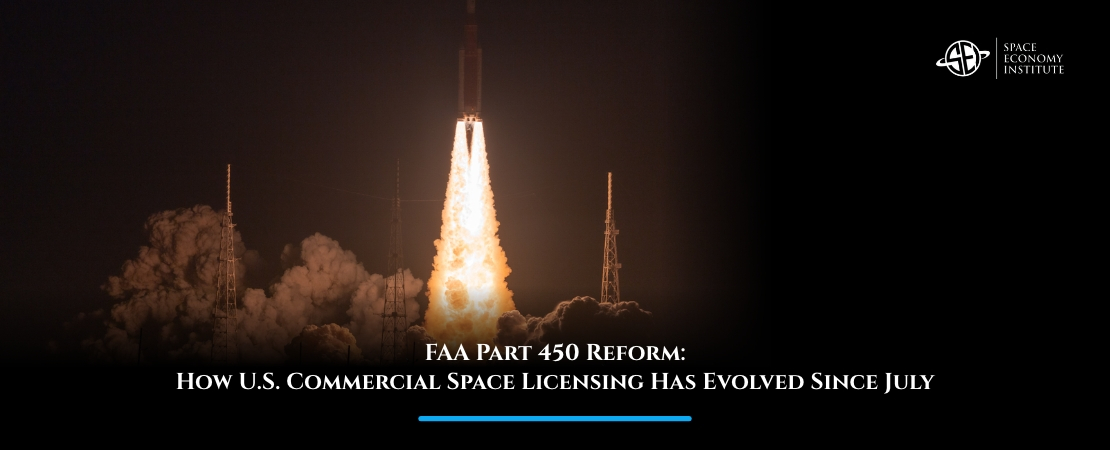
When we first examined the FAA commercial space licensing reform in July, the debate centred on a fundamental policy question: how can the United States accelerate launch and reentry approvals while preserving public safety, environmental oversight and regulatory credibility?
Three months later, the reform has entered a more operational phase. On November 4, the public-comment period closes on five additional proposals concerning Part 450, the regulatory framework governing U.S. commercial launch and reentry licensing.
The focus has therefore shifted from broad regulatory reform toward the practical efficiency of the licensing process itself.
How the FAA Part 450 Reform Has Developed
The current reform is best understood as a sequence of related, but distinct, regulatory developments.
March 2026: Part 450 becomes the common licensing framework.
Commercial launch and reentry activities in the United States require authorization from the Federal Aviation Administration. In March 2026, the FAA completed a five-year transition to Part 450, replacing four previous regulatory frameworks with a more unified system.
Part 450 adopts a largely performance-based approach. Rather than prescribing identical technical solutions for every vehicle, the framework establishes safety outcomes that operators must demonstrate they can meet. It can also authorize multiple vehicle configurations, mission profiles and launch sites under a single license, providing greater flexibility for commercial operators.
July 2026: reform expands to environmental and legal requirements.
On July 28, the FAA proposed a further layer of reform. Under specific circumstances, the agency would be able to waive requirements arising from 13 federal laws when those provisions were not considered necessary to protect public health, safety, property, national security or U.S. foreign-policy interests.
The measures included major environmental legislation such as the National Environmental Policy Act, the Endangered Species Act and portions of the Clean Air and Clean Water Acts.
This was the development examined in our July article. The proposal raised a broader policy debate over the balance between faster commercial space approvals, environmental protection and public accountability.
October 2026: attention turns to the Part 450 licensing process itself.
On October 6, the FAA announced five additional proposed changes to Part 450. Unlike the July initiative, these measures focus primarily on the technical and administrative procedures involved in obtaining a commercial launch or reentry license.
The proposals would expand electronic application submissions, streamline elements of flight-safety documentation, reduce duplicated analyses where risks are already addressed through approved methods, introduce a limited exception within lightning-hazard requirements and clarify aspects of blast-risk calculations.
November 4: the consultation period closes.
The November 4 deadline marks the end of public consultation on these five measures. The proposals do not automatically enter into force at that point. The FAA must first assess stakeholder feedback before determining whether and how the changes should be incorporated into final rules.
From Broad Regulatory Reform to Operational Efficiency
The distinction between the July and October initiatives is significant.
The July proposal addressed the wider legal and environmental framework surrounding commercial space licensing. The October measures examine the mechanics of the Part 450 process more closely: how documentation is submitted, how safety analyses are structured and where regulatory duplication may be reduced.
This reflects an important evolution in the reform.
For a launch provider, regulatory compliance requires substantial engineering and administrative resources. If similar technical information must be repeatedly reformatted or analysed for different parts of an application, those requirements translate into additional labour, cost and time.
The October proposals are intended to reduce some of this procedural burden while preserving the safety outcomes required under Part 450.
The relevant economic question is therefore not simply whether regulation is stringent or permissive. It is whether operators can demonstrate compliance efficiently, consistently and predictably.
Commercial Space Growth Is Increasing Regulatory Pressure
The reform is taking place against a rapidly expanding U.S. launch market.
According to the Department of Transportation, U.S. operators accounted for 217 of the 329 commercial space launches conducted worldwide in 2025. The government expects the number of FAA-licensed launches and reentries to continue increasing substantially over the next decade.
Higher launch frequency changes the nature of the regulatory challenge.
A licensing system developed for relatively infrequent missions must increasingly accommodate reusable launch vehicles, multiple spaceports, recurring launch campaigns and a wider range of commercial reentry operations.
As a result, regulatory capacity is becoming part of the infrastructure required to support market growth.
Launch vehicles, manufacturing facilities and spaceports determine how many missions industry can technically perform. Commercial space regulation can influence how many of those missions can actually proceed on schedule.
Delays or uncertainty in the licensing process can affect satellite deployment timelines, customer contracts, launch-pad utilization and investment planning. For emerging companies in particular, regulatory predictability can influence capital requirements and the timing of revenue generation.
Streamlining Regulation Without Weakening Oversight
The objective of regulatory reform should not be reduced simply to faster approvals.
Launch and reentry activities create genuine public-safety, aviation and environmental risks. The FAA therefore has to reconcile commercial efficiency with its responsibility to maintain appropriate safeguards.
A useful distinction is between regulatory protection and regulatory friction.
Regulatory protection refers to the safety, environmental and public-interest outcomes that the framework is designed to preserve. Regulatory friction refers to unnecessary duplication, administrative complexity or uncertainty in the process used to demonstrate compliance.
An effective reform should reduce the latter without compromising the former.
Viewed from this perspective, the October Part 450 proposals represent a practical test of whether commercial space regulation can become more scalable through targeted procedural improvements rather than through a general reduction in regulatory standards.
What Comes Next for FAA Commercial Space Licensing
The evolution of the reform since March shows a clear progression.
March established Part 450 as the common framework for U.S. launch and reentry licensing. July addressed broader legal and environmental requirements. October introduced targeted changes to the internal licensing process. The November 4 deadline now closes the consultation phase and moves the debate toward implementation.
The next stage will be the most important from an economic perspective.
The effectiveness of the FAA Part 450 reform will ultimately be measured by whether commercial operators experience greater predictability, lower administrative burden and a licensing system capable of supporting higher levels of launch and reentry activity while maintaining appropriate safety and environmental protections.
For the United States, this is increasingly a question of industrial competitiveness as well as regulatory policy. A commercial space sector capable of scaling technically also requires a regulatory framework capable of scaling institutionally.
If this topic is of interest, the Master in Space Economy by the Space Economy Institute explores how regulation, public policy, commercial strategy and technological innovation interact in the development of global space markets. Discover more about the Master and how regulatory frameworks influence investment, competition and growth across the space economy.