
- October 27, 2026
- Posted by: admin
- Category: Uncategorized
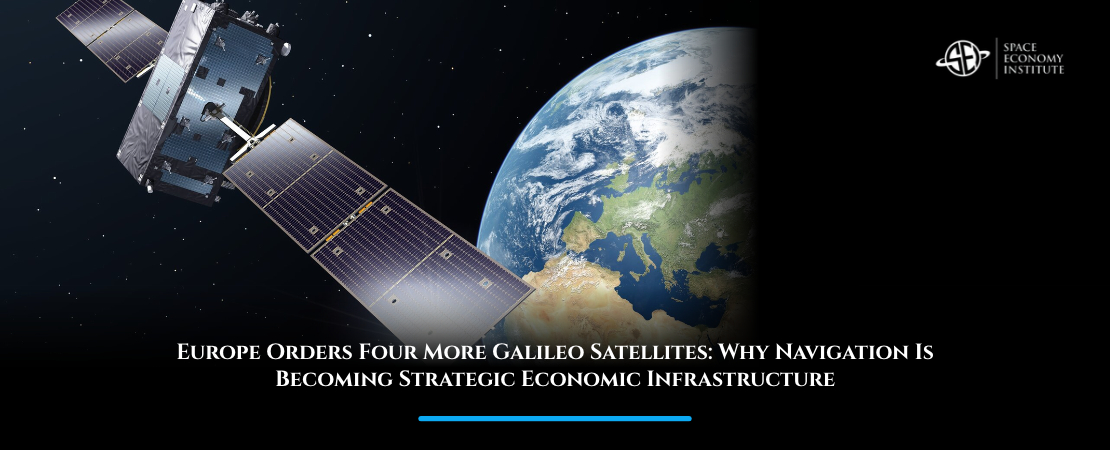
Europe is expanding the next generation of its Galileo satellite navigation system.
On October 27, the European Space Agency announced contracts for four additional Galileo Second Generation satellites, bringing the planned G2 fleet to 16 spacecraft. Airbus Defence and Space and Thales Alenia Space will each build two of the new satellites, scheduled for delivery in 2031.
The contracts may look like another satellite-manufacturing order. In reality, they reflect something much larger: positioning and timing have become critical infrastructure for the modern economy.
Navigation Is an Invisible Layer of the Economy
Most people encounter satellite navigation through maps on their smartphones or car navigation systems.
But systems such as Galileo and the U.S. GPS provide three interconnected services: positioning, navigation and timing, often referred to as PNT.
The timing element is particularly easy to overlook.
Satellites carry extremely precise atomic clocks. Their signals allow systems on Earth not only to determine where they are, but also to synchronize operations with extraordinary precision.
That capability supports telecommunications networks, electricity grids, financial transactions, aviation, shipping, rail transport and emergency services.
ESA estimates that around 10% of European GDP is enabled by satellite navigation. EUSPA expects global GNSS revenues to rise from more than €300 billion in 2024 to over €580 billion by 2034.
The economic value of Galileo therefore extends far beyond the satellites themselves.
A logistics company optimizing routes, a farmer operating precision machinery or a bank synchronizing transactions may all depend on space infrastructure without considering themselves part of the space industry.
Why Europe Needs Its Own Navigation System
Galileo was created partly because relying entirely on foreign satellite navigation systems creates strategic dependence.
GPS is operated by the United States. China operates BeiDou, while Russia operates GLONASS. Galileo gives the European Union its own global navigation infrastructure under civilian control.
That autonomy has become more important as dependence on satellite navigation has increased.
If navigation signals are disrupted, the consequences can extend quickly into the wider economy. Aircraft and ships can lose reliable positioning. Telecommunications networks and power grids can face timing problems. Financial and industrial systems can also be affected.
This transforms satellite navigation from a useful digital service into an issue of economic resilience and strategic sovereignty.
The four newly ordered satellites are therefore not simply replacements. They form part of Europe’s effort to maintain independent access to an infrastructure layer on which many other industries depend.
Galileo Second Generation Is Designed for a More Hostile Environment
The threat is no longer only technical failure.
GNSS signals can be deliberately disrupted in two main ways.
Jamming overwhelms legitimate satellite signals with radio interference, preventing receivers from using them. Spoofing is more sophisticated: false signals are transmitted to convince a receiver that it is somewhere—or sometime—different from reality.
These incidents are increasingly relevant around conflict zones and major transport corridors. ESA reported that more than 10,000 ships were affected by malicious GNSS interference globally during the second quarter of 2025 alone.
Galileo Second Generation is being designed partly around this new environment.
The satellites will include stronger navigation antennas, digitally reconfigurable payloads, advanced atomic clocks and inter-satellite links, allowing spacecraft to communicate and cross-check information directly with one another. They will also incorporate improved protection against jamming and spoofing.
These capabilities make the constellation not only more accurate, but more resilient.
And resilience increasingly has economic value.
The Commercial Opportunity Sits Downstream
Galileo itself is publicly funded infrastructure, but much of the economic activity it enables occurs in the private sector.
Once reliable positioning and timing signals exist, companies can build products and services on top of them.
Autonomous vehicles need accurate localization. Drones require navigation. Precision agriculture depends on positioning to automate machinery and optimize inputs. Maritime companies use satellite navigation for fleet operations. Telecom networks rely on precise timing.
Galileo is also introducing differentiated capabilities such as its High Accuracy Service and authentication technologies designed to help receivers determine whether navigation information is genuine.
This creates opportunities for companies developing receivers, antennas, software, cybersecurity tools, navigation services and applications for industries far removed from satellite manufacturing.
The commercial lesson is important: the value of space infrastructure is often much larger downstream than the cost of the satellites themselves.
When Satellite Infrastructure Becomes Economic Sovereignty
Europe’s latest Galileo contracts illustrate how space policy, industrial strategy and economic competitiveness increasingly overlap.
The satellites manufactured by Airbus and Thales Alenia Space will support European aerospace employment and technological capabilities. But the larger strategic value lies in maintaining reliable infrastructure used by billions of devices and countless economic activities on Earth.
As economies become more automated and interconnected, secure positioning and timing will become more—not less—important.
Galileo therefore shows why the space economy cannot be measured only by rocket launches or satellite revenues. Some of its most important assets are the invisible systems on which the rest of the economy increasingly depends.
If this topic interests you, the Master in Space Economy by the Space Economy Institute explores satellite markets, strategic autonomy, public investment, downstream applications and the economic impact of space infrastructure. Discover more about the Master and how space-based systems are reshaping industries and economies worldwide.