
NASA’s Moon Base Rovers Move Forward: Why Lunar Mobility Could Become a New Infrastructure Market
- October 23, 2026
- Posted by: admin
- Category: Uncategorized
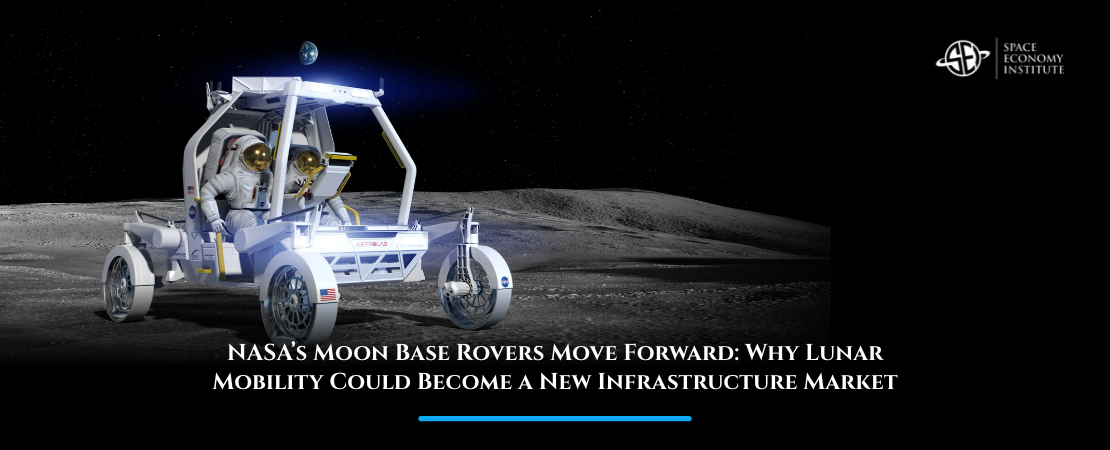
NASA is moving closer to putting a new generation of vehicles on the Moon.
In an October 20 progress update, the agency confirmed that lunar terrain vehicles developed by Astrolab and Lunar Outpost remain on track for flight-ready delivery by the end of 2027, with deployment to the lunar South Pole planned for 2028. The vehicles will initially operate without astronauts—mapping terrain, carrying equipment and collecting data before supporting future crewed missions.
The development highlights an often-overlooked part of the emerging lunar economy: getting to the Moon is only the first transportation problem. The next one is moving around once you arrive.
Mobility Is Becoming Lunar Infrastructure
During the Apollo programme, lunar rovers were essentially mission hardware: NASA built them for astronauts to use during specific expeditions.
The new model is more ambitious.
NASA’s lunar terrain vehicles, or LTVs, are designed to operate both with astronauts and autonomously. Between crewed missions they can be remotely controlled from Earth, transporting equipment, conducting scientific work and surveying future operating areas.
That makes them less like traditional exploration vehicles and more like surface infrastructure.
A lander can deliver cargo to one point on the Moon. A rover can move that cargo kilometres away, transport scientific instruments, connect different sites and eventually support activities such as construction or resource prospecting.
The comparison with terrestrial logistics is useful: delivering a container to a port creates limited value if there is no transport network capable of moving it to where it is actually needed.
The Moon will face a similar “last-mile” problem.
NASA Is Buying Capability, Not Simply Owning a Rover
There is another important difference from Apollo: NASA increasingly wants industry to provide lunar mobility as a commercial capability.
The agency has awarded approximately $219 million to Astrolab and $220 million to Lunar Outpost for the first phase of lunar terrain vehicles, while Blue Origin has been contracted to deliver the vehicles to the lunar South Pole.
NASA explicitly describes its approach as acquiring LTV capability from industry rather than simply developing and owning every vehicle itself.
Economically, that matters.
NASA provides the initial demand necessary for companies to invest in vehicles, software, batteries, communications systems and autonomous navigation. But once that infrastructure exists, the same platforms could potentially serve additional customers.
This is how a government exploration programme can begin creating a commercial market.
Why Moving Things Around the Moon Matters
The potential customer does not necessarily need to be an astronaut.
Imagine a company wanting to deploy a scientific instrument several kilometres from its landing site. Another business may eventually need to transport equipment for power generation, communications or resource extraction. A research institution could want samples collected across several locations.
All of them need mobility.
Astrolab already describes its broader FLEX platform as a logistics system capable of carrying modular payloads, supporting scientific missions, deploying infrastructure and assisting with construction. The company has also worked with lunar-resource company Interlune on integrating excavation equipment that could one day support activities such as surface preparation and resource harvesting.
Lunar Outpost similarly positions its Pegasus vehicle for exploration, science, resource prospecting and surface preparation.
This illustrates a broader principle: economic activity requires infrastructure before it can scale.
Before the Moon can support laboratories, communications networks, resource operations or longer-term settlements, equipment must be moved, positioned, maintained and connected.
From Exploration Vehicles to Lunar Logistics
That creates the possibility of a new business model.
Instead of every lunar mission designing its own rover, future customers could purchase mobility as a service: pay to transport a payload, survey an area, deploy equipment or perform a remote operation.
Astrolab is already developing this logic commercially. Its FLIP rover is expected to carry NASA payloads as well as commercial payloads, while its larger FLEX architecture is designed for future government and private missions.
Over time, the value could extend beyond individual vehicles.
A fleet of reusable surface vehicles could become a shared logistics network, supporting multiple landers and customers rather than being tied to one mission. In the same way that launch is evolving from a bespoke event toward a transportation service, lunar mobility could eventually become standardized infrastructure.
The economic question is therefore not simply how much a rover costs.
It is how many different activities become possible once reliable transportation exists on the lunar surface.
The Moon Needs a Logistics Layer
NASA’s latest rover update shows that the lunar economy will depend on much more than rockets and landers.
If sustained activity develops around the lunar South Pole, mobility could become one of its foundational services—connecting landing sites, scientific equipment, resources and eventually permanent infrastructure.
For companies such as Astrolab and Lunar Outpost, that creates the possibility of moving from government exploration contracts toward a broader lunar logistics market.
If this topic interests you, the Master in Space Economy by the Space Economy Institute explores lunar markets, commercial space infrastructure, public-private partnerships and the business models emerging across the global space sector. Discover more about the Master and the economic systems that could shape humanity’s long-term presence beyond Earth.