
Blue Origin Wants Multiple New Glenn Launches a Week: Why Launch Cadence Is Becoming a Competitive Advantage
- October 20, 2026
- Posted by: admin
- Category: Uncategorized
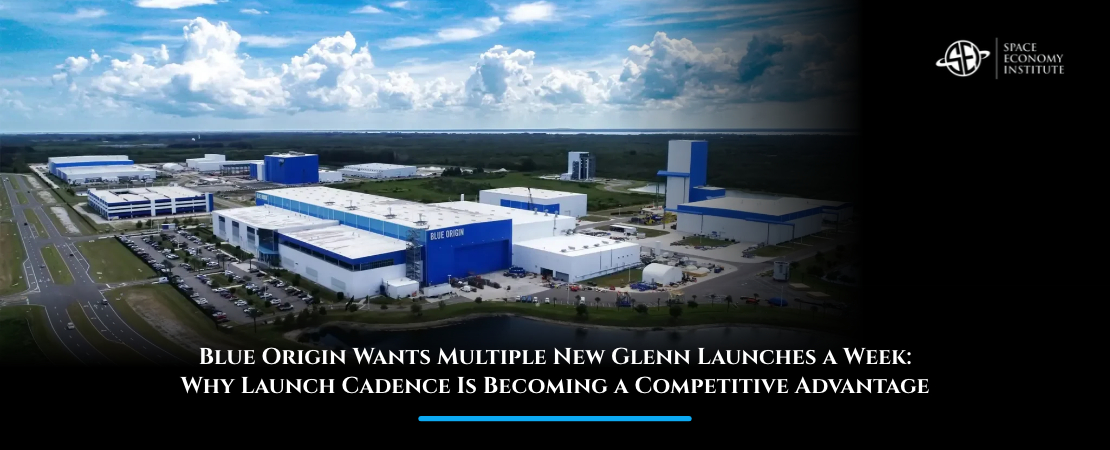
Blue Origin is preparing New Glenn for a very different scale of operations.
The company has announced a $330 million expansion of its Florida manufacturing facilities, designed to support production of up to 150 New Glenn upper stages per year. It is also expanding launch pads, payload-processing capacity and booster-recovery infrastructure, with the long-term ambition of reaching multiple New Glenn launches per week by the end of the decade.
The announcement points to an increasingly important shift in the commercial launch market: the next competitive advantage may not be simply building a powerful rocket, but being able to launch reliably, repeatedly and at industrial scale.
The Economics of Launch Frequency
In the launch industry, cadence simply refers to how often a provider can fly.
That frequency matters economically.
Rocket companies operate expensive factories, launch pads, engineering teams, recovery vessels and ground infrastructure. Many of those costs exist whether a provider launches five missions a year or fifty.
Flying more frequently allows those fixed costs to be spread across a larger number of missions, improving the economics of the overall system.
Higher cadence also creates value for customers. A satellite operator facing a launch delay does not necessarily want to wait several months for the provider’s next available mission. More frequent flights create scheduling flexibility and can make access to orbit more predictable.
The comparison with aviation is imperfect but useful: an aircraft becomes economically powerful because it can perform the same transportation service repeatedly. Commercial launch is increasingly moving toward the same logic.
Scaling the Entire Launch System
Blue Origin’s investment shows why increasing launch frequency requires much more than producing additional rockets.
Its Florida expansion will add automated machining, welding, inspection and material-handling systems, with capacity for up to 150 upper stages annually once the facility is fully operational.
But manufacturing is only one part of the system.
Satellites must be delivered, tested, integrated and encapsulated before launch. Launch pads need to be prepared between missions. Reusable boosters have to be recovered, inspected and returned to service.
Blue Origin is therefore also expanding payload-processing facilities and recovery infrastructure, including additional landing platforms for New Glenn’s reusable first stage.
The economic lesson is important: launch capacity is determined by the slowest part of the system.
A provider may have enough rockets available, but a bottleneck in payload integration, pad turnaround or booster refurbishment can still limit the number of missions it can perform.
Commercial launch is therefore beginning to resemble a complex logistics and manufacturing operation rather than a sequence of isolated aerospace projects.
Constellations Are Changing Launch Demand
This scale-up is partly being driven by a fundamental change in what customers need.
Traditional satellite programmes often involved one spacecraft developed over several years and launched on a single mission.
Large constellations work differently.
Amazon Leo, for example, is building a broadband network that will eventually require thousands of satellites. Amazon has already placed more than 200 spacecraft in orbit and plans a substantially higher launch rate as deployment accelerates. New Glenn is expected to carry large batches of Amazon Leo satellites on future missions.
For customers like this, launch is no longer a one-off purchase.
Constellations require continuous deployment, followed eventually by replacement missions as satellites reach the end of their operational lives.
The commercial product therefore changes from simply “access to orbit” to something closer to reliable transportation capacity available on a recurring basis.
That creates an advantage for launch providers capable of offering frequent missions at predictable intervals.
Reusability Only Matters If Operations Can Scale
Reusable rockets are central to this transition, but reuse by itself does not guarantee high flight rates.
A booster that lands successfully still needs to be recovered, inspected, refurbished where necessary and prepared for its next mission. If that process takes months, much of the economic benefit of reusability is lost.
The operational system surrounding the rocket therefore becomes just as important as the vehicle itself.
SpaceX has demonstrated the impact of this approach. Its Falcon fleet has reached launch rates that would have been difficult to imagine a decade ago, changing expectations across the industry about how frequently orbital transportation systems can operate.
Blue Origin now faces a similar challenge with New Glenn.
Successfully developing a heavy-lift rocket is one achievement. Transforming that rocket into a repeatable transportation service is another.
From Rockets to Space Logistics
The commercial launch market is therefore entering a new phase.
Competition will still depend on payload capacity, reliability and price. But increasingly, it will also depend on how effectively providers can coordinate manufacturing, launch infrastructure, payload processing, booster recovery and refurbishment.
For satellite constellation operators, governments and commercial customers, the winning launch provider may not simply be the company with the most capable rocket. It may be the one that can provide dependable access to orbit whenever customers need it.
Blue Origin’s Florida expansion illustrates this transition from bespoke rocket programmes toward something closer to industrial-scale space logistics.
If this topic interests you, the Master in Space Economy by the Space Economy Institute explores how launch economics, industrial capacity, supply chains, technology and emerging business models interact across the global space sector. Discover more about the Master and the economic forces shaping the next generation of space infrastructure.