
SpaceX’s 800 MHz Deal: Why Spectrum Is a Strategic Space Economy Asset
- October 9, 2026
- Posted by: admin
- Category: Uncategorized
The Most Valuable Part of a Satellite Network May Be Invisible
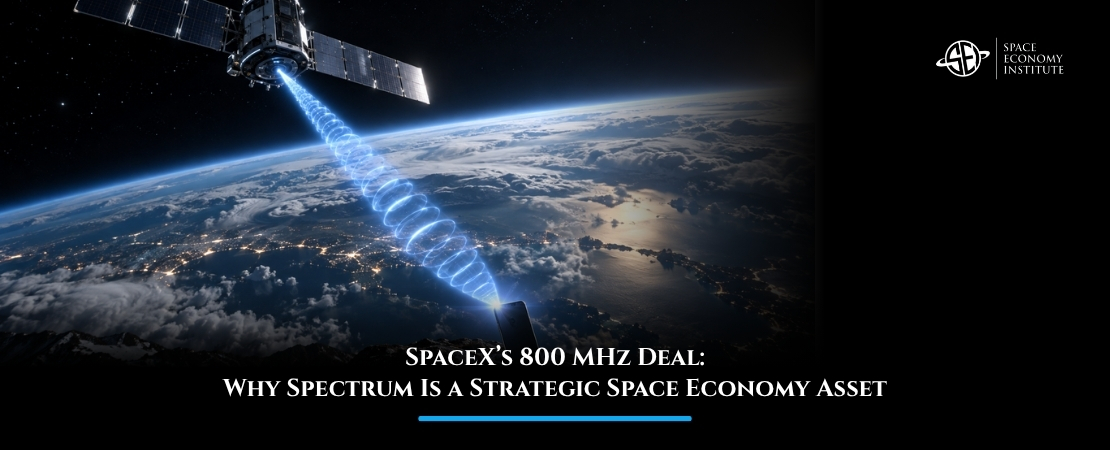
SpaceX is moving closer to becoming much more than a satellite broadband provider. On October 8, the company agreed to acquire Grain Management’s nationwide 800 MHz spectrum portfolio, comprising up to 14 MHz of paired low-band spectrum, subject to FCC approval. The deal is designed to support Starlink Mobile, combining satellite and terrestrial connectivity. It provides a timely lesson in one of the least visible but most valuable resources in the Space Economy: radio spectrum.
What Is Spectrum — and Why Do Satellite Companies Need It?
Satellites communicate by transmitting electromagnetic signals across specific radio-frequency bands. Governments and international regulators coordinate access to these frequencies because two networks using the same spectrum improperly can interfere with each other.
This makes spectrum a scarce economic resource.
A company can manufacture thousands of satellites, but if it does not have sufficient rights to transmit signals to customers, the constellation’s commercial potential is limited. Spectrum licenses therefore function somewhat like invisible infrastructure: they determine where, how and with what capacity a communications network can operate.
Different frequencies also behave differently. Higher-frequency spectrum can provide large amounts of capacity, while lower frequencies generally travel farther and penetrate obstacles more effectively.
That is why SpaceX’s latest acquisition matters.
Why 800 MHz Changes Direct-to-Device Connectivity
Starlink Mobile already has access to 2 GHz mid-band spectrum, which SpaceX intends to use for high-capacity satellite-to-phone communications. The newly acquired 800 MHz spectrum would serve a different purpose.
Low-band signals can travel longer distances and penetrate buildings, vegetation and other obstacles more effectively. SpaceX says the 800 MHz layer would help Starlink Mobile provide connectivity even when users are indoors—one of the major technical limitations facing direct-to-device satellite services today.
Most existing smartphones already support 800 MHz frequencies, potentially allowing users to access the network without purchasing a dedicated satellite phone.
The architecture therefore combines two complementary layers:
2 GHz satellite connectivity provides capacity from space, while 800 MHz provides broader and more resilient coverage.
This is a useful example of why connectivity networks are rarely built around a single frequency band.
Satellite and Terrestrial Telecom Are Converging
The broader story is not simply about spectrum. It is about the disappearance of the traditional boundary between a satellite operator and a mobile carrier.
SpaceX says Starlink Mobile will combine its satellite-to-mobile constellation with terrestrial infrastructure, creating a network capable of reaching devices “from both the ground and space”.
That could transform direct-to-device connectivity.
The first generation of satellite-to-phone services has largely focused on eliminating dead zones: emergency messaging or basic connectivity where terrestrial towers do not exist. A hybrid network could instead compete for mainstream mobile customers.
The FCC has also approved SpaceX’s Gen2 Starlink Mobile application for 15,000 satellites optimized for global 2 GHz connectivity, according to Reuters.
The market immediately recognized the competitive implications: shares of T-Mobile, Verizon and AT&T fell around 6% in extended trading following the announcement.
Spectrum Is Becoming Part of Space Company Strategy
For space businesses, the lesson extends beyond SpaceX.
The future satellite communications market will not be determined only by who can launch the most spacecraft. Competitive advantage increasingly depends on controlling several layers simultaneously: satellites, launch capacity, spectrum, terminals, terrestrial infrastructure, software and customer relationships.
Spectrum can also create a significant barrier to entry. Unlike manufacturing capacity, it cannot simply be produced when demand increases. Useful frequency bands are finite, heavily regulated and often already assigned.
That makes spectrum policy an important part of Space Economy strategy. Companies such as SpaceX, AST SpaceMobile, Amazon Leo and traditional telecom operators must negotiate not only technological challenges but licensing regimes, international coordination and interference rules.
The competitive battlefield is therefore partly in orbit—and partly inside regulatory agencies.
What Comes Next for the Satellite-Telecom Market
SpaceX’s 800 MHz agreement matters to satellite operators, telecom carriers, regulators, investors and billions of mobile users. It shows how direct-to-device connectivity could evolve from an emergency service into a genuine competitor to terrestrial mobile networks.
If this topic is of interest, you can learn more about satellite communications, spectrum management, direct-to-device technology, telecom business models and space regulation in the Master in Space Economy by the Space Economy Institute. Discover more about the Master and explore how control of invisible infrastructure such as spectrum is shaping the next generation of the global Space Economy.