
American Airlines Chooses Starlink: How Satellite Internet Is Transforming Aviation
- October 8, 2026
- Posted by: admin
- Category: Uncategorized
Airplanes Are Becoming Part of the Satellite Economy
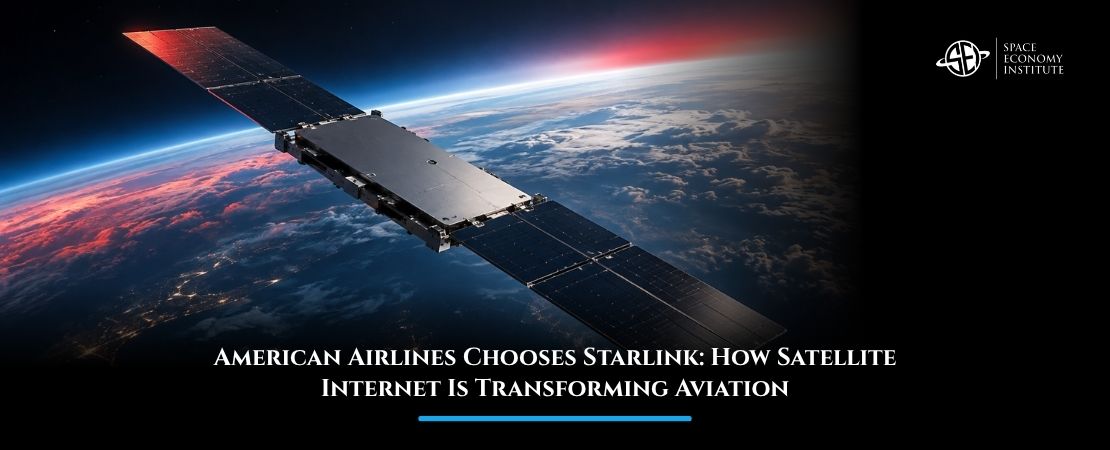
Satellite broadband is rapidly moving from remote homes into one of the world’s largest transportation networks. On October 8, American Airlines announced that Starlink will be installed across its entire mainline fleet of more than 1,000 aircraft, beginning in early 2027. More than 165 million passengers travel on those aircraft each year. The announcement offers a clear example of an important Space Economy trend: satellite constellations are becoming infrastructure for industries far beyond space itself.
Why LEO Changes In-Flight Connectivity
Providing internet to an aircraft moving hundreds of kilometers per hour is technically difficult. Traditional aviation connectivity has relied on either ground-based networks or satellites operating much farther from Earth.
Low Earth orbit constellations change that equation.
Because LEO satellites orbit much closer to Earth than traditional geostationary communications satellites, signals travel shorter distances. This can reduce latency enough for applications such as video calls, online gaming, cloud collaboration and real-time streaming to work more like terrestrial broadband.
American says Starlink’s new Performance Aero Terminal can deliver speeds of up to 1 Gbps per terminal. The airline plans to install the system across more than 500 Airbus narrowbodies, over 400 Boeing narrowbodies and approximately 130 Boeing widebody aircraft.
But the terminal itself is only one piece of the system. Delivering connectivity requires satellites, spectrum, gateway infrastructure, aircraft antennas, software and regulatory certification. Starlink now has Supplemental Type Certificates available or in development across a growing range of Airbus, Boeing, Embraer and other aircraft platforms.
That makes aviation a useful example of how the space economy creates value through an entire infrastructure chain rather than a single satellite.
Airlines Are Becoming Major Satellite Customers
The economics are also changing.
Satellite operators traditionally served governments, broadcasters, telecom companies and remote users. Airlines now represent another potentially large enterprise market because every connected aircraft can consume significant bandwidth for thousands of hours over its operational life.
American is not alone.
United reported in July that Starlink was already installed on 450 mainline and United Express aircraft, with fleetwide deployment targeted by the end of 2027. The airline also said customer-satisfaction scores on Starlink-equipped flights were twice those recorded on other United flights.
Meanwhile, Delta has chosen a different supplier. It plans to install Amazon Leo on an initial 500 aircraft beginning in 2028, creating direct competition between two major LEO constellations for aviation customers.
That competition matters because airlines can provide satellite operators with large, predictable contracts while exposing millions of travelers to their networks.
From Wi-Fi Amenity to Digital Platform
There is also a deeper shift in how airlines think about connectivity.
Historically, onboard Wi-Fi was often treated as an optional amenity—and sometimes an expensive one. High-capacity satellite connectivity allows an airline to treat the aircraft more like a permanently connected digital environment.
Passengers can stream entertainment, work in cloud applications or communicate in real time. Crews can operate dedicated connectivity networks. Over time, airlines could use the same infrastructure for operational data, maintenance information, personalized services and new digital commerce experiences.
Starlink already supports separate crew networks, demonstrating how one satellite connection can serve both passengers and airline operations.
For airlines, connectivity can therefore become part of the wider competition for customer loyalty rather than simply a source of Wi-Fi fees.
For satellite companies, that expands the addressable market from broadband subscribers into mobility infrastructure.
The Space Economy Is Moving Into Everyday Industries
American Airlines’ decision matters to satellite operators, aircraft manufacturers, antenna suppliers, airlines, telecom companies and passengers. It also shows why the Space Economy cannot be measured only by rockets and satellites. Much of its future value will be created when space infrastructure becomes embedded inside industries such as aviation, shipping, logistics, agriculture and mobility.
If this topic is of interest, you can learn more about satellite communications, downstream space markets, connectivity business models and commercial space infrastructure in the Master in Space Economy by the Space Economy Institute. Discover more about the Master and explore how satellite networks are becoming part of the infrastructure behind the global economy.