
Open Cosmos ConnectedCosmos: Why the Next Internet Backbone Could Run Through Space
- October 6, 2026
- Posted by: admin
- Category: Uncategorized
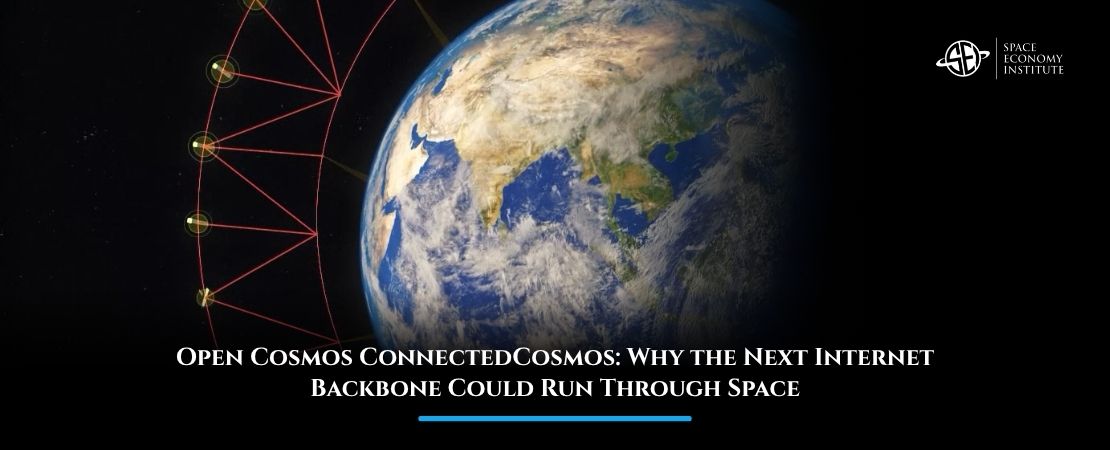
Satellites Are Becoming Routers in Orbit
Europe’s connectivity race is entering a new phase. On October 5, Open Cosmos confirmed that 192 satellites will form the core of its ConnectedCosmos low Earth orbit network, with more than 96 planned in orbit by the end of 2028 and global coverage targeted for 2030. But the most interesting part is not the constellation size. ConnectedCosmos is designed to route large volumes of data between satellites using optical links, changing how information moves around the planet.
What Is an Optical Inter-Satellite Link?
Most people imagine a satellite communicating directly with a ground station: data comes down from space, moves through terrestrial networks, and may eventually travel back to another satellite.
Optical inter-satellite links, or OISLs, allow satellites to communicate directly with each other using laser beams.
Instead of immediately sending data to Earth, a satellite can pass information to another spacecraft, which forwards it again across the constellation until the data reaches the most appropriate point for delivery.
It is essentially a mesh network in space.
Lasers are attractive because optical communications can carry very large amounts of data and are less susceptible to radio-frequency interference. ESA is already developing standards for future optical satellite networks targeting extremely high-capacity links, including architectures approaching terabit-per-second performance.
The technology is not purely experimental. Europe’s existing European Data Relay System has already used laser communications to relay Earth-observation information between spacecraft, demonstrating the basic principle of moving data through space before transmitting it to users on Earth.
Why Avoid Ground Stations?
The economic and strategic benefit becomes clearer when considering how satellite data normally travels.
An Earth-observation satellite may collect imagery over a region but have to wait until it passes over a compatible ground station before transmitting that data. A connected orbital network can instead send the information sideways to another satellite with a better route to the user.
ConnectedCosmos intends to use this architecture to transport raw imagery, video, databases and other large datasets directly through its orbital network. Open Cosmos describes the system as a “gatewayless sovereign space mesh.” That does not mean ground infrastructure disappears entirely: data still needs to reach users on Earth. Rather, information does not need to repeatedly descend into terrestrial infrastructure during its journey.
This can matter during natural disasters, military conflicts or major network outages. If a particular ground station, fiber connection or subsea cable becomes unavailable, traffic can potentially be rerouted through space toward another access point.
From Connectivity to “Active Resilience”
Open Cosmos is also combining the communications network with its existing Earth-observation satellites.
That creates an interesting Space Economy model.
Imagine a satellite detecting a wildfire, suspicious vessel or damaged piece of critical infrastructure. Instead of waiting to downlink the complete dataset through its next ground-station pass, the observation could move through the satellite network toward computing infrastructure or a decision-maker much faster.
The commercial product therefore becomes more than connectivity or imagery alone. It becomes a chain:
observe → move data → analyze → deliver intelligence.
Open Cosmos calls this model “active resilience.” Its ConnectedCosmos communications layer is designed to work alongside its OpenConstellation Earth-observation system and DataCosmos analytics platform, integrating traditionally separate parts of the space value chain.
Why Interoperability May Matter More Than Satellite Numbers
Open Cosmos also says it is exploring a federated architecture, where independently owned European satellite systems could interoperate with the network rather than one company having to own every spacecraft.
This could become economically important. Terrestrial internet infrastructure works because different networks connect through common standards. Satellite constellations have historically been much more vertically isolated.
If optical terminals, routing systems and network protocols become interoperable, future orbital networks could potentially expand by adding nodes from multiple operators. ESA is already developing optical-link specifications partly to encourage precisely this kind of interoperability.
Open Cosmos says its own European manufacturing infrastructure can produce up to one satellite per day, while a recent €300 million funding round is supporting the expansion of manufacturing and connectivity services.
The Road Toward an Orbital Internet Backbone
ConnectedCosmos matters to satellite operators, governments, telecom companies, Earth-observation businesses, defense agencies and cloud providers because it illustrates a deeper transformation: satellites are evolving from independent spacecraft into nodes of networked digital infrastructure.
If this topic is of interest, you can learn more about satellite communications, space data networks, downstream applications, space infrastructure and emerging business models in the Master in Space Economy by the Space Economy Institute. Discover more about the Master and explore how networked satellites are creating a new digital layer of the global space economy.