
Axiom Station and Redwire: Why Power Is Critical to the Commercial Space Economy
- October 5, 2026
- Posted by: admin
- Category: Uncategorized
The Hidden Infrastructure Behind Commercial Space Stations
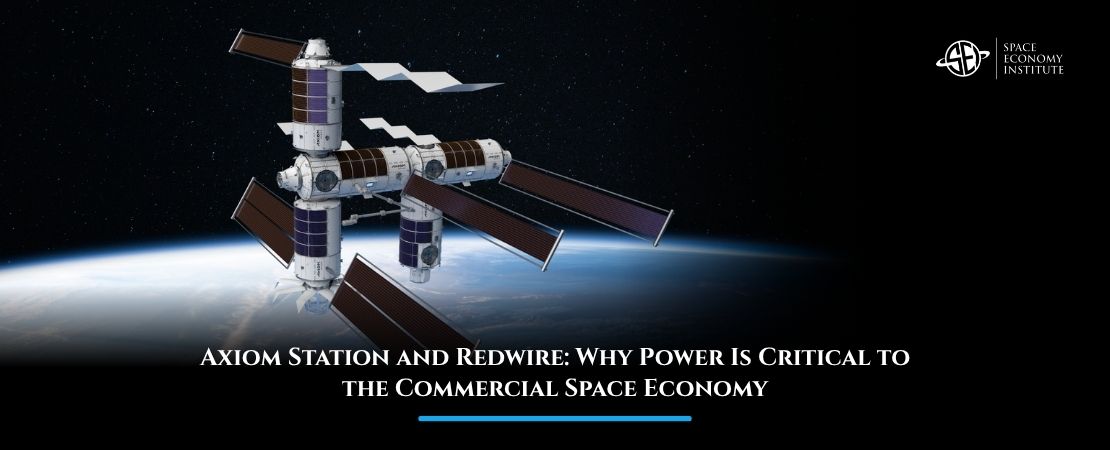
The commercial space-station economy is often discussed in terms of astronauts, laboratories and microgravity manufacturing. But none of those markets can exist without reliable electricity. On October 5, Redwire announced a new contract from Axiom Space to provide two Roll-Out Solar Array wings for Axiom Station’s second module. The agreement offers a useful window into an essential but less visible layer of the space economy: orbital power infrastructure.
Power Is the Currency of an Orbital Platform
A commercial station is effectively a small industrial facility operating hundreds of kilometers above Earth. Electricity is required for life support, communications, computers, scientific equipment, thermal-control systems and every commercial payload operating onboard.
That means power capacity has direct economic consequences.
A pharmaceutical experiment may require electrically powered laboratory equipment. An in-space manufacturing process may need continuous energy for hours or days. Future orbital computing systems could require substantially more. If a station cannot supply enough power, it cannot simply add unlimited customers.
For commercial operators, electrical capacity can therefore become analogous to rack power in a terrestrial data center: part of the infrastructure that determines how many customers can be served and what kinds of services can be sold.
Axiom describes its future station as a platform for microgravity research, product development and manufacturing, as well as human spaceflight. Its first module is undergoing final assembly at Thales Alenia Space in Turin and is planned for launch in 2028; a second module is expected less than a year later. Together, the two are designed to create an operational, free-flying station capable of supporting four crew members.
What Is a Roll-Out Solar Array?
Redwire’s ROSA — Roll-Out Solar Array — technology solves one of the basic engineering problems of generating electricity in space: solar panels need to be large once deployed but compact during launch.
Instead of relying on a conventional rigid structure, ROSA uses flexible solar-array blankets supported by composite booms. Those booms store strain energy while rolled and then deploy autonomously in orbit, reducing reliance on complex motors and deployment mechanisms. NASA says ROSA systems can produce more than 30 kilowatts per panel, depending on configuration.
The technology is already proven in orbit. Variants have been deployed on the International Space Station to augment its aging power system, demonstrating how a relatively compact launch package can create a much larger electricity-generating surface once in space.
Redwire is already producing ROSA wings for Axiom Station’s first module. The new award extends that role to the second module, giving the technology an increasingly important place in the emerging commercial station architecture.
From Space Hardware to Orbital Utilities
This is where the announcement becomes economically interesting.
The post-ISS low Earth orbit market will require much more than complete space stations. It will need an ecosystem of specialized suppliers providing power, thermal management, communications, docking systems, robotics, life support, transportation and logistics.
These are effectively orbital utilities.
Companies supplying them can participate in the growth of the space economy without necessarily operating their own station. Redwire, for example, can sell power infrastructure to station developers, government programs and other spacecraft operators.
This resembles the “picks and shovels” model seen in other industries: rather than betting entirely on which commercial station eventually attracts the most customers, infrastructure suppliers can serve multiple platforms.
The opportunity could expand further as power requirements grow. Axiom itself says human-rated orbital infrastructure can provide significantly more electrical power, volume and heat-rejection capability than conventional satellites, enabling more demanding computing, research and commercial activities.
Power Could Shape the Economics of Commercial LEO
As low Earth orbit becomes more commercial, station operators will need to think increasingly like infrastructure businesses. Crew time, pressurized volume, data capacity, cooling and kilowatts of electricity may all become resources that must be allocated—and monetized.
For researchers, manufacturers, computing companies and national space programs, access to orbit will therefore mean more than buying a flight. It may mean purchasing an entire package of orbital utilities.
Building the Infrastructure Economy in Orbit
The Redwire-Axiom contract matters because it reveals what a mature commercial space economy actually requires. Rockets provide transportation and stations provide destinations, but businesses cannot operate there without reliable infrastructure supporting them every day.
If this topic is of interest, you can learn more about commercial space stations, orbital infrastructure, space value chains and emerging business models in the Master in Space Economy by the Space Economy Institute. Discover more about the Master and explore how the infrastructure behind human spaceflight is creating new commercial markets in low Earth orbit.