
HyPrSpace Opens Rocket Engine Factory: France Scales Hybrid Launch Manufacturing
- October 1, 2026
- Posted by: admin
- Category: Uncategorized
Europe’s Launch Race Moves Into the Factory
Europe’s commercial launch race is becoming an industrial competition. On October 1, French startup HyPrSpace opened its first mass-production facility near Bordeaux, targeting annual production of 100 rocket engines. The 7,000-square-meter factory could manufacture enough engines for around 12 orbital launch vehicles per year. For Europe’s space economy, the milestone matters because competitive launch requires more than a rocket that works—it requires the ability to manufacture repeatedly, affordably and at scale.
What Makes HyPrSpace’s Hybrid Engine Different?
HyPrSpace is developing a propulsion architecture that sits between traditional solid and liquid rocket engines.
A hybrid rocket engine typically combines a solid fuel with a liquid oxidizer. HyPrSpace uses liquid oxygen alongside a solid polyethylene-based fuel. Unlike many liquid engines, its architecture does not require complex turbopumps to feed propellant into the combustion chamber. The company argues that fewer components can make the engine simpler to manufacture, reduce production costs and shorten supply chains.
There is a trade-off. Hybrid propulsion has historically struggled to match the performance of advanced liquid engines. HyPrSpace says its patented annular combustion architecture addresses that limitation, and reported average efficiency of 94% during a 2024 test. That remains a company-reported performance figure rather than proof of an operational launch system, but it explains why the technology is attracting attention.
The factory therefore represents an important test of the business thesis: can simpler propulsion turn rocket engines from highly customized aerospace hardware into something closer to series-manufactured industrial equipment?
Baguette One Comes Before the Orbital Rocket
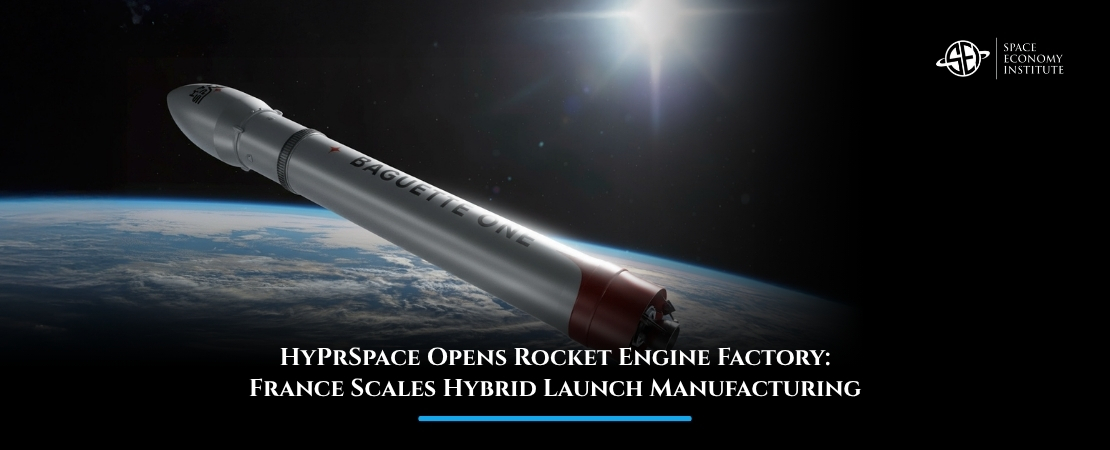
Before HyPrSpace attempts an orbital mission, it plans to validate its technology through Baguette One, a suborbital demonstrator.
France’s Direction générale de l’armement confirmed in September that Baguette One is scheduled to launch in 2027 from the DGA missile-testing site at Biscarrosse, in southwestern France. It would become the first private civilian launcher to fly from mainland France. The mission will test propulsion and other technologies needed for the company’s planned orbital vehicle, OB-1, while also demonstrating potential commercial and defense applications for suborbital flight.
Reuters reports that two additional ground tests are required before the flight demonstration. This distinction is important: HyPrSpace has now created manufacturing capacity, but it has not yet demonstrated orbital launch capability.
That sequence—test, qualify, fly and then scale—is critical in launch economics. Factory capacity generates little value unless reliability follows.
Why Europe Needs More Dedicated Launch Options
HyPrSpace is not trying to compete directly with heavy-lift systems such as SpaceX’s Falcon 9 or Europe’s Ariane 6. Instead, it is targeting customers that value dedicated access to orbit.
Large rideshare missions can offer extremely attractive prices, but customers must often accept the launch provider’s schedule and destination. A dedicated microlauncher can instead give a satellite operator more control over launch timing, orbital inclination and deployment strategy.
That can matter for Earth observation constellations, technology demonstrations, defense missions and satellites that need to reach specific orbital planes quickly.
Europe increasingly wants this capability for strategic reasons as well. A diverse launch market—combining Ariane 6, Vega-C and emerging commercial vehicles—could reduce bottlenecks and give European institutions and companies more options for reaching orbit.
Public Capital Is Helping Create the Market
HyPrSpace also illustrates how European NewSpace is being built through a mixture of private investment and public industrial policy.
The company raised an oversubscribed €21 million Series A in 2025. Its wider development has also benefited from the France 2030 program: the HyPrSpace-led PADA1 consortium was awarded €35 million to advance the orbital launcher and demonstrate Baguette One. Reuters says the company’s overall funding is split roughly evenly between public and private sources.
That model reflects a broader reality of launch. Governments are not merely regulators or customers; they can act as early market makers by financing development, providing testing infrastructure and eventually purchasing launch services.
What Comes Next for Europe’s Launch Economy
HyPrSpace’s new factory matters to satellite operators, propulsion suppliers, investors, governments and Europe’s growing network of launch startups. The real milestone will come when manufacturing capacity translates into reliable flights and paying customers—but opening a plant capable of producing 100 engines annually shows that the company is already planning for a market beyond prototypes.
If this topic is of interest, you can learn more about launch economics, propulsion technologies, European space autonomy, industrial policy and commercial space business models in the Master in Space Economy by the Space Economy Institute. Discover more about the Master and explore how new launch companies are reshaping access to orbit.