
Vast Lunar Programs: How Commercial Companies Could Build NASA’s Moon Base
- September 25, 2026
- Posted by: admin
- Category: Uncategorized
From Commercial Space Stations to the Lunar Surface
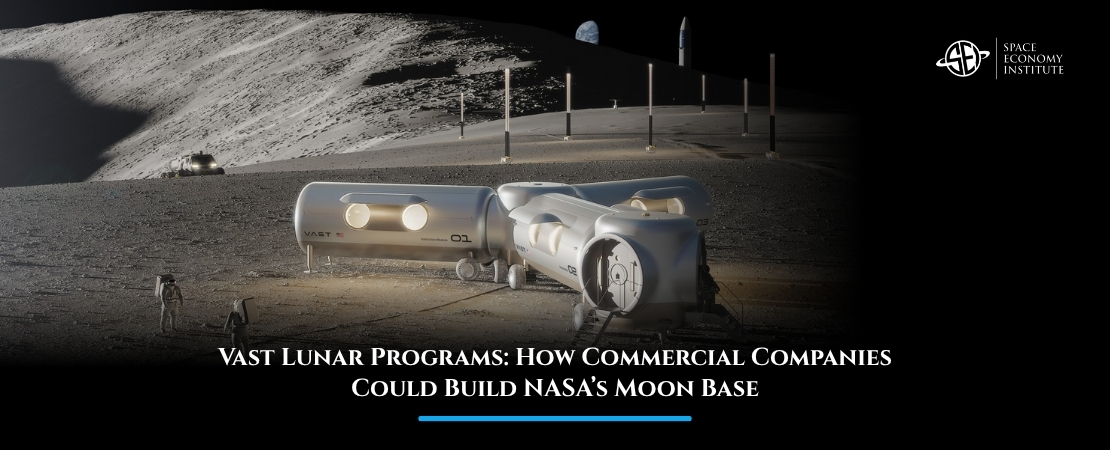
The commercial space-station race is expanding beyond low Earth orbit. On September 23, 2026, Vast established a dedicated Lunar Programs division, proposing power systems, communications satellites, airlocks and habitats for NASA’s emerging Moon Base architecture. The announcement is strategically important because it demonstrates how technologies developed for commercial space stations could become building blocks for an entirely new market: permanent infrastructure on the Moon.
Why Vast Is Moving Toward the Moon
Vast is currently building Haven-1, a commercial crewed space station targeted for launch in 2027 and now in final integration. Rather than developing an entirely separate lunar technology stack, the company plans to transfer systems and manufacturing experience from Haven to its lunar products.
That includes pressure vessels, life-support systems, thermal control, avionics, batteries, flight software and power infrastructure.
Economically, this is significant. Space hardware is expensive partly because new missions frequently require new designs and qualification campaigns. Reusing architectures across LEO stations, satellites and lunar infrastructure could spread development costs across several markets.
Vast is effectively proposing a technology ladder: prove systems in Earth orbit, improve them through repeated operations, then adapt them for increasingly demanding lunar missions.
Power, Airlocks and Habitats: Building the Lunar Value Chain
Vast’s roadmap starts with infrastructure rather than immediately attempting a complete Moon base.
Its proposed Vast Power Station would provide solar generation, energy storage and power distribution. Power is one of the foundational economic requirements for any sustained lunar activity: habitats, rovers, communications systems, scientific equipment and industrial processes all need reliable electricity.
A second product would be a free-standing lunar airlock. The system is intended to test challenges such as lunar dust mitigation, pressure-vessel reliability, spacesuit compatibility and pumping operations before those technologies are incorporated into larger habitats. Lunar dust is especially difficult because it is abrasive, electrostatically charged and potentially damaging to mechanical systems and human equipment.
The longer-term objective is a multi-module lunar habitat supporting long-duration crews, with integrated life support, thermal management, communications, avionics and consumables. Vast says the architecture would heavily leverage Haven-1 technology.
The strategy resembles terrestrial infrastructure development: establish utilities first, validate essential systems, and progressively build more complex facilities around them.
The Moon Will Also Need Its Own Communications Network
Physical habitats are only one part of a functioning lunar economy.
Vast is also proposing a lunar communications, positioning and navigation satellite constellation intended to provide continuous coverage around the lunar South Pole and connectivity back to Earth. The company says the network could complement NASA’s planned Lunar Communications Relay and Navigation Systems while reducing pressure on assets such as the Deep Space Network.
This matters because future lunar operations will require something analogous to terrestrial telecom and navigation infrastructure.
Rovers need positioning. Astronauts need communications. Autonomous equipment needs data links. Scientific instruments must transmit information. Commercial operators will eventually need reliable networks to coordinate logistics and surface operations.
As lunar activity expands, communications and navigation could therefore become recurring service businesses, rather than systems built separately for every mission.
NASA Is Creating a Market, Not Building Everything Itself
Vast’s announcement comes as NASA actively develops its Moon Base program, which aims to establish an enduring human presence near the lunar South Pole. NASA is already soliciting industry proposals for technologies including surface power, oxygen extraction and lunar construction materials, while commercial partners are developing landers, rovers and other infrastructure.
NASA awarded nearly $600 million for four additional commercial lunar delivery missions earlier this year, illustrating how public procurement can create demand for privately developed capabilities.
Vast has not announced a NASA Moon Base contract for these proposed lunar systems. Its new division should therefore be understood as positioning for future procurement opportunities rather than as an awarded program.
That distinction is important—and commercially revealing. Companies are increasingly investing ahead of confirmed contracts because they expect lunar infrastructure to become a significant institutional market.
The Road Toward a Commercial Lunar Economy
Vast’s expansion matters to station developers, lunar lander companies, satellite operators, energy providers, manufacturers, investors and governments. The emerging lunar economy will require far more than rockets and landers: it will need utilities, logistics, communications and places for people to live and work.
If this topic is of interest, you can learn more about lunar markets, commercial space stations, space infrastructure, public-private partnerships and emerging space business models in the Master in Space Economy by the Space Economy Institute. Discover more about the Master and explore how commercial industry could help build the economic infrastructure of the Moon.