
Space Investment Hits $23 Billion: Why Investors Are Returning to the Space Economy
- September 23, 2026
- Posted by: admin
- Category: Uncategorized
Space Capital Is Surging — But the Market Has Changed
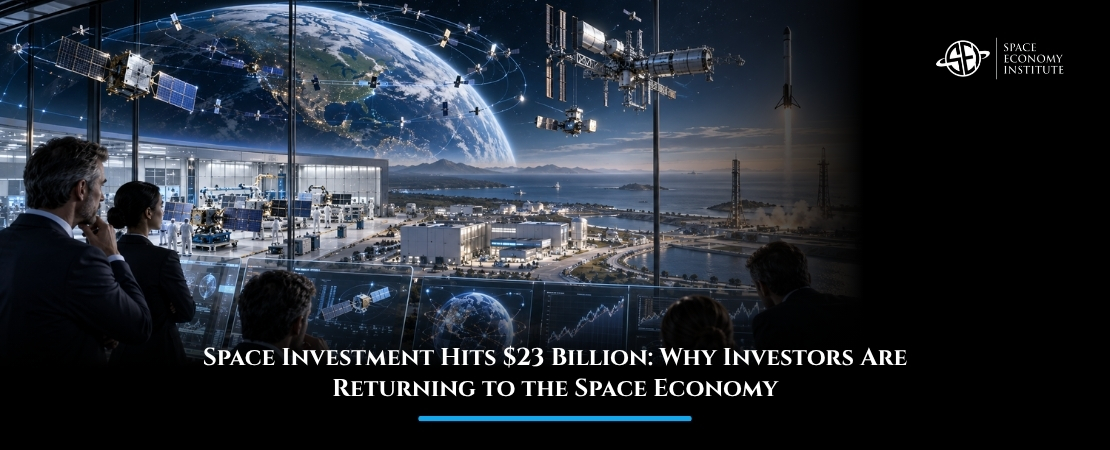
Private investment in space companies is accelerating again. New figures released on September 23 show that global SpaceTech investment reached $23 billion in the 12 months through June 2026, compared with just $9.7 billion during the equivalent period a year earlier. But the most important story is not simply that more money is entering space. Investors are becoming more demanding about where that money goes.
From Space Hype to Commercial Proof
The latest Seraphim SpaceTech Investment Tracker recorded 620 deals during the 12 months to Q2 2026, compared with 582 a year earlier. In Q2 alone, companies raised $7.5 billion across 141 deals, following a record $8 billion in Q1. The largest Q2 financing was a $600 million round for True Anomaly.
Those numbers suggest strong investor appetite, but they do not signal a return to indiscriminate startup funding.
Reuters reports that investors are increasingly prioritizing companies able to demonstrate operational performance rather than relying primarily on future technological potential. The sector is moving from what the report characterizes as hype toward commercial reality.
That distinction is crucial. A startup with an impressive spacecraft design is no longer enough. Investors increasingly want evidence of government contracts, recurring commercial customers, satellites already operating, manufacturing capacity, defensible technology, and a credible path toward scale.
Space is starting to be financed more like an industrial sector.
Earth Observation Shows What Commercial Maturity Looks Like
Earth observation is one of the clearest examples of this transition.
The underlying satellite technology is increasingly established. The commercial battle is moving downstream toward analytics: turning satellite data into information customers can actually use.
An agricultural company may not want satellite imagery itself; it wants to know when to irrigate or plant. A shipping company wants vessel intelligence. An energy trader wants to know whether a refinery is operating. Emergency authorities want early wildfire detection.
As Relm Insurance’s Andrew Bonwick explained, customers increasingly purchase the answer to a business problem rather than thinking of the product as a “space service.”
That shift has major implications for startup valuations. Companies able to connect space infrastructure with specific customer workflows can generate recurring revenue and demonstrate measurable economic value. Investors are therefore becoming more selective within Earth observation, favoring businesses with visible revenues and experienced management teams.
In-Space Manufacturing Shows the Other Side of the Market
Not every emerging space market has reached that stage.
In-space manufacturing remains much earlier in its development. Microgravity could enable valuable pharmaceutical, biotechnology, semiconductor, fiber-optic, and advanced-material processes, but companies still face major infrastructure constraints.
Manufacturing something in orbit is only part of the problem. Companies also need affordable launch, reliable orbital platforms, predictable production processes, and — critically — a way to return products to Earth.
The new report identifies limited launch and return capability as a constraint, while some companies remain stuck at pilot-project scale.
This helps explain why infrastructure such as commercial space stations, orbital transfer vehicles, and new return capsules is attracting attention. The economic potential exists, but the supporting ecosystem must mature before the market can scale.
Manufacturing, Supply Chains and Insurance Become Investable Markets
A third trend is happening further upstream.
As satellite production increases, supply chains are becoming more complex. Space companies increasingly depend on propulsion systems, electronics, optical payloads, solar arrays, specialized materials, semiconductors, software, testing facilities, and precision manufacturing.
The report notes that some companies are responding by bringing more production in-house, reducing supplier dependence and gaining greater control over cost and schedules.
Even insurance is evolving. Traditional aerospace policies were designed around large, expensive missions rather than fleets of smaller experimental spacecraft and new orbital business models. That mismatch is creating opportunities for specialized insurance products capable of covering a rapidly changing commercial market.
The result is a much broader investment landscape: value is no longer concentrated only in rockets and satellite operators.
What the $23 Billion Really Tells Us
The resurgence of space investment matters to entrepreneurs, investors, governments, manufacturers, insurers, and companies that depend on satellite-enabled services. But the headline should not be interpreted simply as another space investment boom.
The stronger signal is market maturation. Capital is increasingly rewarding companies that can connect advanced space technology with real economic demand.
If this topic is of interest, you can learn more about space finance, Earth observation, satellite markets, investment strategy, and emerging space business models in the Master in Space Economy by the Space Economy Institute. Discover more about the Master and explore how investment is transforming space from an emerging technology sector into a global industry.