
Hong Kong Targets Space IPOs: Why Capital Markets Matter to the New Space Economy
- September 18, 2026
- Posted by: admin
- Category: Uncategorized
The Space Race Is Moving to the Stock Exchange
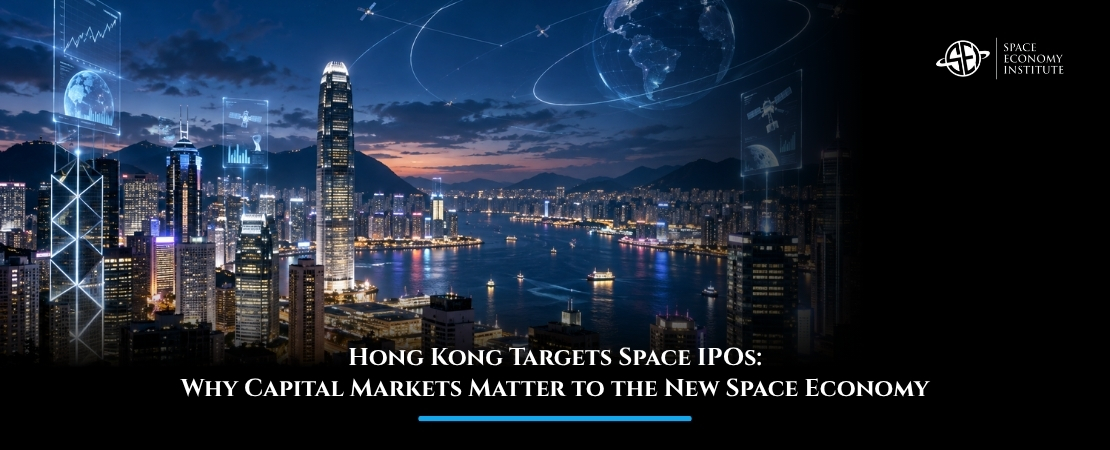
Building rockets and satellite constellations requires enormous amounts of capital long before companies become profitable. Hong Kong now wants a larger role in financing that growth. In its 2026 Policy Address, the Hong Kong government said HKEX will consider changes to Chapter 18C of its listing rules to attract emerging industries including aerospace. The move comes as Chinese rocket and satellite companies prepare for public listings and investors show growing appetite for space businesses.
Why Space Companies Need Different Financing Rules
Space businesses are difficult fits for traditional stock-market requirements. A reusable launch company may spend years developing engines, factories and rockets before generating significant revenue. Satellite constellation operators can face similarly high upfront costs before enough spacecraft are deployed to support commercial services.
Hong Kong’s Chapter 18C was introduced in 2023 specifically for specialist technology businesses that may not yet satisfy conventional profit and revenue requirements. Aerospace technology is already an eligible category, including satellite systems, payloads, space-enabled communications, spacecraft development and space exploration.
The framework distinguishes between commercial and pre-commercial companies. A commercial company currently needs at least HK$250 million in annual commercialisation revenue and an expected market capitalisation of at least HK$4 billion. A pre-commercial company can list before reaching that revenue threshold but faces stricter requirements and currently needs an expected valuation of at least HK$8 billion.
That type of structure is particularly relevant to space, where technological maturity can arrive years before profitability.
China’s Commercial Space Companies Are Approaching Public Markets
The timing is significant because China’s private space sector is rapidly entering a more capital-intensive stage.
Reusable launch company LandSpace is pursuing a listing on Shanghai’s STAR Market and aims to raise 7.5 billion yuan, or roughly $1.1 billion, to support development and expand reusable launch operations. Investor interest strengthened after LandSpace successfully recovered the first stage of its Zhuque-3 rocket in August, becoming one of the few commercial companies globally to land an orbital-class booster.
Other companies, including CAS Space, are also pursuing public-market financing. Hong Kong therefore risks losing a generation of Chinese space listings to Shanghai unless its own framework becomes competitive.
The government’s strategy goes beyond IPO rules. Its September policy announcement also proposes faster vetting of low-Earth-orbit satellite licences, support for aerospace R&D, assistance with international spectrum coordination, strategic investment through the Hong Kong Investment Corporation and work on new commercial space insurance products.
Together, these measures suggest an ambition to position Hong Kong not as a rocket-manufacturing hub, but as a financial and professional-services gateway for the commercial space industry.
SpaceX Has Changed How Investors View Space
The broader backdrop is the growing financial visibility of space companies. SpaceX’s record-setting public listing earlier this year put space infrastructure in front of mainstream institutional investors and intensified interest in companies developing rockets, satellites, communications networks and orbital services. Reuters reported that SpaceX targeted a roughly $1.75 trillion valuation around its June IPO, highlighting the scale capital markets can assign to vertically integrated space businesses.
But the comparison also exposes an important distinction. SpaceX combines launch with Starlink, giving it a large recurring-revenue communications business. Many emerging rocket companies still depend heavily on development funding and future launch contracts.
Public markets can provide them with billions for factories, engines and launch infrastructure, but listing does not remove technological or commercial risk.
Capital Is Becoming Space Infrastructure
The significance of Hong Kong’s move extends beyond China. The global space economy is reaching a stage where financial infrastructure is becoming almost as important as launch infrastructure.
Reusable rockets, satellite megaconstellations and advanced spacecraft require investments that can exceed what venture capital alone can comfortably finance. Successful companies therefore need pathways from venture funding to growth equity, institutional capital and eventually public markets.
Stock exchanges that understand the long development cycles and unusual economics of space technology could become important actors in determining which companies successfully scale.
What Comes Next
Hong Kong’s push affects rocket manufacturers, satellite companies, investors, exchanges and governments competing to build commercial space ecosystems. The next generation of global space leaders will require not only advanced technology and customers, but deep and durable access to capital.
If this topic is of interest, you can learn more about space finance, investment, commercial launch markets and emerging space business models in the Master in Space Economy by the Space Economy Institute. Discover more about the Master and explore how finance is shaping the next phase of the global space economy.