
Impulse Space Raises $808M: Why In-Space Mobility Is Becoming Critical Infrastructure
- September 17, 2026
- Posted by: admin
- Category: Uncategorized
Getting to Space Is No Longer the Whole Problem
The commercial launch market has made reaching orbit dramatically more accessible. But getting a satellite into space is not always the same as getting it where it needs to operate. On September 16, Impulse Space announced a $308 million extension to its Series D, bringing the round to $808 million. The financing highlights growing investor conviction around a new infrastructure market: moving spacecraft efficiently after launch.
What Is In-Space Mobility?
A launch vehicle typically places a satellite into a predefined orbit. For many missions, however, that orbit is only the first stop.
A communications satellite may ultimately need to reach geostationary orbit. A defense spacecraft may need to reposition quickly. A small payload launched through rideshare may need to separate from other customers and reach its own destination. Lunar or deep-space missions require even greater changes in velocity and trajectory.
This is the problem addressed by in-space mobility: spacecraft and propulsion systems that transport payloads after their primary launch.
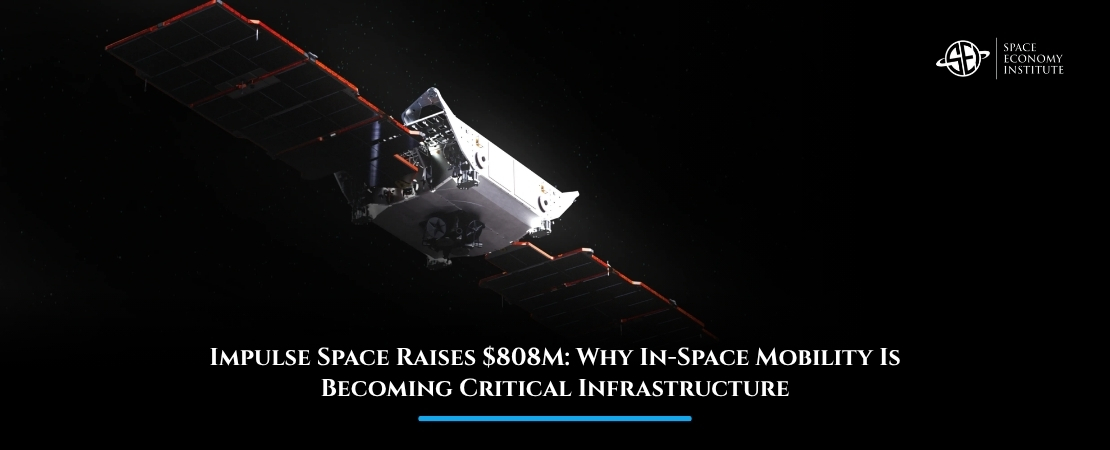
Impulse Space is building several systems around this idea. Its Mira spacecraft is designed for hosting, deployment, precision maneuvering, and rendezvous operations. The larger Helios is a high-energy “kick stage” that can transport payloads from low Earth orbit to destinations including medium Earth orbit, geostationary orbit, lunar trajectories, and Earth escape.
A kick stage effectively acts as another transportation layer after the rocket has completed its job.
Why Helios Could Change GEO Access
The economics are particularly interesting for geostationary orbit, approximately 36,000 kilometers above Earth.
Traditionally, reaching GEO can require a large launch vehicle or a spacecraft to spend weeks or months gradually raising its own orbit. Helios is designed to provide much faster transportation. Impulse says the vehicle can deliver payloads from LEO to GEO in less than one day, using its methane-and-oxygen Deneb engine.
This opens a different business model.
A satellite could launch affordably as part of a rideshare mission to low Earth orbit, then use an orbital transfer vehicle to complete the journey. Impulse’s Caravan rideshare service is designed around this concept, allowing multiple customers to share Helios capacity for higher-energy destinations. The company’s current mission schedule already shows strong demand for upcoming GEO rideshare opportunities.
In economic terms, this begins to separate launch from orbital delivery in much the same way that international freight separates ocean transport from last-mile distribution.
$808 Million Signals Investor Confidence
Impulse initially announced a $500 million Series D in June 2026. The additional $308 million announced this week brings the total round to $808 million. Reuters reported that the extension values the company at approximately $5.4 billion, compared with $4.26 billion at the June financing.
The capital will support product development, manufacturing expansion, facilities, and hiring. Impulse says its workforce has more than doubled over the past year as commercial and government demand has grown.
That demand is increasingly institutional as well as commercial. In July, the U.S. Space Force added Impulse Space to National Security Space Launch Phase 3 Lane 1, making it an unusual participant because Helios is an upper stage rather than a conventional launch vehicle. The Space Force confirmed that Impulse and Relativity joined Blue Origin, SpaceX, ULA, Rocket Lab, and Stoke Space in the Lane 1 provider pool.
Impulse has also received a $28 million contract extension supporting VICTUS SALO 2 and 3, demonstrating defense interest in spacecraft capable of responsive maneuvering.
From Rockets to a Transportation Network
The larger trend is that the space economy is beginning to develop layers of infrastructure.
Rockets provide access to space. Orbital transfer vehicles move payloads between destinations. Refueling systems could eventually extend spacecraft life. Servicing vehicles may repair or reposition satellites. Lunar transport systems could move cargo between Earth orbit and the Moon.
As these markets develop, the economic model of space begins to resemble a transportation network rather than a collection of individual missions.
Impulse is even studying architectures in which Helios transports cargo toward the Moon, illustrating how orbital mobility could eventually connect LEO, GEO, lunar orbit, and destinations beyond Earth.
What Comes Next for the Orbital Economy
Impulse Space’s $808 million financing matters to satellite operators, launch providers, defense agencies, investors, manufacturers, and companies planning missions beyond low Earth orbit. It demonstrates that the next bottleneck in space may not simply be reaching orbit, but moving efficiently once there.
If this topic is of interest, you can learn more about orbital transportation, satellite infrastructure, space logistics, and emerging business models in the Master in Space Economy by the Space Economy Institute. Discover more about the Master and explore how new infrastructure is transforming space from a destination into an interconnected economic environment.