
Starship Flight 14: Why SpaceX’s First Orbital Mission Could Reshape the Space Economy
- September 16, 2026
- Posted by: admin
- Category: Uncategorized
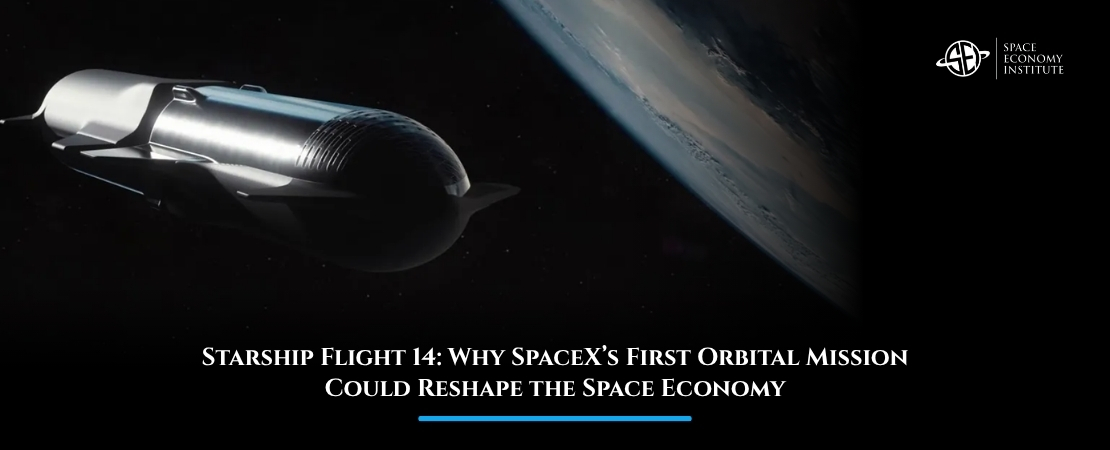
Starship Is Approaching Its Most Important Test Yet
SpaceX is preparing for a milestone that could change the economics of access to orbit. The company is targeting September 22, 2026 for Starship Flight 14, pending regulatory approval. Unlike previous tests, this mission is designed to send Starship into a stable Earth orbit for the first time and deploy operational Starlink V3 satellites. The mission represents a critical test of whether Starship can begin moving from development program to commercial infrastructure.
From Suborbital Testing to Real Orbital Operations
Starship’s previous flights were deliberately conducted on suborbital trajectories. That allowed SpaceX to test launch, stage separation, atmospheric reentry and other systems without leaving the spacecraft in orbit if something went wrong.
Flight 14 is different. SpaceX plans to place Starship at an altitude of roughly 275 kilometers, where it is expected to complete about six orbits of Earth during a mission lasting almost ten hours. The spacecraft would then perform a deorbit maneuver before reentering and splashing down in the Pacific Ocean west of Chile.
That longer mission profile will allow SpaceX to test capabilities that cannot be fully demonstrated during a short suborbital flight, including sustained orbital operations, payload deployment and an intentional deorbit burn.
Economically, that distinction is crucial. A rocket becomes valuable not when it reaches space, but when it can reliably place useful payloads into the required orbit.
Starlink V3 Is the First Commercial Test
Flight 14 is expected to carry 26 Starlink V3 satellites, making it Starship’s first deployment of operational payloads into orbit.
This is strategically important because Starlink’s next generation requires much more launch capacity than Falcon 9 can efficiently provide. V3 satellites are significantly larger and more capable than previous generations. Reporting around the mission indicates that each V3 spacecraft is designed to add approximately 1 terabit per second of network capacity.
That means Starship is not simply another launch vehicle for SpaceX. It is tightly linked to the economics of Starlink.
If SpaceX can launch dozens of large V3 satellites at once, the company could expand broadband capacity more rapidly, support higher user speeds and strengthen emerging services such as direct-to-device connectivity. In turn, Starlink revenues can help finance Starship development.
This creates a powerful vertical integration loop: SpaceX builds the rocket, manufactures the satellites, launches its own constellation and monetizes the resulting communications infrastructure.
Why Full Reusability Changes the Equation
The long-term promise of Starship comes from full reusability.
Falcon 9 already reuses its first stage, dramatically changing launch economics. Starship is designed to go further by eventually recovering and rapidly reflighting both the Super Heavy booster and the upper-stage spacecraft.
Flight 14 will not yet demonstrate the complete operational model. The booster is expected to perform its return sequence toward an offshore splashdown zone rather than return directly to the tower, while the ship will end its mission in the Pacific.
But each successful test reduces technical uncertainty.
If rapid full reusability becomes practical, the impact would extend well beyond Starlink. Lower transportation costs and greater payload capacity could support commercial space stations, lunar logistics, large Earth-observation platforms, orbital manufacturing, space tugs, deep-space missions and entirely new satellite architectures that are currently too expensive to launch.
Starship Could Change What Companies Build
The most important economic consequence may not be cheaper launches alone. It could be a change in how spacecraft are designed.
For decades, satellites have been optimized around strict launch constraints: every kilogram matters, volume inside the fairing is scarce and hardware must often be highly customized.
A very high-capacity launch system could weaken some of those constraints. Companies may be able to build larger spacecraft, carry more redundancy, use cheaper materials or launch complete systems that would previously need to be assembled differently.
In other words, Starship could influence the economics of the entire upstream value chain, not just transportation.
What Comes Next
Starship Flight 14 matters to satellite manufacturers, telecom operators, launch competitors, governments, investors and companies developing future orbital infrastructure. A successful mission would not prove that Starship is fully operational, but it would move the program significantly closer to becoming a commercial transportation system rather than an experimental rocket.
If this topic is of interest, you can learn more about launch economics, satellite constellations, reusable rockets and emerging space infrastructure in the Master in Space Economy by the Space Economy Institute. Discover more about the Master and explore how new transportation systems are reshaping the economics of space.