
SpaceX Starfall: How Orbital Return Could Unlock the In-Space Manufacturing Economy
- September 15, 2026
- Posted by: admin
- Category: Uncategorized
The Space Economy Gets a Return Ticket
For decades, getting hardware into orbit has been the central economic challenge of spaceflight. Now a second market is emerging: bringing valuable products back. On September 15, 2026, Luxembourg-based Space Cargo Unlimited was revealed as the first commercial customer for SpaceX’s new Starfall reentry platform. The planned 2028 mission could carry up to one tonne of commercial payloads, moving orbital manufacturing closer to an industrial business model.
What Is SpaceX Starfall?
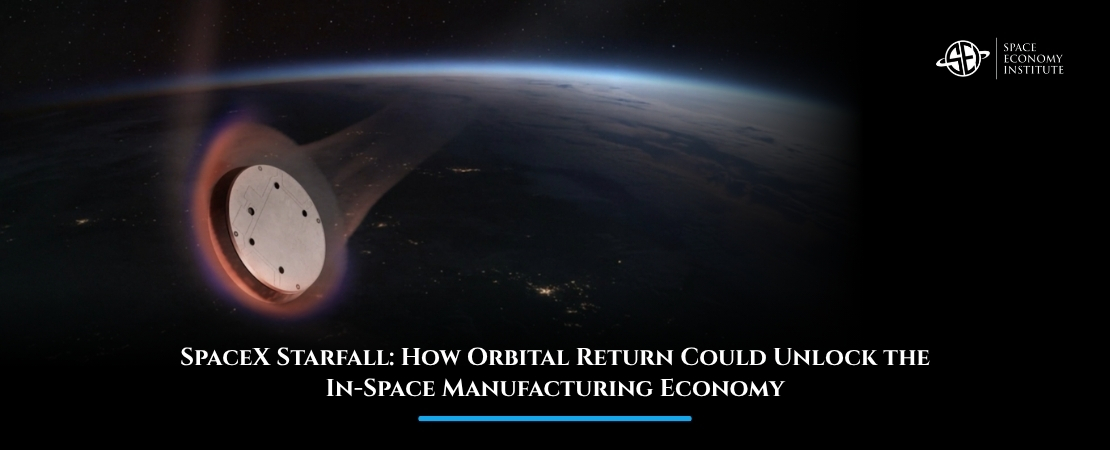
Starfall is an uncrewed reentry vehicle designed to transport experiments, manufactured products, and other high-value payloads safely from orbit back to Earth.
According to FAA documentation, the capsule is approximately 3.1 meters in diameter and 0.75 meters high, with a mass of about 2,100 kilograms and capacity for up to 1,000 kilograms of payload. It uses a large thermal protection system to survive atmospheric reentry and parachutes for recovery in the Pacific Ocean.
SpaceX already flew a Starfall demonstration mission aboard Falcon 9 on June 23, 2026. The U.S. Space Force said the flight demonstrated Starfall reentry technology intended to expand commercial access to microgravity and future cargo-return capabilities.
The longer-term concept is more ambitious. Starfall is intended to fly with Starship, allowing SpaceX to combine high-volume transportation to orbit with high-volume return to Earth.
That matters because launch is only half of the in-space manufacturing equation.
Why Space Cargo Unlimited Is Important
The first commercial customer is Space Cargo Unlimited, a European mission integrator focused on microgravity research and manufacturing.
For the planned 2028 flight, the company intends to place its BentoBox manufacturing platform inside Starfall, creating what it describes as a one-tonne orbital factory. The platform is designed to host multiple customer experiments and production processes in a shared microgravity environment.
Potential markets include pharmaceuticals, biotechnology, advanced materials, semiconductors, and fiber optics.
Microgravity can change the way materials behave. Without gravity-driven sedimentation and convection, researchers can produce crystals, biological structures, alloys, and other materials under conditions that cannot easily be replicated on Earth.
The challenge has always been economics. A product manufactured in orbit has little commercial value if bringing it home is extremely expensive, infrequent, or unreliable.
Starfall is designed to attack that bottleneck.
The Rise of the “Downmass” Market
The launch industry usually focuses on upmass: how much material can be transported into space.
In-space manufacturing creates an equally important market for downmass: how much valuable material can be returned.
Until now, substantial return capacity has largely depended on crewed systems such as SpaceX Dragon. New companies including Varda Space Industries have demonstrated that automated capsules can return pharmaceutical and research payloads from orbit, helping validate a dedicated commercial reentry market.
Starfall takes that model toward larger scale. Its planned payload capacity of up to one tonne could make it possible to return significantly larger production batches rather than individual research samples.
The FAA describes the broader objective as creating a scalable commercial market offering access to microgravity, orbital dwell time, and safe return as a service. The agency’s environmental documentation even frames Starfall as a possible way to scale manufacturing experiments pioneered aboard the International Space Station into a more commercially sustainable system.
From Transportation to an Orbital Supply Chain
This development also shows how the space economy is evolving from isolated missions into supply chains.
A future manufacturer could send equipment and raw materials to orbit, operate an automated production facility, process materials in microgravity, return finished products through Starfall, recover them on Earth, and repeat the process.
If Starship eventually provides frequent, lower-cost transportation, this loop could become much more economically attractive.
For SpaceX, the strategy also expands its addressable market. The company would no longer earn revenue only from launch, broadband, and government missions. It could provide infrastructure for an entirely new category of economic activity: orbital production and return logistics.
What Comes Next for the In-Space Economy
Starfall’s first customer is significant for pharmaceutical companies, materials startups, biotech researchers, investors, launch providers, and companies developing commercial space stations. It suggests that the question is shifting from whether manufacturing in space is technically possible to whether it can become economically repeatable.
If this topic is of interest, you can learn more about in-space manufacturing, orbital logistics, commercial space stations, and emerging space business models in the Master in Space Economy by the Space Economy Institute. Discover more about the Master and explore how new infrastructure is turning low Earth orbit into an economic environment.