
Japan’s Michibiki 7 Launch: Why QZSS Is Strategic for the Space Economy
- August 14, 2026
- Posted by: admin
- Category: International
Japan Strengthens Its Positioning Infrastructure
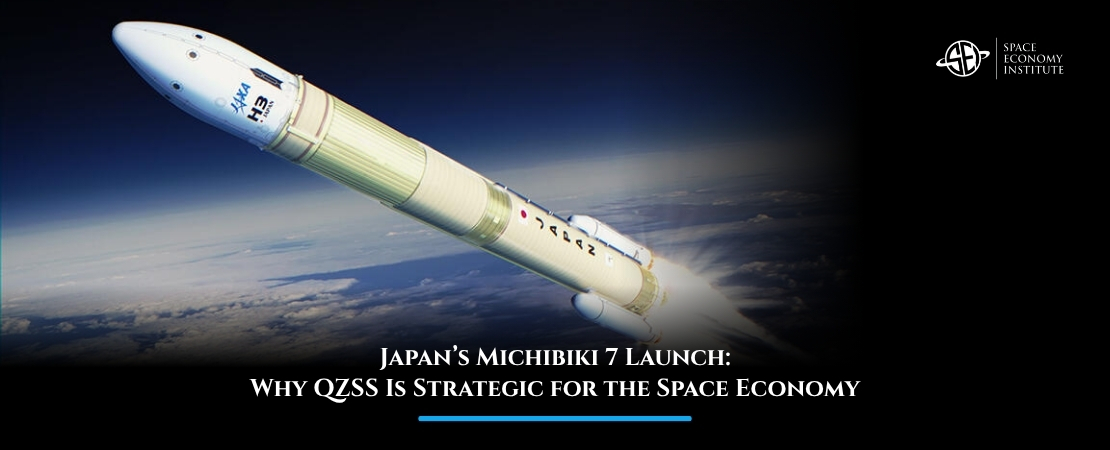
Japan has taken another important step toward navigation sovereignty. On August 11, 2026, JAXA successfully launched Michibiki No. 7, also known as QZS-7, aboard the H3 Launch Vehicle Flight No. 9 from Tanegashima Space Center. As of August 14, the mission is one of the most relevant space economy developments in Asia because it strengthens Japan’s Quasi-Zenith Satellite System, or QZSS, and reinforces the country’s autonomous access to space.
What QZSS Is and Why It Matters
QZSS is Japan’s regional satellite positioning, navigation, and timing system. It is often described as “Japan’s GPS,” but its role is more specific: it improves positioning coverage and accuracy over Japan and the Asia-Oceania region, especially in environments where standard GNSS signals can be blocked or weakened.
This matters because Japan has dense cities, mountainous terrain, islands, ports, offshore routes, industrial zones, and disaster-prone regions. In urban canyons or mountain valleys, signals from global navigation satellites can be obstructed. QZSS satellites are designed to remain high in the sky over Japan for long periods, improving the availability and reliability of positioning services.
The system supports much more than maps on smartphones. Positioning, navigation, and timing services are critical for autonomous driving, smart agriculture, logistics, aviation, maritime operations, construction, emergency response, telecommunications, financial networks, energy systems, and disaster management. In other words, QZSS is not just a space program. It is economic infrastructure.
Why Michibiki 7 Is Important
The successful launch of Michibiki 7 advances Japan’s plan to expand QZSS toward a seven-satellite constellation. The Japanese Cabinet Office explains that, once QZSS becomes a seven-satellite system, at least four QZSS satellites will always be visible above Japan, enabling sustained positioning using QZSS alone.
That is a major strategic shift. Today, most countries rely heavily on foreign GNSS systems such as GPS, Galileo, GLONASS, or BeiDou. These systems are highly valuable, but they are also strategic assets controlled by governments. For advanced economies, dependence on external navigation infrastructure can become a vulnerability during crises, cyberattacks, regional instability, or military conflict.
By expanding QZSS, Japan is strengthening its ability to provide more resilient national positioning services. This is especially important for sectors where even small disruptions can have high economic costs: aviation routing, precision farming, port logistics, financial timestamps, autonomous mobility, and disaster response coordination.
H3 and the Launch Autonomy Dimension
The mission is also important because it was launched on Japan’s new H3 rocket, developed by JAXA and Mitsubishi Heavy Industries as the country’s next-generation flagship launcher.
JAXA reported that H3 Flight No. 9 lifted off at 4:23:31 a.m. Japan Standard Time on August 11, and that QZS-7 separated successfully about 29 minutes and 4 seconds after liftoff, reaching its planned orbit.
For Japan, this matters beyond the satellite itself. A sovereign navigation system needs reliable sovereign launch capacity. If a country builds strategic satellites but depends entirely on foreign rockets, its deployment schedule and resilience remain exposed. H3 is therefore part of Japan’s broader space economy architecture: launch capability, satellite infrastructure, manufacturing, ground systems, and downstream services.
The Commercial Opportunity Around Precision Positioning
The economic value of QZSS will be created downstream. More reliable positioning enables companies to build services in autonomous vehicles, robotics, infrastructure monitoring, logistics optimization, drone operations, maritime tracking, disaster warning, and precision agriculture.
This is where navigation satellites become a platform market. The satellites provide signals; companies build applications on top of those signals. Startups, telecom operators, automotive firms, insurers, mapping platforms, construction companies, and public agencies can all benefit from better location and timing reliability.
The more accurate and resilient the signal layer becomes, the more sophisticated the applications can be.
What Comes Next for Japan’s Space Economy
Michibiki 7 affects government agencies, mobility companies, farmers, logistics operators, emergency services, telecom networks, financial systems, satellite manufacturers, launch providers, and downstream technology firms. It shows that the space economy is not only about exploration or broadband. It is also about the invisible infrastructure that allows modern economies to function.
If this topic is of interest, you can learn more about satellite navigation, launch autonomy, space infrastructure, and downstream space applications in the Master in Space Economy by the Space Economy Institute. Discover more about the Master and explore how positioning, navigation, and timing systems are shaping the future of the global space economy.