
IRIS² Satellite Constellation: Europe’s €15.6 Billion Bet on Secure Space Connectivity
- August 10, 2026
- Posted by: admin
- Category: Uncategorized
Europe Moves From Ambition to Deployment
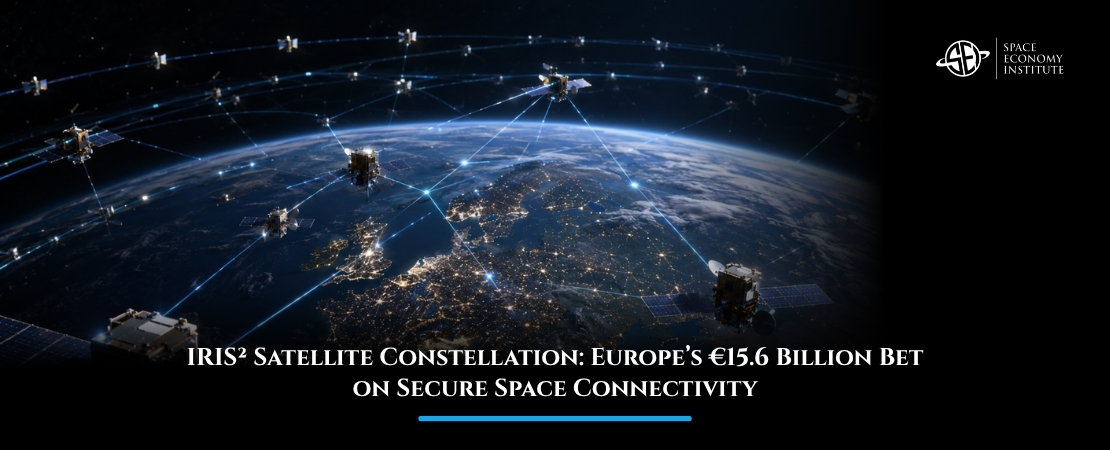
Europe’s secure connectivity strategy has entered a new phase. On August 6, 2026, the European Commission and the SpaceRISE consortium signed an implementation agreement to expand and deploy IRIS², the EU’s flagship satellite constellation. The agreement adds 66 low Earth orbit satellites, bringing the main constellation to 348 satellites. For Europe’s space economy, this is more than a telecom project. It is a sovereignty, security, and industrial competitiveness move.
What IRIS² Is Designed to Do
IRIS², short for Infrastructure for Resilience, Interconnectivity and Security by Satellite, is the European Union’s next-generation secure satellite connectivity system. Its goal is to provide resilient communications for governments, defense users, critical infrastructure, and commercial customers.
The system is designed as a multi-orbit constellation, combining 330 satellites in low Earth orbit with 18 satellites in medium Earth orbit, plus optional elements for specific missions. This matters because different orbital layers offer different advantages. LEO satellites can reduce latency and support broadband-type services, while MEO satellites can provide broader coverage and resilience. Together, they create a more flexible architecture than a single-orbit network.
The latest agreement moves IRIS² from a strategic plan into a more concrete deployment phase. That is important because Europe has spent years discussing the need for sovereign connectivity. Now the question becomes execution: building, launching, operating, and monetizing the constellation.
Why Secure Connectivity Is Now Strategic Infrastructure
Satellite communications used to be treated mainly as a specialized service for remote areas, ships, aircraft, broadcasters, and government users. That view is outdated.
Today, secure connectivity affects defense operations, emergency response, border protection, energy networks, maritime security, financial systems, aviation, logistics, and digital government services. In crisis situations, terrestrial networks can be damaged, jammed, hacked, or politically constrained. Satellites provide resilience.
This is why IRIS² matters for Europe. The war in Ukraine showed how strategically important satellite internet and secure communications can become. It also showed the risks of depending too heavily on non-European systems. Europe wants its own capability: not to isolate itself from commercial partners, but to ensure that essential communications infrastructure remains available, trusted, and under European governance.
In that sense, IRIS² is not simply competing with Starlink. It is answering a different policy question: how can Europe guarantee secure, resilient, sovereign connectivity in an unstable geopolitical environment?
A Major Industrial Program
The space economy impact is substantial. The total IRIS² program budget is reported at around €15.6 billion, combining public and private investment. The SpaceRISE consortium includes SES, Eutelsat and Hispasat, three major European satellite operators, supported by a broader industrial team across space manufacturing, telecommunications, ground systems, cybersecurity, and services.
Hispasat has been selected for a leading role in key parts of the system, including antennas, control systems, and ground links, with a dedicated budget of more than €1.6 billion. It is also expected to lead the development of a LEO segment focused on direct-to-device and Internet of Things connectivity, with up to €600 million allocated to that initiative.
This makes IRIS² an industrial policy tool as much as a communications network. It can support satellite manufacturing, ground infrastructure, terminals, encryption, software-defined networks, launch services, operations, and downstream applications.
The Competitive Challenge
The ambition is clear, but the challenge is significant. IRIS² will enter a market already shaped by SpaceX’s Starlink, Amazon Leo, OneWeb, and emerging Chinese constellations. These systems are moving fast, and some benefit from vertical integration, high launch cadence, and large capital reserves.
Europe’s advantage is different. It can combine regulation, public procurement, defense demand, telecom expertise, and institutional trust. But it must avoid delays, cost overruns, fragmented governance, and slow commercial adoption.
The success of IRIS² will depend on whether Europe can turn political ambition into operational capacity. Secure connectivity only matters if the system is deployed, reliable, affordable, and attractive to both government and commercial users.
What Comes Next
IRIS² affects governments, telecom operators, satellite manufacturers, launch providers, defense agencies, emergency services, and companies that depend on resilient connectivity. Its expansion shows that satellite networks are becoming critical infrastructure, not optional technology.
If this topic is of interest, you can learn more about satellite constellations, secure connectivity, European space policy, and commercial space strategy in the Master in Space Economy by the Space Economy Institute. Discover more about the Master and explore how sovereign satellite infrastructure is shaping the future of the global space economy.