
SpaceX Launch Bottleneck: How Starlink Is Squeezing Rival Satellite Companies
- August 5, 2026
- Posted by: admin
- Category: Competitive research
The Launch Market’s New Power Imbalance
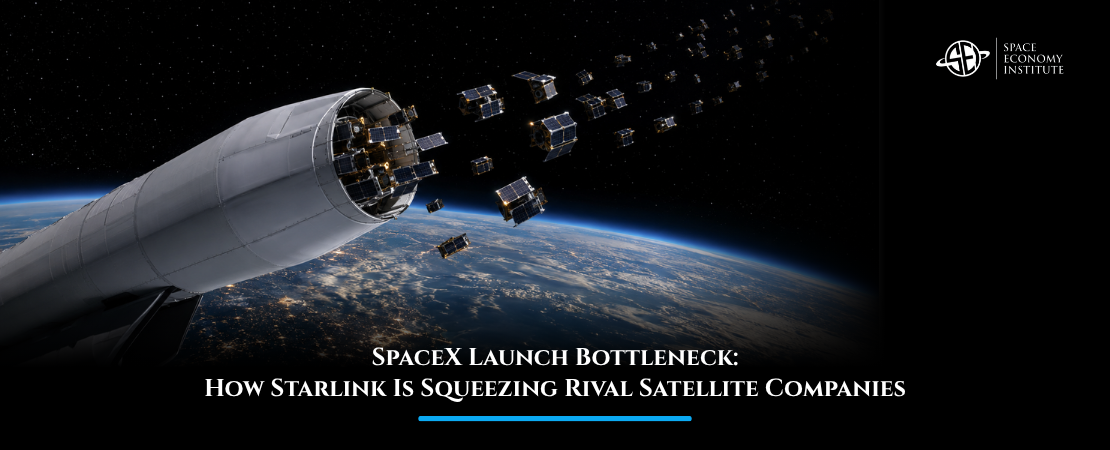
The commercial space economy depends on access to orbit. But as of August 5, 2026, a growing problem is becoming harder to ignore: SpaceX, the world’s dominant commercial launch provider, is increasingly using Falcon 9 capacity for its own Starlink satellites. Reuters reported that Starlink missions now account for about 79% of Falcon 9 launches, up from 54% in 2020, leaving rival satellite companies with fewer available launch slots.
When the Launch Provider Becomes the Competitor
SpaceX’s rise transformed the launch market. Falcon 9 reusability lowered costs, increased cadence, and gave satellite operators a more reliable path to orbit than many traditional alternatives. For years, this benefited the broader space economy.
But SpaceX is not only a launch provider. It is also one of the world’s largest satellite operators through Starlink, its global broadband network. This creates a structural tension: the same company that many satellite businesses rely on to reach orbit is also competing with them in connectivity, data services, and future orbital infrastructure.
According to Reuters, many spacecraft companies are now struggling to book Falcon 9 missions before 2028 or 2029. That matters because launch delays can damage business plans, slow revenue, weaken investor confidence, and give vertically integrated competitors an advantage.
In a fast-moving market, waiting two or three years for launch can be the difference between leading and losing.
Starlink Changes the Economics of Falcon 9
The reason is simple: Starlink has become central to SpaceX’s financial model. Reuters reported that Starlink generated around $11.4 billion in 2025 and now represents roughly 60% of SpaceX’s revenue. That makes internal launch demand more valuable than many external commercial missions.
For SpaceX, prioritizing Starlink is rational. Every Starlink launch expands network capacity, supports customer growth, and strengthens a recurring revenue business. But for the wider market, it creates a bottleneck. Smaller satellite operators, Earth observation startups, telecom challengers, and space infrastructure companies often do not have their own rockets. They depend on launch availability from providers such as SpaceX, Rocket Lab, Arianespace, ULA, Blue Origin, India’s ISRO-linked ecosystem, and emerging startups.
The problem is that few providers currently match Falcon 9’s combination of price, cadence, reliability, and payload capacity.
Rising Costs and Scarce Slots
The bottleneck is not only about availability. It is also about cost. Reuters reported that Falcon 9 launch prices have increased from about $54 million in 2013 to around $74 million today. For well-funded government and defense customers, that may be manageable. For commercial startups building constellations, every increase affects margins, fundraising, and deployment strategy.
This is especially important because many new space business models depend on scale. Satellite broadband, direct-to-device connectivity, synthetic aperture radar, climate monitoring, and in-orbit services all require multiple spacecraft. If launch slots become scarce or expensive, the economics of these constellations become harder.
The result could be a more uneven space economy: large, vertically integrated players accelerate, while smaller companies face delays and higher capital requirements.
A Catalyst for Launch Competition
The pressure may also create opportunity. Rocket Lab is developing Neutron to move beyond small launch. Blue Origin’s New Glenn, ULA’s Vulcan, Ariane 6, Firefly, Relativity Space, Stoke Space, and other providers are trying to expand market capacity. Governments are also paying closer attention to launch resilience and supplier diversity.
For customers, the lesson is clear: launch strategy is now a core business risk. Satellite companies must secure launch access early, diversify providers where possible, design flexible spacecraft, and consider rideshare, dedicated launch, or multi-launch agreements.
For policymakers, the issue is equally strategic. A healthy space economy cannot depend too heavily on one launch provider, even an excellent one. Competition, infrastructure investment, and predictable regulation are essential.
Conclusion
SpaceX’s launch bottleneck shows that access to orbit is not just a technical service. It is market power. As Starlink absorbs more Falcon 9 capacity, rival satellite companies must rethink deployment plans, costs, and competitive strategy.
If this topic is of interest, you can learn more about launch markets, satellite business models, vertical integration, and commercial space strategy in the Master in Space Economy by the Space Economy Institute. Discover more about the Master and explore how access to orbit is shaping the future of the global space economy.