
FAA Commercial Space Licensing Reform: How Faster Launch Approvals Could Reshape the Space Economy
- July 30, 2026
- Posted by: admin
- Category: Uncategorized
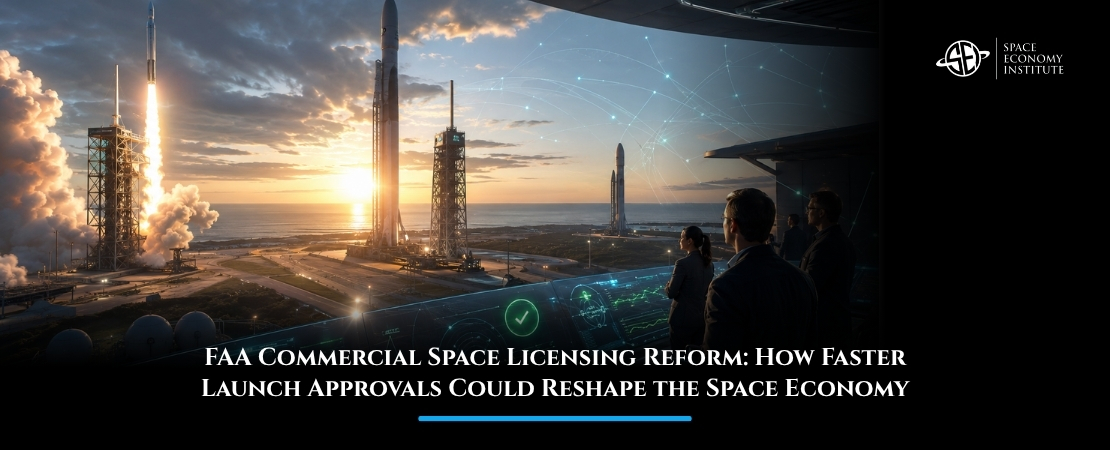
Regulation Becomes a Space Economy Battleground
The space economy is moving faster than the rules built to govern it. On July 28, 2026, the U.S. Federal Aviation Administration announced a new proposal to streamline commercial space licensing for rocket launches, spacecraft reentries, and launch site operations. As of July 30, the proposal has become one of the most important regulatory stories in space: it could accelerate commercial missions, but also intensify debate over environmental protection, public safety, and sustainable growth.
Why Licensing Speed Matters
Launch capacity is one of the foundations of the space economy. Satellite broadband, Earth observation, defense constellations, lunar logistics, space tourism, orbital servicing, and commercial space stations all depend on reliable access to orbit. But access to orbit is not only a technical question. It is also a regulatory one.
Today, launch providers need licenses and approvals before rockets can fly, spacecraft can reenter, and spaceports can expand operations. These reviews are meant to protect public safety, airspace, the environment, and nearby communities. But as launch activity grows, companies argue that slow or duplicated reviews can delay missions, increase costs, and reduce U.S. competitiveness.
The FAA says the goal of its new initiative is to make it faster and easier for commercial operators to secure approvals. Reuters reported that license applications can currently take up to 36 months, although the FAA’s formal review period is 180 days. For an industry moving toward weekly, daily, or eventually higher-cadence launch models, that timeline has become a strategic issue.
A Push for Higher Launch Cadence
The proposed reform reflects the scale of the market shift. The FAA approved a record 204 commercial space operations in 2025, and the number of launches and reentries is expected to keep rising sharply. Companies such as SpaceX, Rocket Lab, Blue Origin, Firefly Aerospace, Relativity Space, and others are pushing toward more frequent missions, reusable vehicles, new spaceports, and more complex reentry operations.
In this environment, regulation becomes part of industrial competitiveness. A country that can approve safe operations faster can attract more launch activity, more infrastructure investment, and more aerospace jobs. Spaceports can become regional economic engines. Launch providers can serve commercial, civil, and defense customers with greater predictability.
This is especially important as satellite constellations expand. More satellites require more launches, replacement cycles, orbital upgrades, and responsive deployment capacity. If licensing becomes a bottleneck, it can slow the entire space value chain.
The Environmental Trade-Off
The most controversial part of the proposal concerns environmental review. Reuters reported that the FAA proposal could allow the agency to waive requirements from 13 environmental and related laws, including the National Environmental Policy Act and the Endangered Species Act, in certain cases.
Supporters argue that redundant reviews across multiple agencies create unnecessary delays and that faster approvals are essential for national competitiveness. Environmental groups and local communities are likely to view the proposal differently. Rocket launches can affect wildlife, protected habitats, air quality, noise levels, coastal areas, public lands, and local infrastructure.
This is the central tension: the space economy needs speed, but it also needs legitimacy. If regulation becomes too slow, innovation suffers. If regulation becomes too weak, public opposition and legal disputes may grow. A sustainable space sector must prove that faster does not mean careless.
From Launch Permits to Market Architecture
This debate is bigger than paperwork. Commercial space licensing shapes who can enter the market, how quickly companies scale, where spaceports develop, and which business models become viable.
A faster licensing system could benefit launch providers, satellite operators, defense customers, tourism ventures, and companies planning reusable spacecraft or orbital infrastructure. It could also strengthen U.S. leadership at a time when Europe, China, India, and other space powers are building their own commercial ecosystems.
But regulatory reform must be designed carefully. The next generation of space activity will involve more launches, more reentries, more satellites, more debris risks, and more interaction with aviation and coastal communities. The winning model will not simply be deregulation. It will be smarter regulation: faster, clearer, more predictable, and still credible.
Conclusion
The FAA’s commercial space licensing reform could become a turning point for the launch economy. Faster approvals may unlock higher cadence, stronger investment, and more competitive space infrastructure. But the sector must balance speed with safety, environmental responsibility, and public trust.
If this topic is of interest, you can learn more about launch markets, space regulation, commercial space strategy, and infrastructure development in the Master in Space Economy by the Space Economy Institute. Discover more about the Master and explore how policy is shaping the future of the global space economy.