
China’s Commercial Space Boom: Why 600 Space Companies Are Changing the Global Space Economy
- July 29, 2026
- Posted by: admin
- Category: International
A New Commercial Space Power Rises
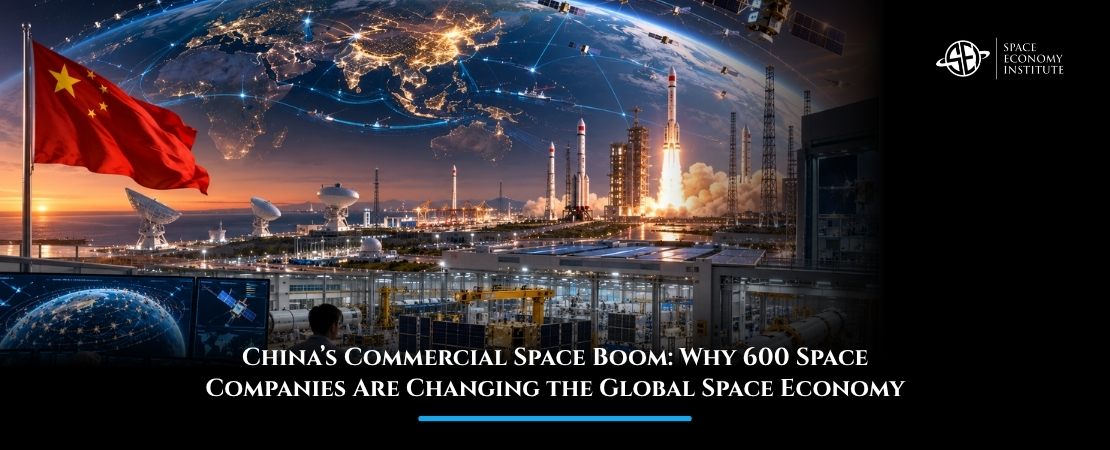
China’s commercial space sector is no longer a small experimental branch of its national space program. As of July 29, 2026, new analysis shows that China’s space ecosystem has expanded from only a few dozen companies after private investment was opened in 2014 to around 600 companies active in launch, satellite manufacturing, communications, remote sensing, ground systems, and space services. This is a strategic shift in the global space economy.
From State Program to State-Backed Commercial Ecosystem
China’s space sector has traditionally been dominated by large state-owned aerospace groups. But since the mid-2010s, Beijing has encouraged private and semi-private space activity as part of a broader strategy to build technological self-sufficiency, industrial scale, and military-civil fusion.
The result is not a Western-style free-market space economy. It is a hybrid model: commercial companies, venture capital, provincial investment funds, state-backed customers, industrial parks, and national strategic priorities all moving in the same direction.
This model gives China several advantages. Startups can access policy support, local government incentives, manufacturing infrastructure, and strategic demand. At the same time, the state can guide the sector toward national goals, including satellite internet, launch autonomy, Earth observation, navigation services, defence applications, and international influence.
For the global market, this means Chinese commercial space companies should not be underestimated simply because they are “private.” Many operate inside a coordinated national industrial strategy.
The Satellite Constellation Race
One of the most important battlegrounds is satellite broadband. China is advancing major low Earth orbit constellation projects such as Guowang and Thousand Sails, both of which are expected to involve more than 10,000 satellites.
This puts China in direct competition with SpaceX’s Starlink and other emerging global systems. Satellite internet is no longer only about connecting remote homes. It supports maritime operations, aviation, disaster response, defence communications, industrial IoT, emergency services, and geopolitical influence.
A large Chinese constellation ecosystem could also support international expansion. By bundling satellite communications, Earth observation, navigation, financing, training, and operational support into partnerships with developing countries, China can turn space infrastructure into a diplomatic and commercial tool.
This is where the concept of a “Space Silk Road” becomes economically important. Space services can be exported as infrastructure, just like ports, railways, telecom networks, and energy systems.
Launch and Manufacturing at Industrial Scale
China’s commercial launch sector is also becoming more competitive. Companies such as LandSpace, Galactic Energy, iSpace, Space Pioneer, Orienspace, and others are developing orbital launch vehicles, reusable rocket concepts, and high-cadence production models.
At the same time, satellite manufacturing is becoming more automated and industrialized. Several Chinese companies are building facilities designed to produce spacecraft faster and at lower cost, supporting the deployment of large constellations.
This is a critical point for the space economy. The future will not be won only by the best rocket or the most advanced satellite. It will be won by the countries and companies that can manufacture, launch, replace, upgrade, and operate space infrastructure at scale.
China’s model is designed around that industrial logic.
A Strategic Challenge for the U.S. and Europe
China’s commercial space rise creates a direct challenge for the United States and Europe. The U.S. still leads in many areas, especially through SpaceX, satellite services, private capital, and advanced launch cadence. Europe has strong aerospace expertise, but remains more fragmented and is still rebuilding autonomous launch capacity.
China’s advantage is coordination. It can align policy, finance, manufacturing, launch, and national demand more directly than many democratic market economies. That does not guarantee success. Chinese companies still face technical, financial, regulatory, and international trust challenges. But the direction is clear: China is building a full-stack commercial space ecosystem.
For Western companies and policymakers, the response requires faster procurement, stronger private investment, industrial scale, launch competitiveness, and international partnerships.
Conclusion
China’s commercial space boom shows that the space economy is becoming a contest between industrial ecosystems, not just individual companies. With around 600 companies, major satellite constellation plans, expanding launch capacity, and a state-backed commercial model, China is positioning space as both an economic engine and a strategic instrument.
If this topic is of interest, you can learn more about commercial space strategy, satellite markets, launch competition, and geopolitical dynamics in the Master in Space Economy by the Space Economy Institute. Discover more about the Master and explore how global competition is shaping the next phase of the space economy.