
Satellite Servicing Economy: How Northrop Grumman’s MRV Is Changing Space Infrastructure
- July 26, 2026
- Posted by: admin
- Category: Innovation
From Disposable Satellites to Serviceable Assets
For decades, satellites were treated as expensive but disposable machines: once fuel ran low or a component failed, operators had limited options beyond replacement. That model is changing. On July 21, 2026, Northrop Grumman’s Mission Robotic Vehicle, or MRV, launched aboard a SpaceX Falcon 9, carrying Mission Extension Pods designed to extend the life of aging satellites in geostationary orbit. For the space economy, this marks a shift from replacement to maintenance.
Why Satellite Life Extension Matters
Geostationary satellites are among the most valuable assets in orbit. Positioned around 36,000 kilometers above Earth, they support television broadcasting, secure communications, weather services, broadband connectivity, and government operations. Building and launching them can cost hundreds of millions of dollars, and their commercial value depends on staying operational for as long as possible.
Many GEO satellites do not stop working because their electronics fail. They often retire because they run out of propellant needed for station-keeping. Without fuel, they can no longer maintain their precise orbital position, even if the payload itself remains functional.
This is the economic logic behind satellite servicing. If a robotic spacecraft can attach a propulsion module to an aging satellite, the operator can gain several additional years of revenue without immediately buying and launching a replacement. In capital-intensive infrastructure markets, extending asset life is often one of the most powerful ways to improve returns.
The MRV Model: A Mechanic in Geostationary Orbit
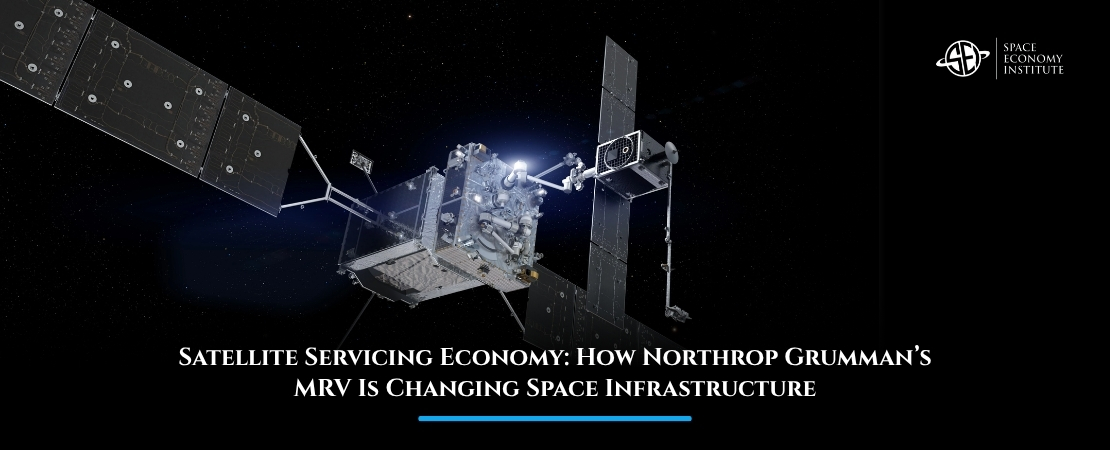
Northrop Grumman’s MRV is designed to act like a robotic service platform in GEO. Instead of docking permanently with one satellite, the MRV can carry small propulsion modules known as Mission Extension Pods. Once it reaches operational orbit, it can use robotic arms to install these pods on client satellites.
The pods function like external jetpacks, giving aging spacecraft the ability to continue station-keeping. This model is important because it makes satellite servicing more scalable. A servicer that can support multiple satellites creates a repeatable business, not just a one-off rescue mission.
The MRV also points toward a broader future. Beyond life extension, robotic servicing platforms could inspect spacecraft, relocate satellites, support repairs, perform upgrades, assist with disposal, and eventually contribute to in-orbit assembly. This would transform satellites from closed, single-use objects into maintainable infrastructure.
A Growing Market for In-Orbit Services
The timing is significant. The in-orbit servicing market is moving from demonstration to commercialization. Recent estimates suggest the global satellite servicing market could grow from around $3.6 billion in 2026 to $7.1 billion by 2033, while broader in-orbit services forecasts point to continued demand for life extension, refueling, inspection, repair, assembly, and debris mitigation.
This growth is being driven by several forces. First, satellite fleets are expanding rapidly in both low Earth orbit and geostationary orbit. Second, governments increasingly want resilient space infrastructure that can be repaired or repositioned during crises. Third, commercial operators want to maximize the value of existing assets. Finally, orbital sustainability is becoming an economic and regulatory priority.
In this context, servicing is not just a technical capability. It is part of the operating model for a more mature space economy.
The Strategic Shift: Space as Infrastructure
The MRV launch also reflects a deeper change in how the space sector thinks about value. Early commercial space was often measured by launch success and satellite deployment. The next phase will be measured by how well companies manage, maintain, upgrade, and protect orbital assets over time.
That creates new opportunities across the supply chain: robotics, autonomous navigation, propulsion modules, docking systems, AI inspection, insurance, mission operations, cybersecurity, and space traffic coordination. It also creates new business models, including satellite life-extension contracts, maintenance subscriptions, inspection services, and end-of-life disposal support.
The more valuable space infrastructure becomes, the more important it becomes to service it.
Conclusion
Northrop Grumman’s MRV mission shows that the space economy is entering a maintenance era. Satellites are no longer just launched and left alone; they are becoming assets that can be supported, upgraded, and extended in orbit.
If this topic is of interest, you can learn more about satellite servicing, in-orbit infrastructure, commercial space operations, and orbital sustainability in the Master in Space Economy by the Space Economy Institute. Discover more about the Master and explore how servicing technologies are redefining the economics of space.