
Artemis III, SpaceX and Blue Origin: NASA’s Commercial Lunar Lander Strategy
- July 21, 2026
- Posted by: admin
- Category: Partnerships
The Moon Program Becomes a Market Test
NASA’s Artemis III mission is back in the spotlight. On July 20, 2026, NASA Administrator Jared Isaacman said the agency remains on track for Artemis III in 2027, despite Blue Origin repairing launchpad damage after a New Glenn test accident earlier this year.
The mission is designed to return astronauts to the lunar surface, but its significance goes beyond exploration. Artemis III is also a test of how commercial landers, public procurement, and private infrastructure will shape the lunar economy. NASA sets the mission goals, while private companies such as SpaceX and Blue Origin develop the commercial lunar lander systems that could support repeated access to the Moon.
NASA’s Role: Mission Architect and Anchor Customer
To understand the relationship between NASA and private companies such as SpaceX and Blue Origin, it is useful to start with NASA’s role.
NASA leads the Artemis program, defines the mission requirements, trains the astronauts, operates the Orion spacecraft, and coordinates the broader lunar exploration architecture. However, NASA is not building every element directly. Instead, it is using commercial contracts to buy key capabilities from private companies.
This is similar to what NASA did with commercial cargo and crew transportation to the International Space Station. Rather than owning every vehicle itself, NASA helped create a market by becoming an anchor customer. SpaceX’s Dragon and other commercial systems grew out of that model.
With Artemis, NASA is applying the same logic to the Moon. The agency wants commercial lunar landers that can carry astronauts and cargo between orbit and the lunar surface. This turns lunar landing capability from a purely government-built system into a service that private companies can develop, improve, and eventually offer for multiple missions.
SpaceX and Blue Origin: Two Commercial Paths to the Moon
SpaceX and Blue Origin are both part of NASA’s commercial lunar lander strategy, but they do not have the same role in Artemis III.
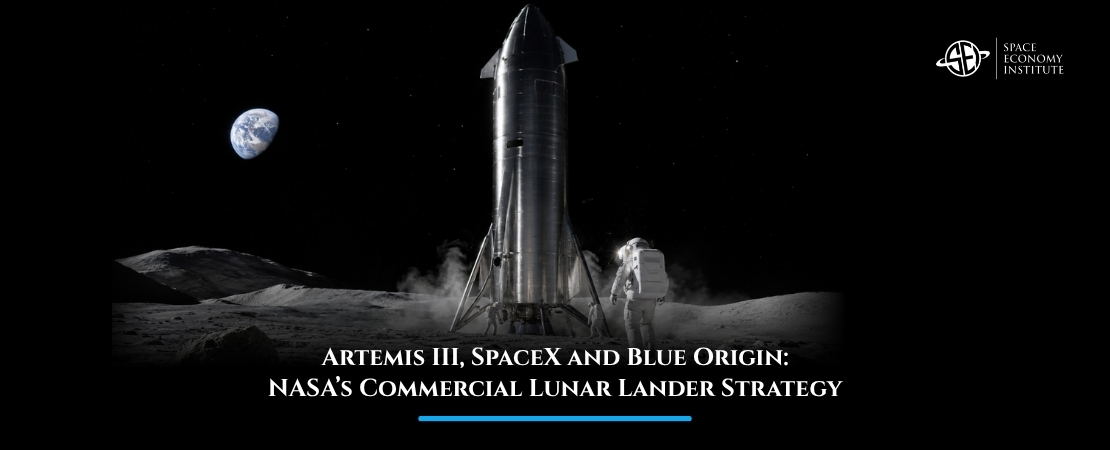
SpaceX plays the central role in the first crewed lunar landing because NASA selected the company’s Starship Human Landing System as the lander for Artemis III. In the mission architecture, astronauts launch from Earth inside NASA’s Orion spacecraft using the Space Launch System. Orion carries them toward the Moon. Once in lunar orbit, Starship carries the astronauts down to the lunar surface and later brings them back to Orion, which returns them to Earth.
This means SpaceX provides one critical transportation layer: the commercial lander that connects lunar orbit with the Moon’s surface. Economically, this is significant because Starship is designed as a large, reusable system. If it works at scale, it could dramatically increase the amount of cargo, equipment, and infrastructure that can be delivered to the Moon.
Blue Origin’s role is different but strategically important. NASA selected Blue Origin’s Blue Moon lander as a second human landing system provider for later Artemis missions. SpaceX is expected to support the first crewed Artemis lunar landing, while Blue Origin is being developed as another commercial lander option for future missions.
This gives NASA redundancy and competition. The goal is not to choose only one winner, but to build a more resilient lunar transportation market. The recent Blue Origin setback shows why this matters. Space infrastructure is hard, expensive, and vulnerable to delays. Launch vehicles fail tests. Engines underperform. Ground infrastructure breaks. Supply chains slip.
In a traditional single-provider architecture, one major failure can threaten an entire program. A multi-provider model can reduce risk, increase launch opportunities, and create price and performance competition. If one system is delayed, another may continue progressing. If both succeed, NASA gains technical diversity, negotiating leverage, and a stronger foundation for sustained lunar access.
Commercial Landers Are the New Lunar Gateways
Once the roles of SpaceX and Blue Origin are clear, the broader economic point becomes easier to see: commercial lunar landers could become the logistics platforms of cislunar space.
The most important economic asset in the Artemis architecture may not be the rocket itself, but the transportation link between lunar orbit and the lunar surface. Landers may carry crew, cargo, rovers, science instruments, construction systems, power units, communications equipment, and eventually commercial payloads.
Over time, these capabilities could support government missions, international partners, research institutions, and private customers. A sustained Moon program will require repeated cargo deliveries, crew transport, surface logistics, power systems, habitats, mobility vehicles, communications networks, and scientific equipment.
This creates demand far beyond the lander companies. Lunar transport requires propulsion systems, cryogenic storage, docking adapters, navigation software, autonomous operations, thermal protection, communications hardware, space-rated electronics, mission insurance, and ground support.
From Exploration Program to Economic Policy
Artemis is also an economic policy instrument. NASA provides the strategic vision, funding, technical requirements, and demand. SpaceX and Blue Origin develop competing private-sector transportation systems. Suppliers across the aerospace industry provide engines, avionics, materials, software, robotics, docking systems, life-support technologies, and mission operations services.
As a result, NASA’s procurement choices influence which companies raise capital, which suppliers scale production, and which technologies become commercially viable. Every Artemis contract supports a broader ecosystem of companies that may later serve commercial customers, international space agencies, research institutions, and private lunar infrastructure projects.
This is why investors, governments, and allied space agencies are watching Artemis III closely. A successful test would strengthen confidence in commercial lunar transportation, while a major delay would remind the market that the Moon remains technically and financially difficult.
Either way, Artemis III is shaping expectations. It shows that the next space economy will be built through partnerships between public agencies and private companies, where government missions help validate commercial infrastructure.
In this sense, Artemis III is not only a mission. It is a market-building mechanism.
Conclusion
Artemis III is more than a step toward returning humans to the Moon. It is a stress test for the commercial lunar economy. The mission will reveal whether private landers, public funding, and competitive infrastructure can support a sustainable future beyond low Earth orbit. SpaceX provides the first Artemis lunar lander, Blue Origin adds future competition and redundancy, and NASA coordinates the architecture that brings these capabilities together.
If this topic is of interest, you can learn more about lunar infrastructure, commercial space strategy, public-private partnerships, and the future of cislunar markets in the Master in Space Economy by the Space Economy Institute. Discover more about the Master and explore how the Moon is becoming the next frontier of economic development.