
Blue Origin Funding Round: Why Private Capital Is Betting on Reusable Rockets and Lunar Infrastructure
- July 13, 2026
- Posted by: admin
- Category: Funding trends
A New Signal from Space Finance
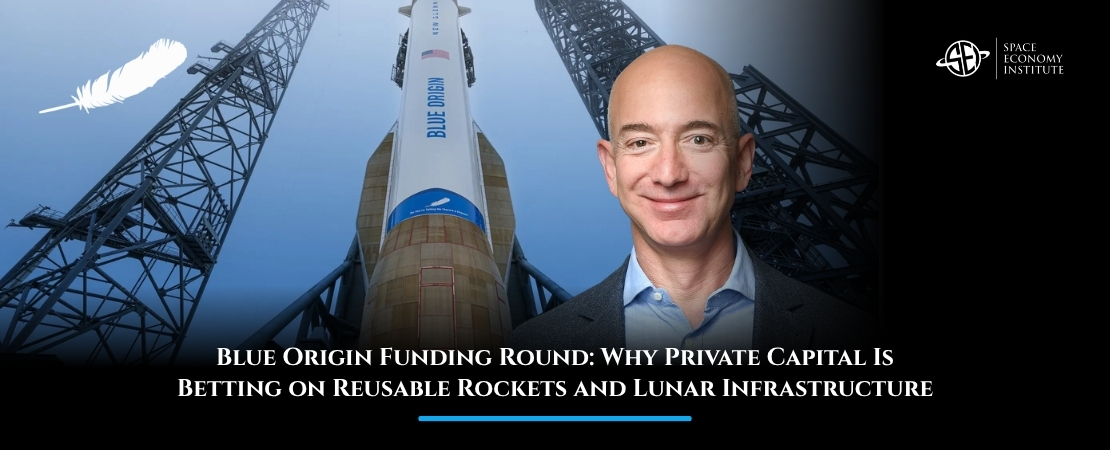
The space economy is entering a new investment phase. As of July 13, 2026, Blue Origin is reportedly seeking its first major external funding round, targeting $10 billion at a pre-money valuation of $130 billion. For a company historically financed by Jeff Bezos, this is a major strategic shift. It shows that private capital is no longer watching the space economy from the sidelines. It wants exposure to launch, lunar systems, defense contracts, and next-generation orbital infrastructure.
From Founder-Funded Vision to Institutional Capital
Blue Origin was founded in 2000 with a long-term mission: building the infrastructure needed for millions of people to live and work in space. For most of its history, the company was funded primarily by Jeff Bezos, allowing it to pursue ambitious programs without depending heavily on outside investors.
That model gave Blue Origin patience, but it also created pressure. The space market has changed dramatically. SpaceX has proved that launch, satellite networks, government contracts, and vertically integrated infrastructure can become a massive commercial platform. Investors now understand space less as a distant frontier and more as an industrial market connected to communications, defense, AI, lunar exploration, and national resilience.
Blue Origin’s reported funding round reflects that shift. External capital could help accelerate production, improve launch cadence, expand infrastructure, and support expensive programs such as New Glenn, Blue Moon, and future orbital systems.
New Glenn and the Launch Capacity Race
At the center of Blue Origin’s commercial strategy is New Glenn, its heavy-lift reusable rocket. New Glenn is designed to carry more than 45 metric tons to low Earth orbit and more than 13 metric tons to geostationary transfer orbit, making it relevant for satellite constellations, national security missions, lunar logistics, and deep-space payloads. , supporting its role in heavy-lift launch competition.
Launch capacity is becoming one of the most important bottlenecks in the space economy. Satellite broadband, Earth observation, defense networks, and commercial space stations all depend on reliable access to orbit. A successful New Glenn program would give customers another heavy-lift option in a market still heavily influenced by SpaceX.
That competition matters. More launch providers can reduce dependency on a single system, create pricing pressure, and provide resilience when one provider faces delays or technical setbacks. For governments, especially the United States, a second or third reliable heavy-lift provider is not just commercial convenience. It is strategic infrastructure.
Lunar Infrastructure as a Market
Blue Origin is also deeply connected to the emerging Moon economy. Its Blue Moon lander family is being developed to support cargo and crewed lunar missions, including NASA’s Artemis architecture. Lunar infrastructure is still early, but it is becoming a real market category: landers, rovers, habitats, power systems, communications, surface mobility, and logistics.
The important point is that the Moon economy will not be built by exploration missions alone. It will require repeatable services. Companies that can deliver cargo, support astronauts, move payloads across the surface, and provide mission operations may become core infrastructure providers for the next phase of lunar development.
For investors, this creates a longer-term thesis. Blue Origin is not only a launch company. It is attempting to position itself across multiple layers of the space value chain: launch, engines, lunar transport, government missions, and eventually in-space infrastructure.
The New Investment Logic of Space
The reported Blue Origin round also shows how space investment is maturing. Investors are looking for companies with strategic assets: reusable vehicles, launch sites, government contracts, advanced engines, lunar systems, and long-term infrastructure programs.
This does not mean risk has disappeared. New Glenn must prove reliable cadence. Lunar landers must meet demanding timelines. Capital requirements are enormous. Competition is intense. But the direction is clear: space is becoming a serious institutional investment category.
The winners will likely be companies that combine technical capability with recurring demand from governments, defense customers, telecom operators, cloud providers, and future lunar markets.
Conclusion
Blue Origin’s reported funding round is more than a financing event. It is a sign that the space economy is entering a capital-intensive infrastructure era, where reusable launch, lunar logistics, and sovereign space capabilities are becoming investable strategic assets.
If this topic is of interest, you can learn more about space investment, reusable rockets, lunar infrastructure, and commercial space strategy in the Master in Space Economy by the Space Economy Institute. Discover more about the Master and explore how private capital is shaping the next phase of the space economy.