
ispace and SpaceX Starship: How Lunar Rideshare Could Open the Moon Economy
- July 8, 2026
- Posted by: admin
- Category: Innovation
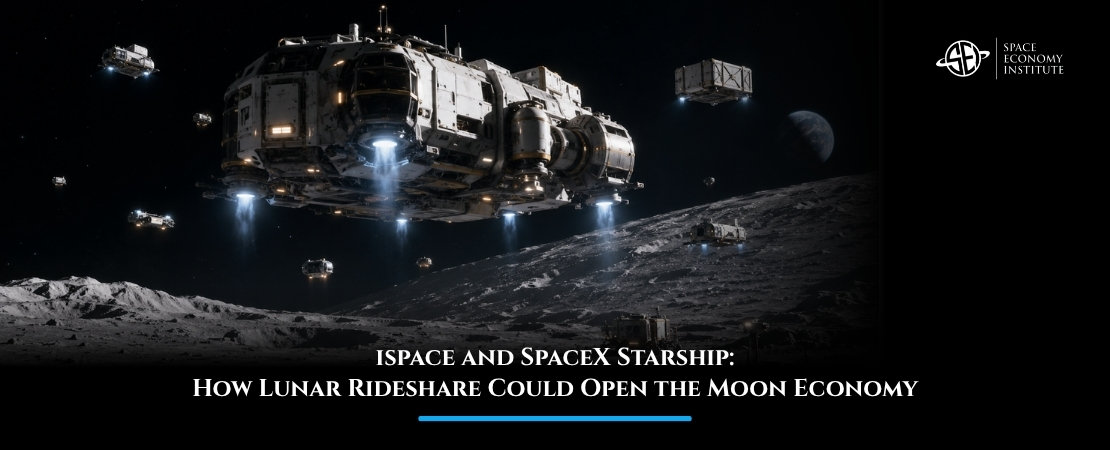
The Moon Is Becoming a Logistics Market
The commercial Moon economy is moving from ambition to infrastructure. On July 8, 2026, Japanese lunar transport company ispace announced a new low-cost cargo service using SpaceX’s Starship system. The idea is simple but powerful: instead of each customer funding a dedicated lunar mission, multiple payloads could share one ride to the Moon. This could turn lunar access into a more scalable logistics market.
From Lunar Landers to Lunar Access
Until recently, commercial lunar missions were mostly built around dedicated landers. A company would develop a spacecraft, sell payload slots, launch toward the Moon, and attempt a landing. This model is technically impressive, but economically difficult. Lunar missions are expensive, risky, and still relatively rare.
ispace knows this challenge directly. The company attempted lunar landings in 2023 and 2025, but both missions failed to reach a successful surface operation. Rather than retreating, ispace is adapting its business model.
Its new Starship-based service positions the company less as a single-mission lander operator and more as a lunar access integrator. That means ispace would help customers share transport capacity, manage payload integration, and support operations after arrival on the Moon.
This is an important shift. In the same way that rideshare launches made Earth orbit more accessible for small satellites, lunar rideshare could make the Moon more accessible for universities, startups, governments, mining technology companies, robotics firms, and research institutions.
The Starship Advantage
The economic logic depends heavily on Starship. SpaceX is developing Starship as a fully reusable heavy-lift system capable of carrying large payloads beyond Earth orbit. For lunar missions, Starship’s promise is scale: more mass, more volume, and potentially lower cost per kilogram than traditional lunar delivery systems.
ispace has reportedly purchased 500 kilograms of capacity for $50 million on a future Starship mission expected to land on the Moon as soon as 2030. That capacity would be shared among customers, with ispace developing a lunar surface vehicle to host and move payloads after landing.
This matters because payload delivery is only one part of the lunar economy. Once equipment reaches the surface, customers may need mobility, communications, power, thermal control, data relay, and operational support. The Moon is not just a destination; it is an environment that requires services.
Why Lunar Rideshare Matters
Lunar rideshare could reduce barriers for companies and institutions that cannot afford a full mission. Instead of buying an entire lander, customers could buy a smaller payload slot and access shared infrastructure.
The result could be a more diversified lunar market. Scientific instruments could share transport with robotics demonstrations. Mining sensors could fly alongside communications hardware. Universities could test technologies next to corporate payloads. National agencies could send experiments without building complete mission architectures from scratch.
This model also supports NASA’s Artemis ecosystem. NASA’s Commercial Lunar Payload Services program has already encouraged private companies to deliver scientific and technology payloads to the Moon. A lower-cost, shared lunar transport model could expand the number of actors able to participate in that ecosystem.
However, the risks remain significant. Starship still has to prove lunar landing operations at scale. ispace must demonstrate that it can manage integration, surface mobility, and reliable post-landing services. Customers will need confidence that payloads can survive launch, transit, landing, and lunar surface conditions.
A New Layer of the Space Economy
The ispace-Starship model points toward a broader transformation: the Moon economy will not be built only by landers. It will require logistics companies, surface mobility providers, power systems, navigation services, communication networks, data platforms, insurance, financing, and mission operations.
If lunar transport becomes more frequent and affordable, the market could move from one-off exploration missions to repeatable commercial services. That is when the Moon begins to look less like a symbolic destination and more like an emerging industrial frontier.
Conclusion
ispace’s Starship-based lunar rideshare service is still years away, but it represents a major strategic idea: lowering the cost and complexity of reaching the Moon through shared access. If successful, it could help turn lunar exploration into a real logistics economy.
If this topic is of interest, you can learn more about lunar logistics, commercial Moon missions, space transportation, and emerging space markets in the Master in Space Economy by the Space Economy Institute. Discover more about the Master and explore how the Moon is becoming the next platform for the space economy.