
Space-Based Data Centers: Why AI Infrastructure May Move Beyond Earth
- July 2, 2026
- Posted by: admin
- Category: Innovation
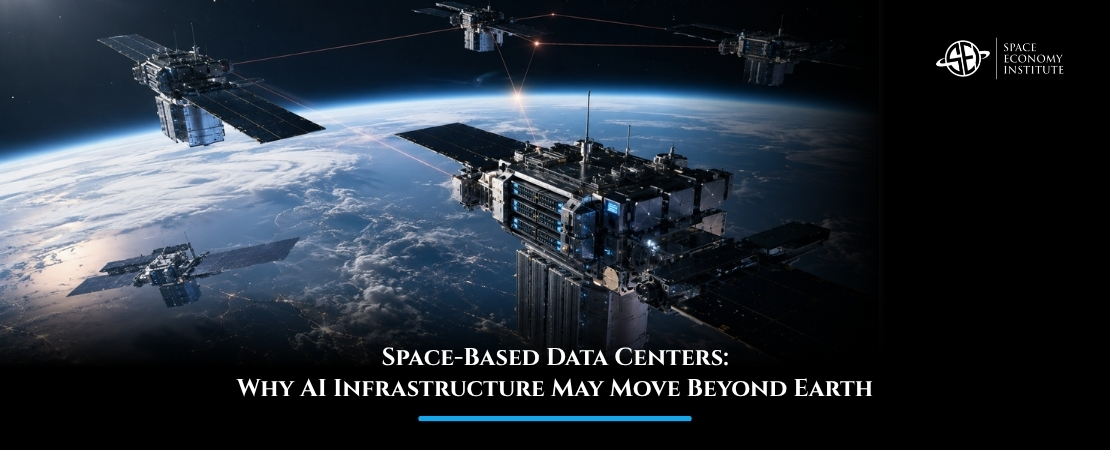
The AI Boom Is Looking Beyond Earth
Artificial intelligence is creating a new infrastructure problem on Earth: data centers require enormous amounts of land, electricity, cooling, chips, and grid capacity. As AI demand accelerates, some of the world’s most ambitious technology and space companies are asking a bold question: could part of the future computing stack move into orbit? In 2026, orbital data centers are shifting from science-fiction concept to serious space economy debate.
From Cloud Computing to Space Computing
Traditional data centers are built close to power sources, fiber networks, and major customers. But the AI boom is putting pressure on that model. Training and running advanced AI systems requires vast computing capacity, and terrestrial data centers increasingly face limits linked to energy availability, cooling, permitting, water use, and local environmental impact.
Orbital data centers propose a radically different architecture. Instead of building every computing facility on Earth, companies could place specialized computing satellites in low Earth orbit, powered by solar energy and connected through laser communications. These satellites could process data in space, support AI inference, reduce the need to downlink massive raw datasets, and eventually become part of a hybrid cloud infrastructure that combines terrestrial, edge, and orbital computing.
This does not mean all data centers will move to space. The strongest early use cases are likely to be space-native workloads: Earth observation, defense monitoring, satellite fleet management, lunar missions, and scientific data processing. In these cases, the data is already generated in orbit, so processing it there could reduce latency and transmission costs.
The SpaceX and Google Signal
The topic became especially hot in 2026 because SpaceX has reportedly presented orbital AI computing as part of its long-term growth story. The company has requested permission for up to one million space-based data-center satellites and aims to test orbital AI computing demonstrations by the end of next year. This is an aggressive vision: combining reusable launch, satellite manufacturing, solar power in orbit, inter-satellite links, and AI infrastructure into one vertically integrated system.
Google is exploring a related idea through Project Suncatcher, a research effort focused on networking solar-powered satellites equipped with AI chips into an orbital computing cloud. The reported plan includes a prototype launch with Planet Labs around 2027. Nvidia is also moving in this direction, with recent hiring linked to space-based AI systems and computing hardware designed for low Earth orbit conditions.
Together, these signals suggest that orbital computing is no longer just a niche academic idea. It is becoming a strategic frontier for companies that already dominate AI, cloud infrastructure, chips, and space systems.
The Technical Reality Check
The opportunity is exciting, but the obstacles are serious. Space is not an easy place to run computers. Radiation can damage electronics. Maintenance is difficult. Launch costs remain significant. Most importantly, cooling is harder than many people assume.
On Earth, data centers rely on air and liquid cooling systems that transfer heat into the surrounding environment. In the vacuum of space, heat cannot be removed by air convection. It must be radiated away, which requires large radiator surfaces. This creates design, mass, and cost challenges.
Networking is another bottleneck. AI systems depend on fast, reliable data movement. Orbital data centers would need robust optical links, ground stations, inter-satellite communications, and intelligent workload management. Without seamless connectivity, space-based computing could become slower and more expensive than terrestrial alternatives.
A New Market, Not a Complete Replacement
The most realistic future is not “data centers leave Earth.” It is a layered digital infrastructure where terrestrial cloud, edge computing, satellites, and orbital data centers work together. Space-based computing may become valuable for specific workloads where solar power, orbital vantage points, sovereignty, resilience, or proximity to satellite data creates a real advantage.
For the space economy, this could open major opportunities in radiation-hardened chips, thermal systems, laser communications, orbital servicing, launch, satellite manufacturing, cybersecurity, and space traffic management.
Conclusion
Orbital data centers are still early, but they represent one of the most ambitious intersections of AI and the space economy. If the model works, space could become part of the global computing infrastructure, not just a place for observation and communication.
If this topic is of interest, you can learn more about orbital data centers, AI infrastructure, satellite networks, and emerging space markets in the Master in Space Economy by the Space Economy Institute. Discover more about the Master and explore how computing, connectivity, and space infrastructure are converging.