
Greece’s Wildfire Satellites: The Rise of Space-Based Climate Intelligence
- June 26, 2026
- Posted by: admin
- Category: Innovation
A New Layer of Climate Security
Wildfires are no longer seasonal emergencies. They are becoming recurring national security, economic, and climate resilience challenges. On June 26, 2026, Greece’s new dedicated wildfire satellite system is drawing global attention because it shows how space technology can move from observation to operational crisis response. For the space economy, this is a powerful signal: Earth observation is becoming real-time climate intelligence.
From Watching Earth to Protecting It
For decades, Earth observation satellites helped scientists monitor forests, oceans, storms, ice sheets, and urban growth. The value was clear, but often indirect: better data, better maps, better historical analysis.
That model is now changing. Governments and companies increasingly need satellite systems that do not simply describe what happened, but help decide what to do next. Wildfire detection is a perfect example. A fire can grow from a small ignition point to a national disaster in minutes, especially during heatwaves, droughts, and strong winds.
This is where space-based climate intelligence becomes economically and socially valuable. Satellites equipped with thermal sensors can detect heat anomalies from orbit, while artificial intelligence can filter false alarms, prioritize alerts, and help emergency teams respond faster.
In this new model, the product is not only imagery. The product is actionable intelligence.
Greece’s Hellenic Fire System
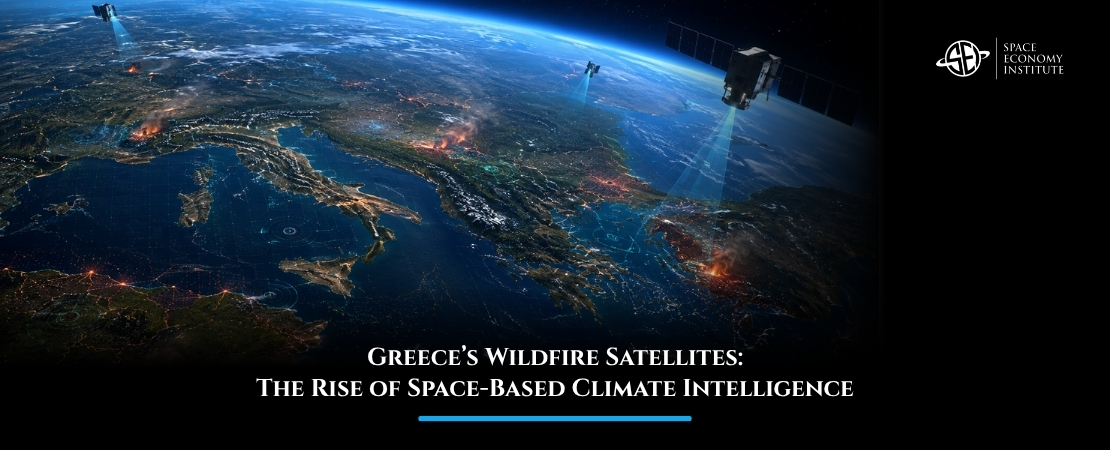
Greece has become the first country to integrate a dedicated wildfire-monitoring satellite constellation into its national firefighting system. Developed by German company OroraTech, the Hellenic Fire System consists of four small thermal satellites launched into low Earth orbit in May 2026.
The system is designed to monitor the entire Greek territory and detect early signs of fire, including very small blazes that traditional satellite systems may miss. This matters enormously in a country that has suffered devastating wildfire disasters, including the deadly 2018 fires near Athens and the record-breaking 2023 blaze in the Dadia forest.
The Hellenic Fire System is not just a scientific mission. It is operational infrastructure. Its goal is to give firefighters faster situational awareness, allowing them to identify ignition points, track fire spread, allocate aircraft and crews, and reduce response delays.
Why AI Makes the Business Case Stronger
The real innovation is not only the satellites, but the intelligence layer built around them. Thermal imagery creates value only when it can be processed quickly and reliably. AI helps convert raw heat signatures into useful alerts.
This is critical because emergency commanders cannot afford to chase false positives. Industrial heat sources, sunlight reflections, and temporary anomalies can all confuse basic detection systems. AI models can improve accuracy by combining satellite imagery with weather conditions, terrain, historical data, and known infrastructure.
The same approach can be applied beyond wildfires. Space-based climate intelligence can support flood monitoring, drought assessment, agricultural risk, urban heat mapping, border security, insurance analytics, and disaster recovery. That makes the market much larger than fire detection alone.
Europe’s Sovereign Space Opportunity
Greece’s satellite wildfire system also fits a broader European strategy: reducing dependence on foreign space infrastructure while developing domestic capabilities in Earth observation, AI, and crisis management.
This is especially important as climate change, geopolitical instability, and infrastructure vulnerability converge. Nations increasingly want sovereign access to satellite data and analytics. They do not want to depend entirely on external providers during emergencies.
For the space economy, this creates demand across the full value chain: satellite manufacturing, sensors, launch services, ground stations, AI analytics, cloud platforms, emergency management software, and public-sector procurement.
It also shows that space markets are becoming more practical. The next generation of space companies will not win only by launching satellites. They will win by solving urgent problems on Earth.
Conclusion
Greece’s wildfire satellite constellation shows how Earth observation is evolving into a real-time climate intelligence market. This is one of the clearest examples of how the space economy can create direct value for citizens, governments, and emergency services.
If this topic is of interest, you can learn more about Earth observation markets, satellite data analytics, climate intelligence, and public-sector space applications in the Master in Space Economy by the Space Economy Institute. Discover more about the Master and explore how space technology is becoming essential infrastructure for life on Earth.