
Commercial Space Stations: NASA’s Race to Replace the ISS
- June 19, 2026
- Posted by: admin
- Category: Innovation
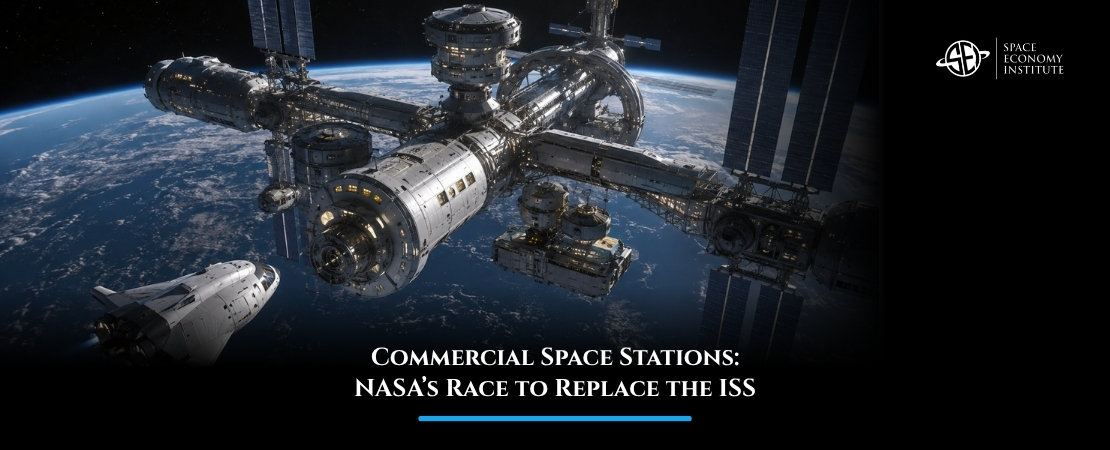
The future of human activity in low Earth orbit is entering a decisive phase. With the International Space Station approaching its planned retirement around 2030, NASA must determine whether privately owned commercial space stations will be ready in time. This is one of the most important questions in the space economy today because it will define how research, manufacturing, tourism, and government operations continue in orbit after the ISS.
Why the ISS Transition Matters
For more than 25 years, the International Space Station has been humanity’s main laboratory in low Earth orbit. It has supported microgravity research, technology testing, astronaut training, international cooperation, and commercial experiments that cannot be replicated on Earth.
But the ISS is aging. Maintaining it safely requires significant resources, and NASA’s long-term strategy is to shift from owning and operating a government platform to buying services from commercial providers. This model mirrors earlier successes in commercial cargo and crew transportation, where NASA became an anchor customer while private companies developed scalable space services.
The transition matters because a gap between the ISS and its successors would not be only symbolic. It could interrupt human research in microgravity, weaken U.S. leadership in low Earth orbit, and slow the development of commercial markets such as in-space manufacturing, biotechnology, pharmaceutical research, media production, and private astronaut missions.
The Rise of Commercial LEO Destinations
NASA’s Commercial LEO Destinations program is designed to support privately owned space stations that can serve both government and non-government customers. Several major concepts are competing in this emerging market, including Axiom Station, Starlab, Orbital Reef, and Vast’s Haven architecture.
These projects represent different visions of the same future: low Earth orbit as a commercial zone. Instead of one government-led laboratory, the next generation of stations could look more like orbital business parks, hosting research labs, manufacturing facilities, tourist missions, defense-related demonstrations, and international users.
The business logic is powerful but challenging. NASA is expected to remain the anchor customer, especially in the early years. Over time, commercial demand must grow enough to justify private investment. That is why the market is still uncertain. The technology is difficult, safety requirements are strict, and building habitable orbital infrastructure requires billions of dollars, long development timelines, and high confidence from investors.
NASA’s 2027 Decision Point
A new Government Accountability Office report released in June 2026 highlights the urgency of the moment. NASA is working with six U.S. companies to develop commercial stations, but the agency has not yet finalized its full acquisition approach. NASA is expected to make critical readiness decisions in 2027, including whether commercial stations can replace the ISS before retirement or whether the agency must consider extending ISS operations beyond 2030.
This is a strategic crossroads. If commercial stations are ready, NASA can accelerate the transition toward a service-based low Earth orbit economy. If they are delayed, NASA may face difficult budget and safety trade-offs: extend an aging ISS, accept a gap in human presence, or redesign its procurement approach.
The stakes go beyond NASA. Investors, suppliers, research institutions, launch providers, and international partners all need clarity. The commercial space station market cannot mature without predictable demand signals, technical requirements, and long-term public-private contracts.
Why This Is a Space Economy Story
Commercial space stations are not just infrastructure; they are market platforms. If successful, they could unlock new revenue streams in life sciences, materials research, human spaceflight, entertainment, sovereign astronaut programs, and orbital logistics.
They would also create demand for adjacent industries: crew transportation, cargo delivery, life-support systems, robotics, docking systems, spacesuits, in-orbit servicing, and space insurance. In this sense, replacing the ISS is not simply a NASA procurement challenge. It is a test of whether low Earth orbit can become a sustainable commercial ecosystem.
Conclusion
The commercial space station race is one of the defining space economy stories of 2026. NASA’s decisions over the next year will influence whether low Earth orbit becomes a true marketplace or remains dependent on government infrastructure. The winners will be companies that combine engineering reliability, financial discipline, and a credible long-term customer base.
If this topic is of interest, you can learn more about commercial space stations, low Earth orbit markets, and public-private space infrastructure in the Master in Space Economy by the Space Economy Institute. Discover more about the Master and explore how the next generation of orbital platforms will shape the future of the space economy.