
The Commercial Surge in Space: Post-Artemis II and the Road to a Trillion-Dollar Orbital Economy
- May 29, 2026
- Posted by: admin
- Category: Economics
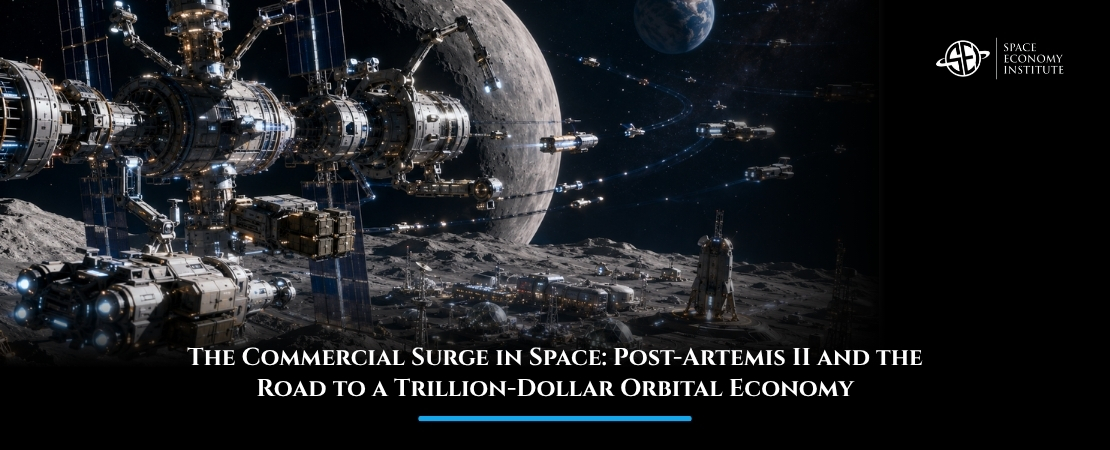
In April 2026, NASA’s Artemis II mission successfully completed humanity’s first crewed lunar flyby in over half a century. Four astronauts circled the Moon, testing deep-space systems and reigniting public imagination. Yet the real story unfolding in 2026 is not just governmental exploration—it is the explosive growth of the commercial space sector. The global space economy, valued at approximately $626 billion in 2025, is accelerating toward $1 trillion by the early 2030s, with nearly 80% driven by private activity. Satellite broadband, in-orbit services, and private investment are reshaping space from a domain of prestige projects into a vibrant economic engine.
The Megaconstellation Boom
Starlink remains the clearest symbol of this shift. By mid-2026, the constellation exceeds 10,000 active satellites, delivering broadband to millions and generating billions in revenue. SpaceX has conducted dozens of dedicated launches this year alone. Amazon’s Project Kuiper is ramping up deployments, while direct-to-device (D2D) capabilities promise to connect ordinary smartphones from orbit.
These networks are lowering connectivity costs dramatically, enabling applications from maritime logistics and aviation to remote education and disaster response. Downstream revenue from satellite services now dominates the space economy, outpacing traditional upstream manufacturing and launch activities. Competition is intensifying, driving innovation in satellite design, spectrum management, and user terminals.
Artemis II as Catalyst
Artemis II demonstrated reliable crewed deep-space operations and validated Orion’s heat shield and life-support systems under real lunar conditions. While the landing is now targeted for later missions, the flyby success de-risks commercial involvement. Private companies are already positioning for lunar infrastructure: communications relays, navigation beacons, and cargo delivery services.
This government-led validation creates demand signals that private capital can confidently answer. In-space refueling demonstrations, orbital debris removal, and satellite servicing missions (e.g., by Astroscale and Orbit Fab) are moving from concept to contract. The orbital economy—manufacturing, data centers, and logistics—is no longer science fiction.
Investment and IPO Momentum
Private investment rebounded strongly in 2025 and continues into 2026, fueled by defense needs, AI infrastructure, and launch capacity. SpaceX’s anticipated IPO, potentially targeting a massive valuation, could unlock liquidity and mainstream investor interest. Other players like Vast (private space stations) and various satellite servicing firms have closed nine- and ten-figure rounds.
Challenges persist: orbital congestion, sustainability, regulatory harmonization, and turning rapid growth into consistent profits. Yet the trajectory is clear. Reusability has slashed launch costs, miniaturization enables affordable constellations, and AI optimizes operations at scale.
Conclusion
The success of Artemis II marks not just a return to the Moon but a handoff to commercial momentum. As governments focus on exploration and strategic capability, private enterprise is building the economic backbone: ubiquitous connectivity, in-orbit services, and future lunar and cislunar markets. For businesses, investors, and policymakers, the message is urgent—space is no longer a frontier; it is becoming critical infrastructure for the 21st-century economy. Those who engage now will shape the multi-trillion-dollar opportunity ahead. The orbital economy is open for business.