
The Dawn of the In-Orbit Economy: From Mega-Constellations to Space-to-Space Commerce
- May 26, 2026
- Posted by: admin
- Category: Innovation
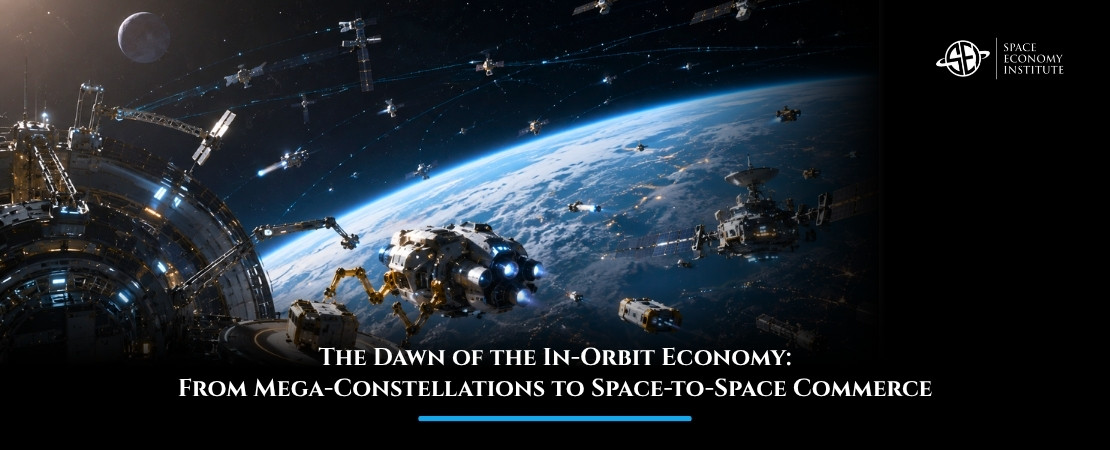
The global space economy has officially crossed a historic threshold, surpassing $600 billion in value. This growth is fueled largely by commercial activity, which now accounts for over three-quarters of the total. As of mid-2026, with recent Starship test flights demonstrating progress toward full reusability, the industry is transitioning from Earth-to-space delivery to a true in-orbit ecosystem. This shift promises to unlock new markets in servicing, manufacturing, and resource utilization.
The Mega-Constellation Backbone
Satellite mega-constellations remain the primary engine of growth. Starlink, Kuiper, and emerging sovereign networks continue to deploy thousands of satellites, delivering broadband, Earth observation, and direct-to-device connectivity. These systems generate substantial revenue through communications and positioning services while creating demand for orbital infrastructure.
Recent Starship Flight 12 (May 22, 2026) tested Version 3 hardware, advancing capabilities for launching larger payloads more efficiently. This is critical: Starship’s high cadence and capacity could dramatically lower costs for constellation replenishment and expansion.
In-Space Servicing and Logistics Emerge
A key evolution is the move toward a “space-to-space” (S2S) economy. Rather than relying solely on frequent launches from Earth, operators are investing in on-orbit refueling, repair, and assembly. Astroscale’s Provisioner spacecraft, slated for a 2026 mission to refuel U.S. Space Force assets, exemplifies this.
In-space logistics reduces dependency on terrestrial supply chains and mitigates debris risks. Companies are exploring orbital data centers, manufacturing platforms, and even fuel depots. AI-driven autonomous operations will manage traffic, optimize resources, and enable complex maneuvers in crowded orbits.
Sustainability and Lunar/Deep-Space Ties
Sustainability is no longer an afterthought. With growing orbital congestion, technologies for active debris removal and responsible end-of-life practices are gaining traction. Meanwhile, the Moon serves as a proving ground: commercial lunar landers and plans for resource extraction (water ice for propellant) are laying foundations for cislunar infrastructure.
The Artemis program and private initiatives signal a future where the Moon acts as a logistics hub, supporting deeper space ambitions while creating Earth-return markets for rare materials.
Challenges on the Horizon
Regulatory harmonization, spectrum management, and investment volatility remain hurdles. Private funding has fluctuated, but defense-driven demand and government-commercial partnerships provide stability. The projected growth to $1 trillion+ by the mid-2030s hinges on solving these coordination issues.
Conclusion
The in-orbit economy is moving from concept to reality. Starship’s maturation, combined with servicing missions and constellation scale, is accelerating a virtuous cycle: lower costs enable more activity, which drives innovation and investment. For businesses, governments, and citizens, this means enhanced connectivity, new scientific frontiers, and economic opportunities that extend humanity’s industrial base beyond Earth. The next decade will determine whether space truly becomes a seamless extension of our global economy—or remains a high-stakes frontier. Stakeholders who invest in sustainable, collaborative infrastructure today will shape tomorrow’s orbital marketplace.