
Building the Space-to-Space Economy: The Next Frontier Beyond Earth Launch
- May 25, 2026
- Posted by: admin
- Category: Economics
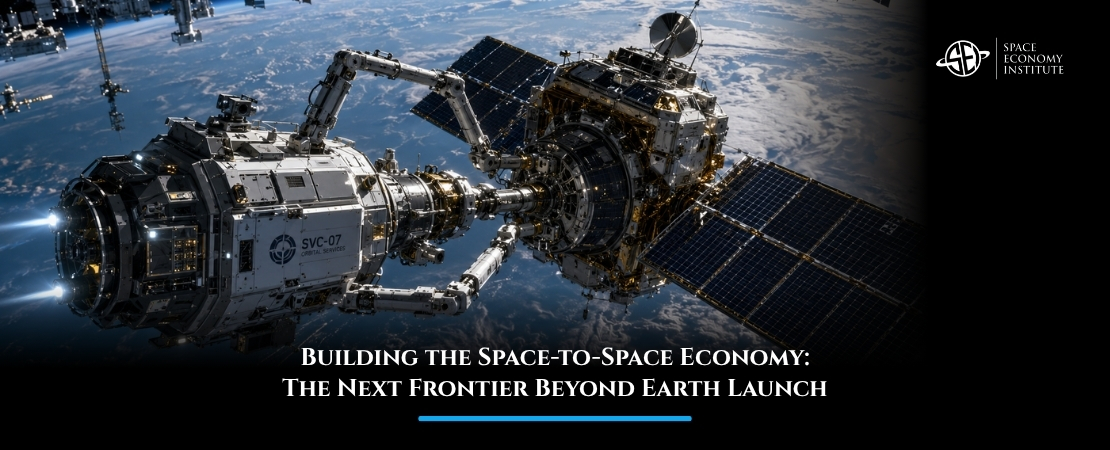
In May 2026, the global space economy hovers around $600–650 billion, with commercial activities driving roughly 75–78% of value. While launch costs have plummeted thanks to reusable rockets, a critical bottleneck remains: everything still depends on frequent trips from Earth’s surface. A new paradigm is emerging—the space-to-space (S2S) economy—where satellites are serviced, refueled, assembled, and even manufactured in orbit. This shift promises to unlock exponential growth by treating space as a self-sustaining industrial environment rather than a remote outpost.
Why On-Orbit Services Matter Now
Recent milestones highlight accelerating momentum. Astroscale U.S. is preparing its Provisioner spacecraft for a summer 2026 launch to refuel two U.S. Space Force satellites—the first operational on-orbit refueling demonstration for national security assets. This capability directly addresses the “satellite deployment bottleneck” that persists even with Starship’s promised high cadence.
Companies like Northrop Grumman (with its Mission Extension Vehicles) and emerging players are proving that extending satellite life by years through docking and refueling is not only technically feasible but commercially viable. For operators of expensive GEO satellites or critical LEO constellations, this translates to billions in preserved asset value and deferred replacement costs.
Megaconstellations Drive Demand
Starlink’s rapid expansion (over 10,000 satellites operational) and Amazon’s Project Kuiper (hundreds launched and scaling aggressively) create massive demand for maintenance infrastructure. Traditional models require deorbiting old satellites and launching replacements—a wasteful cycle. On-orbit servicing enables satellite upgrades, repositioning, and debris mitigation, making megaconstellations more sustainable and economical.
From Servicing to Manufacturing
The long-term vision extends further. In-space manufacturing and resource utilization (ISRU) could use lunar regolith or asteroid materials for propellant, solar arrays, or structural components. Early asteroid mining efforts by AstroForge and others, with follow-on missions planned for 2026, aim to demonstrate extraction of platinum-group metals and water ice. Water can be split into hydrogen and oxygen for fuel—creating orbital “gas stations.”
Challenges and Policy Needs
Technical hurdles remain: precise rendezvous and docking in varying orbits, radiation-hardened robotics, and standardized interfaces. Regulatory frameworks for liability, intellectual property, and traffic management in crowded orbits are underdeveloped. International coordination will be essential to prevent conflicts in this new commons.
Investment is flowing, but private capital must pair with government anchoring (e.g., NASA and Space Force contracts) to de-risk technologies.
Conclusion
The transition to a mature space-to-space economy could multiply the sector’s value manyfold by reducing Earth dependency and enabling truly exponential infrastructure growth. For businesses, it means lower costs and new revenue streams; for humanity, it paves the way for sustainable lunar bases, Mars missions, and a thriving orbital economy. As Astroscale’s 2026 mission demonstrates, the building blocks are falling into place today. The winners in the space economy of 2030+ won’t just be the best launch providers—they’ll be the masters of operations in orbit. Readers should watch this space closely; the next industrial revolution may not happen on Earth, but above it.