
Earth Observation 2026: $8.7 Billion Market Delivers Real-Time Planetary Intelligence
- May 2, 2026
- Posted by: admin
- Category: Innovation
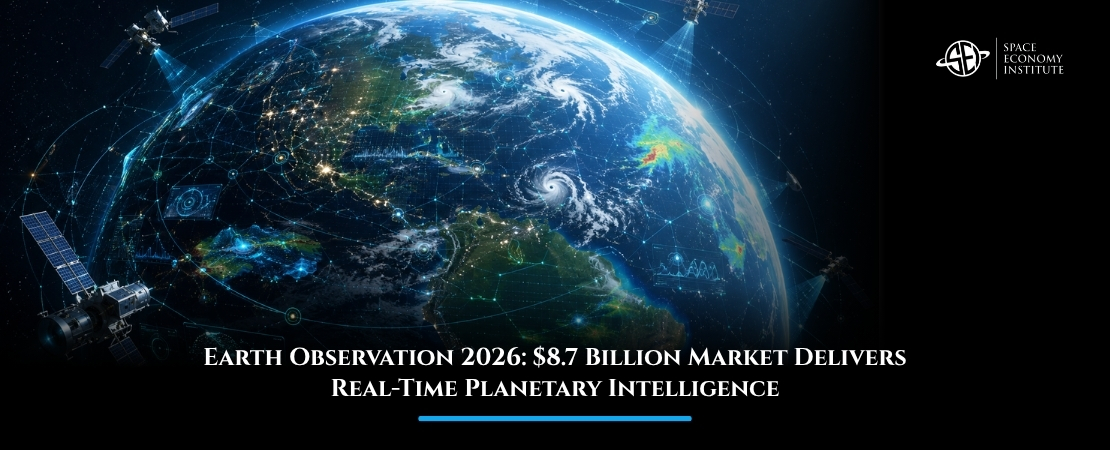
May 2026 has cemented Earth observation as the most mature and commercially vital segment of the space economy. More than 1,240 dedicated EO satellites—spanning optical, radar, hyperspectral, and thermal sensors—now generate over 18 petabytes of data daily, serving 4.2 million paying users across agriculture, insurance, defense, climate science, and urban planning. The market has hit $8.7 billion at a 92% CAGR, driven by AI-powered analytics platforms that turn raw imagery into actionable insights within minutes. What began as government reconnaissance has evolved into a subscription-based intelligence service, where orbital data directly influences trillion-dollar decisions on food security, disaster response, and net-zero transitions. Earth observation is no longer just pictures from space—it is the planet’s operational dashboard.
Satellite Fleet Expansion and Technological Leap
Constellations from Planet Labs, Maxar, ICEYE, and emerging players like China’s Gaofen and India’s EOS-08 have achieved daily global revisit rates under 30 minutes. Synthetic aperture radar (SAR) fleets from ICEYE and Umbra now operate 24/7 regardless of clouds or darkness, while hyperspectral sensors from Orbital Sidekick detect methane leaks and crop stress at 5-meter resolution.
On-board edge AI processes 87% of imagery in orbit, slashing downlink costs and enabling real-time alerts. Reusable launch economics have dropped sensor costs to under $120 per kilogram, allowing operators to refresh fleets every 18–24 months while maintaining 99.6% uptime.
Key Applications and Economic Impact
Agriculture leads revenue at 29%, with precision farming platforms using EO data to boost yields by 12–18% and cut water use by 22%. Insurance firms process 1.4 million claims quarterly via automated damage assessment, saving $3.2 billion annually in payouts. Climate and environmental monitoring account for $2.1 billion, powering carbon-credit verification and biodiversity tracking for ESG compliance.
Disaster response and maritime domain awareness have seen explosive adoption: after recent Pacific typhoons, EO-derived flood maps reached first responders in under 11 minutes. New verticals such as supply-chain visibility and renewable-energy site optimization added $1.4 billion in high-margin contracts this quarter.
Market Dynamics, Regulation, and Data Sovereignty
Subscription models now dominate, with Planet’s daily imagery plans and Maxar’s analytics suites commanding 68% of revenue. Data marketplaces like Airbus’s OneAtlas and Google’s Earth Engine integrate EO feeds into enterprise workflows, creating downstream multipliers estimated at $65 billion.
Regulatory progress includes the EU’s Earth Observation Data Regulation, mandating open-access archives for climate applications, while the U.S. and allies have tightened export controls on high-resolution SAR. Data sovereignty rules in 37 countries require local ground stations, spurring $920 million in regional infrastructure investment. Competition is healthy: U.S. firms hold 51% share, but Asia-Pacific constellations are closing the gap through cost leadership.
Why This Matters for the Future
Earth observation in 2026 has proven that space-based data is indispensable infrastructure for a sustainable, data-driven global economy. The $8.7 billion market today is not merely selling pixels—it is enabling better decisions that protect lives, optimize resources, and accelerate the green transition at planetary scale.
For governments, businesses, and citizens, the view from orbit is unmistakable: real-time intelligence is now a competitive necessity. The satellites overhead this month are delivering insights that shape tomorrow’s food systems, cities, and climate strategies. What starts as daily global monitoring today becomes the foundation for predictive planetary management tomorrow—turning space into humanity’s most powerful tool for understanding and stewarding our home world.