
Artemis II: why returning to the Moon is more difficult than 50 years ago
- February 12, 2026
- Posted by: admin
- Category: Emilio Cozzi
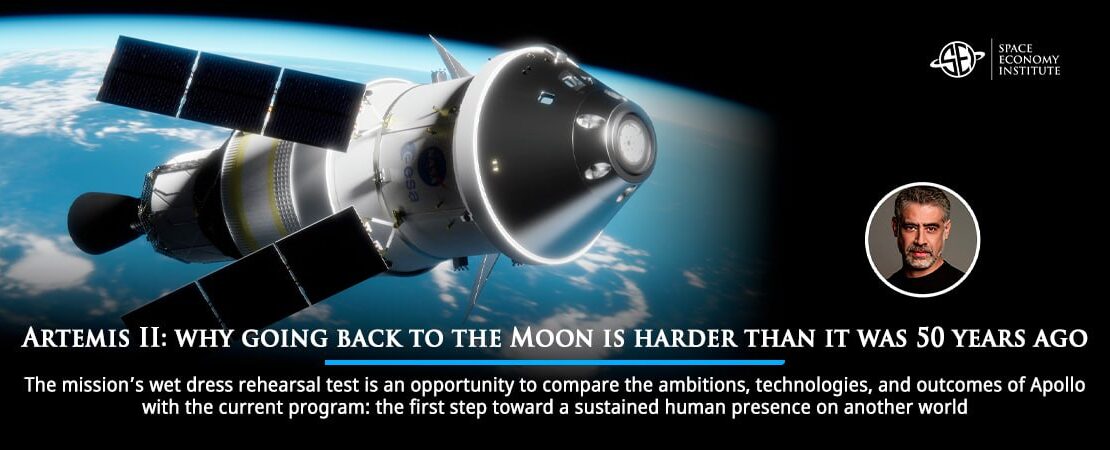
The mission’s wet dress rehearsal test is an opportunity to compare the ambitions, technologies, and outcomes of Apollo with the current program: the first step toward a sustained human presence on another world.
BY EMILIO COZZI
It is one of the questions regularly asked of those who work on or are simply passionate about space: how is it possible that more than half a century after Apollo 11, with all the technological advances in propulsion, materials, and computing power, we are still struggling to return humans to the Moon? The issue was reignited by the recent postponement of Artemis II, the second mission of the new U.S. lunar program and the first scheduled to launch a crew toward our natural satellite since December 1972.
The problematic dress rehearsal
Between February 2 and 3, Italian time, Nasa conducted the Artemis II wet dress rehearsal at Launch Complex 39B of the Kennedy Space Center. This is a rigorous launch simulation, including the full fueling of the rocket and the execution of all procedures up to just before engine ignition.
The test did not go as planned. During the fast fill phase of the central stage tank of the Space Launch System, sensors detected hydrogen leaks at the tail service mast umbilical interface, the connection point between the rocket and the launch tower. Operations were suspended twice, and although the leaks were stabilized within acceptable limits and the wet dress rehearsal resumed, the countdown was ultimately halted at T-5:15, when the hydrogen leak again exceeded allowable limits during the final phase.
“With more than three years between one SLS launch and the next, we expected to encounter difficulties,” said Nasa Administrator Jared Isaacman. “That is exactly why we conducted a dress rehearsal. These tests are designed to identify potential problems before flight.”
Shortly after the test, Nasa canceled the February launch window, which would have closed on the 11th, and moved the target to March 7 to 11, each day with approximately 120 minutes of launch opportunity. A second wet dress rehearsal must be successfully completed before final clearance.
A problem already seen
The déjà vu is inevitable. During the Artemis I campaign in 2022, similar hydrogen leaks contributed to a six-month delay and forced multiple wet dress rehearsal repetitions before the launch, which eventually took place on November 16. At that time, Nasa implemented specific hardware and procedural changes to prevent the problem from recurring.
“This caught us by surprise,” admitted John Honeycutt, chair of the Artemis Mission Management Team, during the February 3 press conference. “The liquid hydrogen connector interface is very complex. When dealing with hydrogen, a small and highly energetic molecule, even tiny imperfections or debris can cause leaks.”
The crucial difference between Artemis I and II is that this time, at the top of the launch system, there are four humans: Reid Wiseman, Victor Glover, and Christina Koch from Nasa, and Jeremy Hansen, an astronaut from the Canadian Space Agency. Glover will be the first Black astronaut, Koch the first woman, and Hansen the first non-American to leave low Earth orbit and venture into deep space, beyond the Moon.
Aside from the records, it is important to note the substantial differences between the first lunar program and the current one.
Apollo and Artemis: different goals, budgets, and risk culture
While Apollo was a sprint driven by the spirit of the Cold War, Artemis is a far more ambitious technological marathon. Between 1969 and 1972, six Apollo missions took twelve astronauts to the Moon for brief stays. The Apollo 11 mission, the first historic human lunar landing, took Neil Armstrong and Eugene Buzz Aldrin to spend just two hours and thirty-two minutes on the lunar surface. At that time, the record was set by Apollo 17, which remained on the Moon for three days. The main objectives of the program were to demonstrate technological superiority, plant a few flags, collect samples, and return home.
Artemis completely reverses this philosophy. The program aims to establish a sustainable and prolonged presence on the Moon in order to lay the foundation for building a lunar economy and, ultimately, to learn how to travel beyond the Moon, toward Mars first. These are no longer brief visits, but the creation of permanent infrastructure.
The approach is also different in terms of cadence. Apollo achieved six landings in three years and then stopped. Artemis plans missions roughly once a year. Where Apollo sought prestige, Artemis seeks sustainability. It is the same difference as between tourism and settlement.
Despite the goal being far more difficult to achieve and the technological complexities much higher, NASA follows an extremely conservative approach. Every system must be meticulously verified before a crewed flight, and anomalies must be completely resolved before the countdown can proceed. This is an approach that tolerates no defects, forged through tragedy.
The numbers, in fact, evoke more than one drama, and not only related to the lunar program. Seventeen NASA astronauts have died on missions or during tests: in addition to the three of Apollo 1, Gus Grissom, Ed White, and Roger Chaffee, in 1967 during a ground test, there were the seven Challenger shuttle victims, including Christa McAuliffe, a teacher selected to conduct experiments and lessons in orbit, in 1986, and the seven astronauts of the Columbia shuttle, including Kalpana Chawla, Rick Husband, and Laurel Clark, in 2003. These are names engraved in the memory of the agency and the public.
The funding issue
The other substantial difference is economic. In 1966, at the height of the first Moon race, NASA’s budget reached 4.41 percent of total federal spending. The Apollo program ultimately cost about 290 billion dollars in today’s terms. For fiscal year 2026, NASA’s budget is 24.4 billion dollars, equal to 0.35 percent of federal spending. In percentage terms, this is one tenth of what it was half a century ago.
The Space Launch System itself is a product of this financial reality. The launch system uses technologies derived from the Space Shuttle. The RS 25 engines on the first four SLS flights are the same ones that flew on the shuttle. It also incorporates components developed for the Constellation program, which was canceled in 2010. Critics sarcastically call it the Senate Launch System, referring to the bipartisan support in Congress motivated by industrial contracts distributed across many states.
The result is staggering costs. According to NASA’s Office of Inspector General report in 2022, each of the first four Artemis launches will require 4.1 billion dollars solely for the construction of the vehicle and ground operations. Development costs are excluded and must be spread over the number of units actually launched. Subsequent estimates indicate that the cost per launch of the SLS alone will remain above 2 billion dollars for the next ten flights. By comparison, a SpaceX Falcon Heavy, with two thirds the payload capacity of the SLS Block 1 used for Artemis II, costs approximately 150 million dollars per launch. It should also be remembered that the SLS has flown only once. This uniqueness makes it difficult to optimize operational procedures.
The still unresolved problems
Beyond hydrogen leaks, Artemis I revealed a concerning anomaly involving unexpected erosion of the Orion capsule heat shield during atmospheric reentry. The shield is built from Avcoat, an ablative material that is supposed to wear away in a controlled manner. During reentry at about 40 thousand kilometers per hour, the material eroded more irregularly and intensely than expected.
NASA identified the main cause as a combination of reentry trajectory and material permeability. For Artemis II, rather than modifying the Avcoat, which would have further delayed the mission, the decision was made to change the reentry trajectory in order to reduce thermal stress. Reid Wiseman, commander of Artemis II, admitted that the delays have been agonizing. He explained that the priority was to understand the root cause and that the agency took the time necessary. He also emphasized that the process was transparent, including for the crew.
The race against time and against China
The postponement of Artemis II to March or April has a domino effect. Artemis III, the mission tasked with returning humans to the Moon, is officially scheduled no earlier than 2028. The latest official timeline mentions September. Artemis III does not depend only on the SLS and the Orion capsule. It also requires the lander, the vehicle that will transport two astronauts to the surface.
NASA awarded its development to SpaceX with a 2.9 billion dollar contract signed in 2021. Starship, the vehicle currently in testing by Elon Musk’s company, employs technologies and operations that have never been demonstrated and are highly complex. One of the main challenges is refueling in Earth orbit with cryogenic propellant. To reach the Moon with enough propellant to land and return, the modified version of Starship called Moonship will need to be refueled in orbit by an estimated ten to twelve tanker launches.
According to internal SpaceX documents obtained by Politico in November 2025, the company expects the first orbital refueling demonstration between two Starships to take place in June 2026. One year later, in June 2027, SpaceX has scheduled an uncrewed demonstration lunar landing. In September 2028 there would be the first opportunity for a crewed mission. These timelines have not yet been agreed upon with NASA and would still fall beyond the original plan even if respected.
In October 2025, NASA’s acting administrator Sean Duffy publicly discussed SpaceX’s delays and announced the reopening of the contractual competition for the Artemis III Human Landing System. Blue Origin and any company able to guarantee results within eighteen months were invited to submit proposals.
Jeff Bezos’s space company already has a 3.4 billion dollar contract signed in May 2023 to provide the Blue Moon Mark 2 lander for Artemis V, scheduled for 2030. According to Eric Berger of Ars Technica, Blue Origin is working aggressively and independently on an alternative solution for Artemis III based on the simpler Blue Moon Mark 1, which does not require orbital refueling. The Mark 1 is already in advanced production, with the first unit completed in October 2025.
If Blue Origin were to quickly qualify the Mark 1 for human flight, it could achieve the first human lunar landing of this century before SpaceX. In that specific case, it would represent a serious setback for Musk’s company and for its iterative development approach.
The geopolitical stakes
The rivalry between the two space billionaires is not the only lunar competition underway, nor is it the most significant. Behind the technical and economic calculations lies a geopolitical race. China has officially announced the goal of sending taikonauts to the Moon by 2030, targeting a landing at the South Pole, the same region planned for Artemis III. The successes achieved in several tests last summer have led many experts to speculate that Beijing could reach the goal as early as 2028.
Bill Nelson, former NASA administrator who was replaced by Isaacman in January 2025, repeatedly stated that the United States must arrive first. He warned that China could attempt to establish norms and practices on the Moon that might include denying other nations access to certain areas. The Trump administration has made lunar exploration a priority, aiming for a United States landing before the end of the presidential term in January 2029. At present, it is a race against time.
If the second wet dress rehearsal is successful and no further anomalies emerge, Artemis II could launch between March and April. The mission would send four astronauts on a roughly ten day circumlunar flight, farther from Earth than any human has ever traveled. However, before human footprints are seen again on another world, it will likely be necessary to wait until at least 2028 and possibly longer. Technical issues with the SLS, high costs, Starship delays, and competition from China create a complex picture.
More than fifty years after Apollo 11, returning to the Moon has proved far more difficult than many imagined. The challenge does not stem from a lack of technology or expertise, but from a combination of unprecedented objectives, reduced funding, extremely high safety standards, and tight political timelines.
The Moon remains at an average distance of 384,400 kilometers. The road to reach it, however, now seems much longer.