
SpaceX: one million satellites (and the merger with xAI) to power artificial intelligence
- February 5, 2026
- Posted by: admin
- Category: Emilio Cozzi
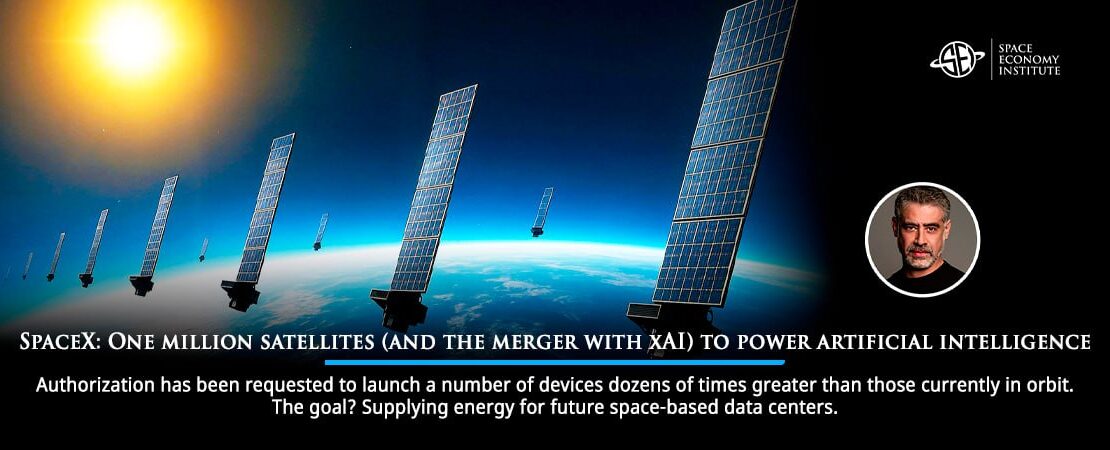
Authorization has been requested to launch a number of devices dozens of times greater than those currently in orbit. The goal? Supplying energy for future space-based data centers.
BY EMILIO COZZI
At present, around the Earth, roughly 15,000 satellites are in orbit.
On January 30, SpaceX asked the Federal Communications Commission (FCC) for permission to launch up to one million satellites in low Earth orbit alone, dozens of times more than those that already occupy it.
Far from science fiction, the official request marks a change of pace, one that is not necessarily positive. It puts in black and white SpaceX’s intention to use communication frequencies and tests the reaction of the FCC and of public opinion.
What Elon Musk wants to build in space is a vast network of datasets and computing centers for the processing required for artificial intelligence to function. On Earth, these infrastructures are multiplying in number and power, with alarming consequences. Now within reach of billions of people, AI is rapidly reaching monstrous energy costs.
“Orbital data centers are the most efficient way to meet the rapidly growing demand for computing power for artificial intelligence,” reads the introduction to the application submitted by SpaceX to the FCC. For this reason, Musk aims to move these technologies beyond the atmosphere. The advantage, as always, is energy and money.
Far from Earth, for Earth
The idea is not new. For some time, researchers have been studying how to build gigantic photovoltaic plants beyond the sky and then transfer the collected, green energy back to Earth. The concept, however, still needs to mature. Bringing that energy, for example via microwaves, from an orbit thousands of kilometers away remains a technological challenge yet to be overcome. So why not move the devices directly into orbit? In fact, this has been happening for decades. Satellites are observers, antennas, probes, each with its own computer, and they already exploit solar energy. The challenge lies in thinking bigger.
“By directly harnessing near constant solar energy with minimal operational and maintenance costs, these satellites will deliver revolutionary energy and cost efficiency, while significantly reducing the environmental impact associated with terrestrial data centers,” SpaceX writes.
These words show how, despite environmental issues not being among the priorities of the MAGA political agenda, the speed at which resources are being consumed to cool servers and computing centers leaves no one indifferent. Alongside this comes the promise of an economic benefit in the medium to long term.
Kardashev II
As usual, Musk aims high. “The launch of a constellation of one million satellites functioning as orbital data centers is the first step toward achieving a Kardashev Type II civilization, capable of fully harnessing the energy of the Sun, while supporting artificial intelligence based applications for billions of people today and ensuring a multiplanetary future for humanity among the stars.”
Conceived by the Russian astronomer Nikolai Kardashev, whose name it bears, the scale classifies the level of technological development of a civilization based on the amount of energy it is able to use. The second level indicates a civilization capable of exploiting all the energy of its star.
SpaceX aims to reach this goal by launching satellites at altitudes between 500 and 2,000 kilometers, with a primary inclination of 30 degrees in heliosynchronous orbits. An interlink will allow data exchange across the constellation and with the Starlink network, which will provide bandwidth to and from ground stations.
On the shoulders of Starship
When it comes to logistics, there is little doubt. A high launch frequency and a super heavy launcher are required, something like Starship, capable of carrying into space “millions of tons per year.” At least in the mind of its creator, Starship, which promises to be the first fully reusable launch system in history, represents the near future of SpaceX.
Once fully operational, according to Musk, “Launching one million tons per year of satellites generating 100 kW of computing power per ton would add 100 gigawatts of AI computing capacity per year, with minimal operational or maintenance requirements. Freed from the constraints of terrestrial deployment, within a few years the lowest cost way to generate AI computation will be in space.”
An important piece of the puzzle should not be overlooked. To finance the goal, which has become SpaceX’s main objective at least in the medium term, the merger with xAI, another Musk company founded to advance artificial intelligence, is now official. This is in view of a stock market listing that could set a record for an initial public offering and push SpaceX’s valuation to around 1.5 trillion dollars, but above all could raise 50 billion dollars in funding, to be invested also in the orbital data center project.
Other environmental issues
Beyond technological limits, SpaceX’s request has already sparked inevitable protests, because it is hard to believe that the environmental issue can be resolved so quickly. On the contrary, orbital congestion could extend the problem beyond the sky. Already today the issue is beginning to manifest itself insistently, and addressing it to avoid collisions and the proliferation of space debris implies significant resources from companies and public bodies.
For its part, SpaceX specifies that the satellites will use “advanced automated collision avoidance systems for risk assessment and low latency response, as well as agile and highly reliable electric propulsion systems that enable precise and efficient maneuvers.” The company also plans to adopt cutting edge solutions to mitigate satellite brightness and avoid compromising scientific observations from Earth.
It should not be forgotten, however, that SpaceX is not the only one ready to scatter thousands of devices in space. At the end of December, China presented to the International Telecommunication Union its plans for two constellations comprising almost 200,000 satellites in total. And while, compared to these numbers, the rest may seem marginal, the number of countries, companies, and research centers intending to send satellites into orbit continues to grow.
It is therefore worth returning to one point. Starship can carry a payload with a mass between 100 and 150 tons and is fully reusable, meaning it retains propellant to return and, after refueling, fly again. Putting one million tons into orbit per year, as SpaceX writes, means assuming at least 6,600 launches in 12 months, 550 launches per month, and more than 18 per day, every day.
Perhaps yes. For now, with all due respect to Musk, the idea remains science fiction.