
The new race for reusable rockets
- December 25, 2025
- Posted by: admin
- Category: Emilio Cozzi
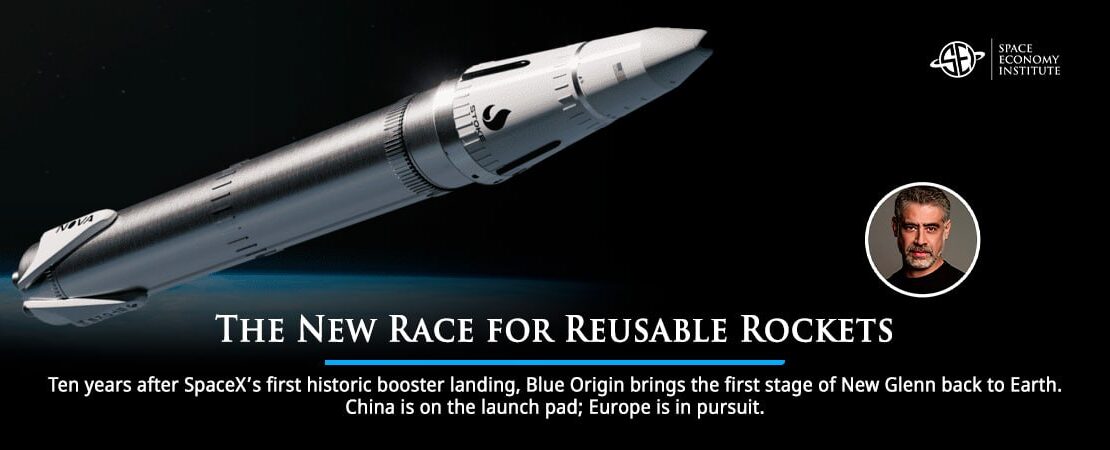
Ten years after SpaceX’s first historic booster landing, Blue Origin brings the first stage of New Glenn back to Earth. China is on the launch pad; Europe is in pursuit.
BY EMILIO COZZI
On December 21, 2015, just a few minutes after liftoff, the first stage of a Falcon 9 launch vehicle from the then not so well known Space Exploration Technologies Corporation touched down again on Landing Zone 1 at Cape Canaveral Space Force Station in Florida, gently hitting an X painted on the black asphalt.
It had never happened before that, after launch, a space rocket would come back and land.
Space Exploration Technologies Corporation, which the world was learning to know as SpaceX, showed the way by effectively inaugurating another space race. From that moment the paradigm of access to space would change, and reaching orbit would no longer be the only objective. The reliability of launch vehicles would be measured together with their long term sustainability and launch frequency. Securing a solid supply chain of space rockets capable of returning to the ground to fly again and again would become a strategic priority.
It nevertheless took a decade before someone else replicated the feat of Elon Musk company. It was Jeff Bezos, with the booster of the new heavy launcher New Glenn, on the second attempt. Two decades to confirm how the reuse of space launch vehicles was not, and is not, a futuristic whim of billionaires obsessed with space. On the contrary, the new economics of the sector is based on transport services that are not only reliable but increasingly on demand.
There is a need to launch smaller payloads and much more often. The record for annual launches is broken every year, and 2025 will confirm the trend. Throwing away an entire rocket every time is a habit to abandon.
So far SpaceX has managed it by reusing at least one part, the Falcon 9 boosters, although with Starship it promises to create the first fully reusable vehicle in the history of spaceflight.
Meanwhile, to know who will be next, one has to look to China.
Beijing on the launch pad
In recent days two strong signals have come from the orbital debuts of the Zhuque 3 by LandSpace, the first large Chinese launch vehicle designed for first stage recovery, and of the Long March 12A, also known as CZ 12A. The flight of Zhuque 3 achieved its main objective, namely orbital insertion, but recovery failed due to an anomaly in the final phase of the landing burn.
A similar outcome occurred for Long March 12A, whose reusable version is developed by the Shanghai Academy of Spaceflight Technology, known as Sast, a subsidiary of the state giant Casc. After apparently reaching orbit successfully, the first stage of the rocket crashed into the ground while attempting a controlled return.
Full success would have been an epoch making event. Instead these were only two exceptional events, confirming that today Beijing still does not possess the technology of SpaceX and Blue Origin.
Despite the loss of the boosters, the complete return profile, at least for Zhuque 3, was validated. The launch vehicle survived atmospheric descent, demonstrated guidance and aerodynamic control capabilities comparable to those of Falcon 9, and made Zhuque 3 the most advanced private project in the launcher segment in all of China, and in the global context, especially outside the United States.
Another Chinese private company, iSpace, is also active with Hyperbola 3, around which it is building an entire reuse cycle, including a dedicated maritime recovery vessel called Xingji Guihang and a factory for advanced assembly and testing of onboard systems.
The first orbital flight with recovery is scheduled for 2026.
Space Epoch successfully tested its Yuanxingzhe 1 in May, with a hop and return to the ground.
Also in China, the Tianlong 3 of Space Pioneer, with a reusable first stage, detached from its launch pad in September 2024. Unfortunately it was not for an intentional liftoff. It was supposed to remain firmly anchored to the ground for a static fire test. The result was a disaster. The Celestial Dragon, this is the meaning of Tianlong, should nevertheless rise above the atmosphere between the end of this year and the beginning of 2026.
The same applies to Cas Space, which with its Kinetica 2 aims to resupply the space station of the People Republic, Tiangong.
Fts Space is developing Qitian 1, and Cosmoleap is working on Leap 1. Even with future reusable launch vehicles China aims to remind the world that it is large and populous.
After the launch of Long March 12A, on the state side the China Aerospace Science and Technology Corporation, Casc, is planning at a date yet to be defined the debut of Long March 10A. For this launcher Casc will adopt a first stage recovery method that does not involve landing, but the use of a net via a naval platform. The first attempt is expected by the end of 2026.
Twelve months on the launch pad
According to current lists, in 2026 as many as 13 debuts of launch vehicles that are at least partly reusable are expected. These are mainly very light rockets, capable of carrying a few hundred kilograms into low Earth orbit, that is within two thousand kilometers from Earth.
Among them worthy of mention are Agnibaan by the Indian company AgniKul Cosmos and Nova by Stoke Space, designed to be fully reusable.
Heavier exceptions are the American Eclipse by Firefly Aerospace and Neutron by Rocket Lab, which can respectively deliver 16 and 13 tons to low Earth orbit.
Terran R by Relativity Space will go even further, being able to carry 33 tons of payload to low Earth orbit.
One should not forget, of course, SpaceX Starship, which in the first months of 2026 should test the new Block 3 version.
The upcoming European attempts
Europe is taking part in the race with projects funded by the Future Launchers Preparatory Programme and by the European Launchers Challenge, both of the European Space Agency, which have been discussed recently on these pages in relation to the funding decisions of the Ministerial Council.
Among the most advanced projects is Themis, a prototype developed by ArianeGroup. It is a test model for the first stage of a launcher, whose technology will also be useful for another rocket designed for reuse, Maia by MaiaSpace, a company also within the ArianeGroup sphere.
The first takeoff and landing tests will be carried out at the Norwegian spaceport of Kiruna in the coming months. The inaugural flight of Maia, another featherweight launcher with only 500 kilograms of payload, is also planned for 2026, while the first attempt to recover its booster will have to wait until the following year.
To see Ariane Next fly with its reusable first stage, the evolution of Ariane 6, the current European heavy launcher, the wait could instead extend even into the next decade.
Returning to 2026, three other partially reusable rockets from the European Launchers Challenge could take flight. These are Miura 5 by the Spanish company Pld Space, designed for payloads just above one ton, Prime by the British company Orbex, which carries up to 180 kilograms, and Rfa One by the German Rocket Factory Augsburg, with 1,600 kilograms.
It is interesting to note how most models are endowed with modest power, which implies lower costs both in terms of development and materials. It is the idea of a tailor made transport service, even for a single customer, with the possibility of series production and therefore scalability. At the same time it is the first step toward becoming big.
Italy with Avio
Italy, together with France the only European actor currently in possession of the technologies and means to access space, is not designing new reusable rockets.
Avio, the company that produces Vega C and the boosters of Ariane 6, is developing Vega Evolution, known as Vega E, and in parallel liquid propulsion engines using oxygen and methane, meaning restartable engines, which in the future could power a recyclable launch vehicle.
A contract recently signed with the European Space Agency provides for the study of an upper stage, responsible for releasing the payload into the intended orbit, that could be reused.
Upper stages capable of reentering the atmosphere must withstand the high temperatures of deorbiting, with engines to slow down or systems to glide and return intact to the ground. These are essential characteristics also for another type of vehicle, crew capsules. Europe does not have them, and they were discussed only briefly at the recent Ministerial meeting in Bremen last November, where ministers of the member countries decide how and how much to fund space strategies and programs for the following three year period.
Meanwhile, projects for reusable cargo vehicles such as the still unnamed one by Thales Alenia Space, Susie by ArianeGroup, or Nyx by The Exploration Company, the main advanced concepts, are progressing. However, their future evolution into crew transport vehicles remains, for the moment, foreseeable but entirely hypothetical.