
ESA’s Hera Reveals DART’s Impact: Why Planetary Defence Is an Economic Investment
- November 26, 2026
- Posted by: admin
- Category: Uncategorized
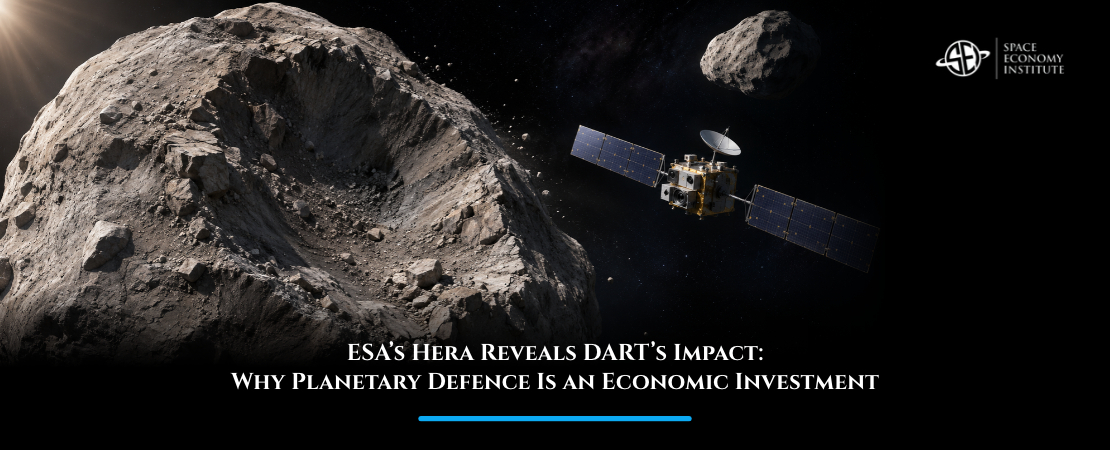
On November 25, the European Space Agency unveiled the first close-up images of Dimorphos, the asteroid struck by NASA’s DART spacecraft in 2022. The images reveal a stadium-sized crater, unexpected changes in the asteroid’s rotation and hundreds of nearby boulders.
Beyond the scientific discovery, the findings highlight an important question for the space economy: how should governments invest in technologies designed to prevent rare but potentially catastrophic events?
From a Scientific Experiment to Planetary Defence
In September 2022, NASA deliberately crashed its Double Asteroid Redirection Test (DART) spacecraft into Dimorphos, a small asteroid orbiting a larger one called Didymos.
The objective was to test a technique known as kinetic impact: changing an asteroid’s trajectory by striking it with a spacecraft.
The experiment succeeded. DART shortened Dimorphos’s orbital period around Didymos by approximately 33 minutes, demonstrating that humans can deliberately alter the motion of a celestial body.
Neither asteroid poses a threat to Earth. The mission was designed as a controlled experiment to prepare for future risks.
However, measuring the orbital change was only part of the challenge. Scientists still needed to understand precisely how the impact affected the asteroid.
That is the purpose of ESA’s Hera mission, which reached the asteroid system in November 2026.
The images unveiled yesterday show a large impact crater, significant changes in Dimorphos’s rotation and unexpectedly complex surrounding debris.
These observations will help scientists understand how different asteroids respond to collisions.
Why Understanding Asteroids Has Economic Value
Planetary defence is fundamentally a problem of risk management.
Asteroid impacts capable of causing major destruction are rare, but their potential consequences for populations, infrastructure and economic activity can be enormous.
The challenge is not simply detecting a dangerous object. Governments also need reliable methods for changing its trajectory before a collision becomes unavoidable.
Different asteroids may respond differently to the same intervention.
A dense, solid asteroid may behave differently from one composed of loosely connected rocks. The amount of material expelled during an impact can also influence how effectively the object is deflected.
Hera will measure Dimorphos’s physical properties, including its mass, structure and composition, allowing researchers to improve models used to predict the results of future interventions.
More reliable predictions can support better decisions about when to intervene, what technology to deploy and how much investment is required.
The value lies in reducing uncertainty before an actual emergency occurs.
Planetary Defence as a Public Investment
Unlike satellite telecommunications or Earth observation, planetary defence does not yet represent a conventional commercial service market.
Its benefits are difficult to assign to individual paying customers.
If an asteroid threatening Earth is successfully deflected, entire populations and economic systems benefit, regardless of who financed the operation.
Economists describe this as a public good: a benefit that can be shared widely and from which people cannot easily be excluded.
This creates a strong rationale for government investment and international cooperation.
NASA’s DART mission and ESA’s Hera programme illustrate how public institutions can finance the development and validation of capabilities that may be essential for collective security.
The economic return is not necessarily direct revenue. It can take the form of avoided damage, reduced systemic risk and improved preparedness.
As with other forms of disaster prevention, investing before a threat materializes can be substantially more effective than attempting to respond after its consequences become unavoidable.
A Specialized Industrial Ecosystem Is Emerging
Although planetary defence is primarily publicly funded, its development creates opportunities for private space companies.
Hera was developed by a European industrial consortium led by OHB in Germany, involving approximately 100 companies, including 28 small and medium-sized enterprises.
These businesses contribute technologies ranging from spacecraft navigation and imaging systems to autonomous operations and miniature scientific instruments.
Hera will also deploy two CubeSats, Milani and Juventas, currently planned for January 2027. These small spacecraft will investigate asteroid materials and internal structure, demonstrating advanced operations in an extremely low-gravity environment.
Such technologies could support future scientific missions, autonomous spacecraft operations and other commercial applications requiring precise navigation around celestial bodies.
ESA is also developing the Ramses mission to investigate asteroid Apophis during its close but safe approach to Earth in 2029.
These programmes demonstrate how institutional investment can sustain specialized industrial expertise while improving planetary security.
When Space Investment Protects the Wider Economy
Hera’s latest findings represent another step toward transforming asteroid deflection from an experimental capability into a more reliable form of planetary protection.
For governments, the priority is reducing long-term risks to people and infrastructure. For the space industry, these programmes create opportunities to develop advanced technologies and specialized expertise.
The broader lesson is that the economic value of space investment is not always measured through commercial revenue, but also through the risks it helps society prevent.
If this topic interests you, the Master in Space Economy by the Space Economy Institute explores how public investment, technological innovation, international cooperation and industrial strategy shape the development of the space sector.
Discover more about the Master in Space Economy and the forces shaping the future of the global space economy.