
GalaxEye Selects Bellatrix for 30 Satellites: Why Electric Propulsion Is Becoming Critical to the Space Economy
- November 25, 2026
- Posted by: admin
- Category: Uncategorized
India’s private space industry has secured an important new agreement in satellite propulsion.
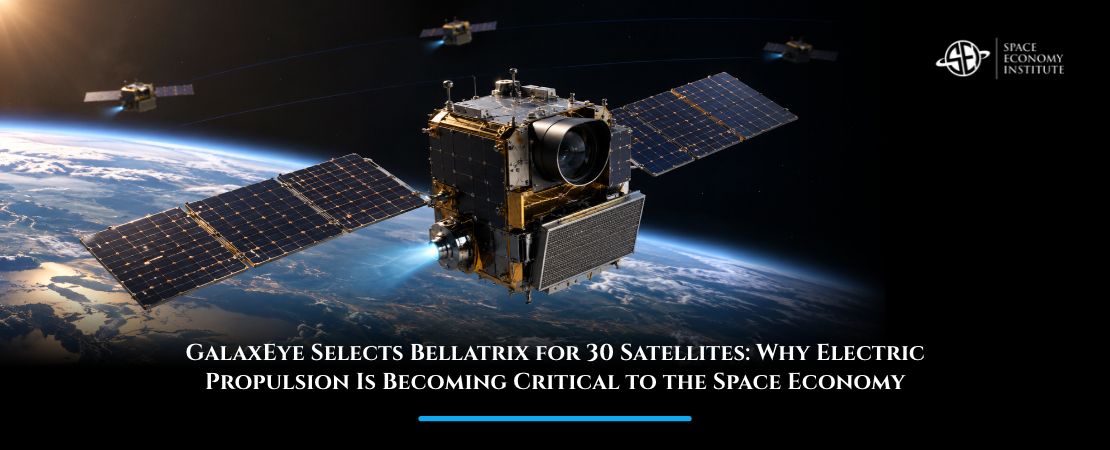
On November 24, Bengaluru-based GalaxEye selected Bellatrix Aerospace to supply electric propulsion systems for its next 30 Drishti Gen-II satellites. The multi-year contract covers the development, manufacturing and testing of propulsion systems for GalaxEye’s planned Earth-observation constellation.
The agreement illustrates an increasingly important aspect of the commercial space industry: launching satellites is only the beginning. Their ability to move and maintain precise orbits is essential to delivering reliable services to customers.
Why Satellites Need Propulsion After Launch
Rockets transport satellites into space, but they do not necessarily place every spacecraft in its exact operational position.
Once deployed, satellites may need to adjust their altitude, maintain their orbital configuration and perform manoeuvres to avoid potential collisions.
This is particularly important for satellite constellations: networks of spacecraft working together to provide continuous or frequent coverage of Earth.
Consider an Earth-observation company promising customers updated images of the same location at predictable intervals.
If its satellites drift away from their planned orbital positions, the company may struggle to maintain those schedules.
Orbital precision therefore becomes part of service reliability.
Propulsion also helps compensate for atmospheric drag, which gradually reduces the altitude of satellites operating in low Earth orbit. At the end of their missions, controlled manoeuvres can facilitate safe disposal.
Without sufficient manoeuvring capability, satellites may face operational limitations even when their instruments remain functional.
Why Electric Propulsion Is Gaining Ground
Bellatrix will supply its Arka Hall-effect electric propulsion system, a technology designed to manoeuvre spacecraft efficiently.
Unlike conventional chemical propulsion, which produces thrust through chemical reactions, electric propulsion uses electrical energy to accelerate propellant particles.
The resulting thrust is relatively small, but the system can operate efficiently over extended periods.
According to the European Space Agency, electric propulsion systems can accelerate propellant considerably faster than conventional chemical thrusters, allowing spacecraft to perform manoeuvres while carrying less propellant.
This creates an important economic advantage.
Reducing propellant requirements can free spacecraft mass for additional instruments, power systems or other mission equipment.
Alternatively, the same satellite may be able to perform more manoeuvres throughout its operational lifetime.
Electric propulsion is not universally superior. Its lower thrust means some manoeuvres take longer, while electrical power availability and system complexity influence overall performance.
Nevertheless, propellant efficiency and operational flexibility make it increasingly attractive for commercial satellite constellations.
The Commercial Importance of Orbital Mobility
GalaxEye is developing an Earth-observation constellation combining optical imaging with synthetic aperture radar (SAR), which can collect information through clouds and during darkness.
These complementary technologies could allow the company to serve customers requiring frequent and reliable observations, including governments, infrastructure operators and businesses monitoring environmental conditions.
Bellatrix’s propulsion systems are intended to move the satellites from their initial deployment orbits into their assigned imaging positions and support subsequent orbital adjustments.
This directly connects spacecraft engineering with commercial performance.
Customers purchasing satellite imagery increasingly require predictable delivery, consistent coverage and reliable service.
Propulsion supports those requirements by helping operators manage orbital positioning and maintain constellation performance.
The business value therefore extends beyond the propulsion hardware itself. A satellite’s ability to manoeuvre contributes to the reliability of the services it can sell.
A New Stage for India’s Private Space Supply Chain
The agreement also reflects the growing maturity of India’s commercial space industry.
Both companies are privately owned and based in Bengaluru. Bellatrix specializes in propulsion technologies, while GalaxEye develops satellite platforms and Earth-observation services.
Rather than developing every component internally, GalaxEye is purchasing a critical subsystem from a specialized domestic supplier.
The companies describe the agreement as India’s largest business-to-business order between private space companies by satellite volume.
This illustrates the emergence of a more specialized industrial structure.
As the market develops, manufacturers can increasingly focus on specific technologies—propulsion, sensors, communications or spacecraft platforms—while satellite operators integrate those capabilities into complete commercial services.
Such specialization can support greater manufacturing efficiency, technical expertise and economies of scale.
However, the contract does not mean all 30 satellites have been manufactured or deployed. Its economic impact will depend on successful delivery, integration, future launches and constellation operations. The financial value of the agreement has not been disclosed.
From Spacecraft Components to Commercial Infrastructure
The GalaxEye–Bellatrix agreement demonstrates how satellite propulsion is becoming an important part of the commercial space value chain.
As constellations expand, operators require reliable technologies for orbital positioning, manoeuvring and mission management. Specialized suppliers can address this demand while supporting more sophisticated domestic space ecosystems.
For India, the agreement represents another step toward a private space industry capable of supplying critical technologies to commercial customers.
If this topic interests you, the Master in Space Economy by the Space Economy Institute explores how satellite markets, industrial supply chains, technology and emerging business models interact across the global space sector.
Discover more about the Master in Space Economy and the economic forces shaping the next generation of commercial space infrastructure.