
India Backs SatSure With ₹60 Crore: How Satellite Data Is Transforming Agricultural Finance
- November 20, 2026
- Posted by: admin
- Category: Uncategorized
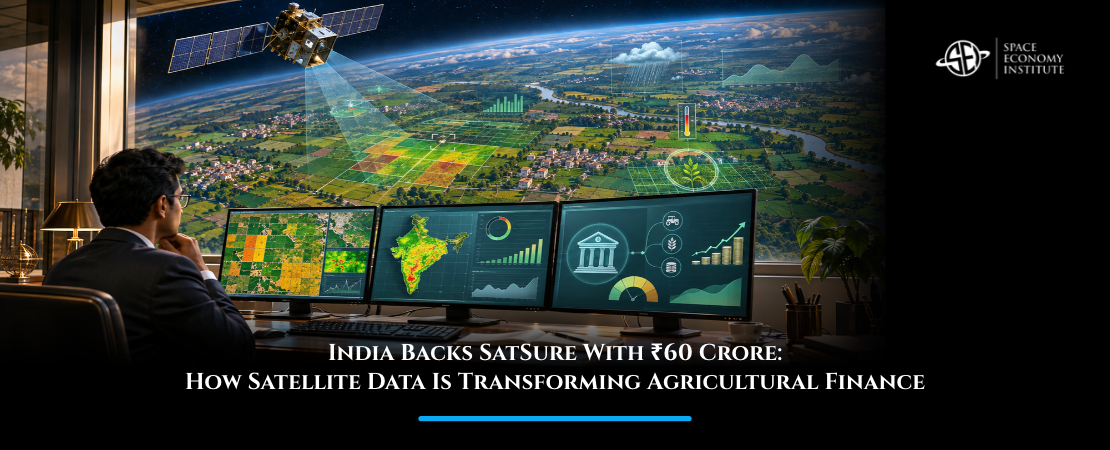
India is investing in a space company whose technology is already being used by banks and financial institutions.
On November 20, SatSure announced a ₹60 crore investment (approximately $6.4 million) from the government-backed Antariksh Venture Capital Fund, marking the first close of a planned ₹200 crore Series B funding round.
The announcement illustrates an important development in the space economy: satellite technology is increasingly creating value not through the images it collects, but through the financial and commercial decisions those images help improve.
When Satellites Become Tools for Financial Decisions
Agricultural lending presents a significant challenge for financial institutions.
Before approving a loan, a bank needs to assess a farmer’s ability to repay it. However, obtaining reliable information about agricultural land, crop conditions, irrigation and exposure to environmental risks can require expensive field inspections and lengthy administrative procedures.
Satellite Earth observation offers a complementary source of information.
Satellites repeatedly capture images of agricultural regions, allowing analysts to monitor vegetation, land use and environmental changes over time.
Combined with weather records, land ownership information and machine-learning models, these observations can help financial institutions evaluate agricultural risk more efficiently.
SatSure has developed this approach through SatSource, a platform that converts geospatial information into risk assessments used by banks.
The company reports that its technology has helped reduce agricultural loan assessment processes from weeks to minutes in certain applications.
Crucially, satellites do not determine whether someone deserves a loan. They provide additional evidence that lenders can incorporate into their decisions.
From Satellite Imagery to Commercial Intelligence
The business model extends beyond selling satellite photographs.
A bank assessing thousands of agricultural borrowers does not necessarily need individual images of every field. It needs structured information about crop conditions, historical productivity and potential financial risks.
SatSure combines satellite imagery, climate data and artificial intelligence to generate that information.
Its technology is integrated into India’s Unified Lending Interface, a digital infrastructure initiative designed to make verified information more accessible to financial institutions.
This allows satellite-derived assessments to enter existing banking workflows rather than remaining isolated research products.
The economic value comes from improving the efficiency and consistency of risk assessment.
For lenders, better information can reduce due-diligence costs and support more informed credit decisions. For farmers, faster evaluations may improve access to formal financial services.
The same analytical capabilities can also support agricultural insurance, helping insurers monitor crop conditions and evaluate potential losses.
Why India Is Investing Public Capital in Space Startups
The latest funding also illustrates India’s evolving approach to developing its commercial space industry.
The Antariksh Venture Capital Fund is supported by IN-SPACe, the government body responsible for promoting and authorizing private space activities, and managed by SIDBI Venture Capital.
Unlike a traditional research grant, venture capital involves investing in companies with the expectation of financial returns.
Publicly backed investment can help companies finance expensive technological development while attracting additional private capital.
SatSure intends to use the funding to develop new satellite-imaging capabilities, expand its international operations and strengthen its artificial intelligence products.
Its subsidiary, KaleidEO, is preparing optical satellite payloads for a planned orbital mission in 2027.
SatSure is also part of a private consortium selected to develop India’s national Earth-observation constellation through a public-private partnership.
These initiatives reflect a broader industrial strategy: developing domestic capabilities while supporting companies capable of competing in international markets.
The Economics of Turning Space Data Into Services
SatSure’s business illustrates where commercial value can emerge within the satellite industry.
Manufacturing and launching spacecraft requires substantial upfront investment. However, companies can generate continuing revenue by converting satellite observations into services that customers use repeatedly.
A financial institution may pay for ongoing agricultural risk assessments. An insurer may purchase crop-monitoring services. A government may require regular information about infrastructure or land use.
This creates opportunities for recurring revenue models based on data analytics rather than one-time hardware sales.
Nevertheless, commercial success depends on more than access to satellite imagery.
Providers must demonstrate that their assessments are accurate, reliable and economically valuable. Data quality, integration with customer systems and the cost of delivering services remain important competitive factors.
The broader lesson is that space companies increasingly compete on their ability to solve problems in established industries, not simply on their ability to operate satellites.
A Growing Market Beyond Traditional Aerospace
SatSure’s latest investment demonstrates how India’s commercial space sector is expanding beyond launch vehicles and spacecraft manufacturing.
Banks, insurers and agricultural businesses are becoming customers of technologies that depend on space infrastructure, even when their primary activities have little connection to aerospace.
For emerging space economies, this creates opportunities to develop companies that combine satellite capabilities with expertise in finance, agriculture and other industries.
If this transformation interests you, the Master in Space Economy by the Space Economy Institute explores how investment, satellite applications and emerging business models create economic value across different sectors.
Discover more about the Master in Space Economy and the forces shaping the global space industry.