
- November 19, 2026
- Posted by: admin
- Category: Uncategorized
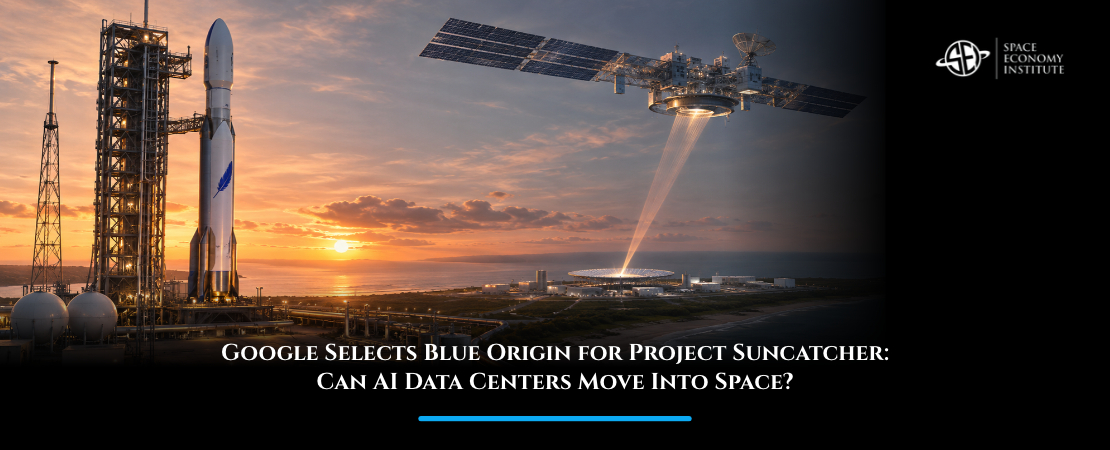
Google is taking another step toward an unconventional solution to the growing demand for artificial intelligence computing.
On November 19, Google and Blue Origin announced an agreement to launch AI computing satellites aboard New Glenn in early 2029. The mission forms part of Project Suncatcher, Google’s initiative to investigate whether space can host large-scale computing infrastructure powered by solar energy.
The announcement introduces a significant question for the space economy: could orbit eventually become a commercially competitive location for data centers?
Why Google Is Looking Beyond Terrestrial Data Centers
Artificial intelligence requires enormous computing capacity.
Training and operating advanced AI models involves specialized processors working continuously across large data centers. These facilities require substantial electricity, cooling systems, land and supporting infrastructure.
As AI demand expands, obtaining sufficient energy and developing new facilities are becoming increasingly important constraints.
Project Suncatcher explores a different approach: placing computing infrastructure in orbit, where satellites can access abundant sunlight.
Google estimates that solar panels operating in suitable low Earth orbits could generate significantly more energy than equivalent installations on Earth’s surface, partly because they avoid atmospheric losses and can receive sunlight almost continuously.
The proposed infrastructure would use Tensor Processing Units (TPUs), Google’s specialized processors for artificial intelligence, installed aboard interconnected satellites.
Rather than collecting satellite imagery, these spacecraft would perform computing tasks themselves.
The distinction is important: the objective is not simply to make satellites more intelligent, but to investigate whether general-purpose AI computing capacity can be delivered from space.
From Experimental Hardware to Orbital Computing Infrastructure
Project Suncatcher has already progressed beyond initial laboratory research.
On October 1, Google launched its first prototype satellite in partnership with Planet Labs. The spacecraft successfully established communication with Earth and subsequently demonstrated the operation of a data-center-class TPU in orbit.
The experiment showed that Google’s computing hardware could execute initial AI workloads under actual space conditions.
However, operating one processor is fundamentally different from supporting a commercial computing network.
The newly announced Blue Origin agreement represents a larger development step.
Scheduled for the first quarter of 2029, the dedicated New Glenn mission will deploy satellites with computing capacity approximately equivalent to individual server racks in terrestrial data centers.
Google ultimately envisions an interconnected network of spacecraft capable of sharing information and distributing computational workloads.
This could transform satellites from specialized computing devices into components of a distributed orbital data center.
The Economics of Moving Computing Into Orbit
The commercial proposition depends on a fundamental trade-off.
Terrestrial data centers require ongoing expenditure on electricity, cooling, buildings and associated infrastructure. Orbital facilities could potentially benefit from abundant solar energy while avoiding some terrestrial constraints.
However, building infrastructure in space introduces substantial additional costs.
Satellites must be manufactured, launched, protected against radiation and operated remotely. Their computing components must withstand extreme temperatures and function without conventional maintenance.
Cooling presents a particularly demanding challenge. Although space is cold, it is a vacuum, meaning satellites cannot remove heat through ordinary air circulation. High-performance processors require carefully designed thermal systems that radiate excess heat away.
Communication is another constraint. Large AI workloads involve moving enormous quantities of information between processors, requiring extremely high-capacity links between satellites and Earth.
The economic question is therefore whether the benefits of orbital solar power can eventually outweigh launch, manufacturing, communications and operating costs.
Google’s research suggests falling launch prices could improve the business case over time, but commercial competitiveness remains unproven.
A New Customer Market for the Space Industry
Project Suncatcher also illustrates how the space industry’s customer base is expanding.
Traditionally, launch providers have transported communications satellites, scientific spacecraft, navigation systems and exploration missions.
Large technology companies now represent another potential source of demand.
If orbital computing becomes economically viable, it could create markets for high-capacity launch services, specialized satellite platforms, radiation-resistant processors, advanced thermal systems and optical communications infrastructure.
The Google–Blue Origin agreement demonstrates how this potential demand is beginning to influence commercial relationships today, even before the underlying business model has been validated.
Importantly, the 2029 mission is a research and technology-development milestone, not the launch of a fully operational commercial data center.
Its results will help determine whether the concept can develop into an investable infrastructure market.
When Computing Infrastructure Extends Beyond Earth
Google’s latest agreement highlights the growing intersection between the space economy and the global technology industry.
Orbital data centers remain experimental, and their future depends on solving significant technical and economic challenges.
Nevertheless, the involvement of major technology companies suggests that space infrastructure is increasingly being considered for applications far beyond traditional aerospace markets.
If this topic interests you, the Master in Space Economy by the Space Economy Institute explores how emerging technologies, infrastructure investment and innovative business models are creating new commercial opportunities.
Discover more about the Master in Space Economy and the forces reshaping the global space industry.