
ICEYE Bids €2 Billion for Avio: Why Europe’s Space Industry Is Moving Toward Vertical Integration
- November 18, 2026
- Posted by: admin
- Category: Uncategorized
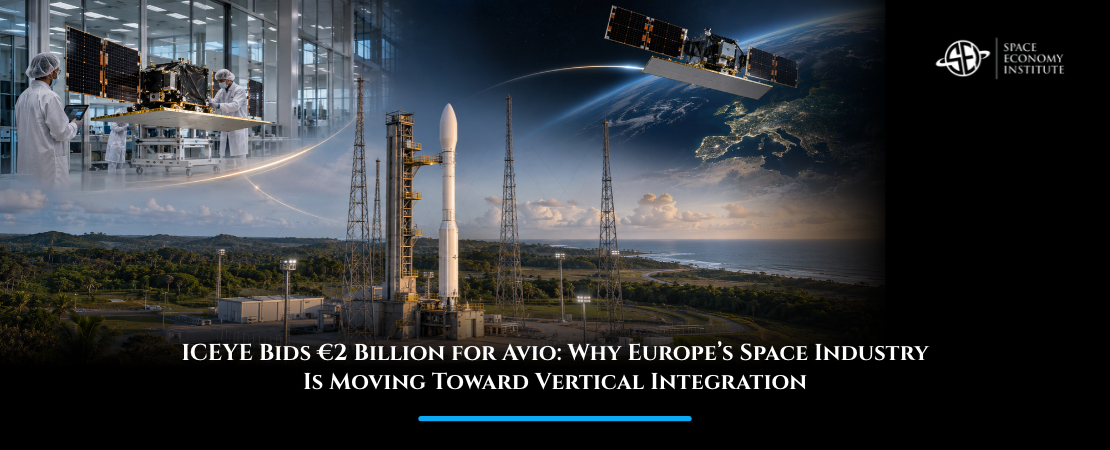
Europe could soon see the emergence of a new integrated space and defence group.
On November 17, Finnish satellite operator ICEYE announced an approximately €2 billion takeover bid for Avio, the Italian aerospace company behind Europe’s Vega launch vehicles. The all-cash offer values Avio shares at €41 each, representing a 21.3% premium over their previous closing price.
The proposed acquisition illustrates an important trend in the space economy: companies are seeking greater control over the entire chain of activities, from launching satellites to delivering services to customers.
Bringing Satellite Manufacturing and Launch Under One Group
ICEYE and Avio operate in different but complementary parts of the space industry.
ICEYE specializes in synthetic aperture radar (SAR) satellites, which use radar signals to observe Earth regardless of cloud cover or daylight conditions. Its systems provide intelligence for governments, defence organizations, insurers and emergency-response services.
Avio, meanwhile, develops propulsion technologies and the Vega family of launch vehicles, which transport satellites into orbit from Europe’s Spaceport in French Guiana.
Combining these capabilities would create a company operating across several stages of the space value chain: satellite manufacturing, launch, constellation operations and intelligence services.
This approach is known as vertical integration: bringing activities that would otherwise be performed by separate suppliers under common ownership.
For space companies, controlling more of the value chain can improve coordination, reduce dependence on external providers and create opportunities for more integrated commercial offerings.
The Economic Logic Behind the Acquisition
The strategic rationale becomes clearer when considering how the two businesses depend on one another.
ICEYE needs reliable access to launch services to expand and replenish its satellite constellation. Avio, in turn, needs sufficient demand to justify investment in production facilities, launch infrastructure and future vehicle development.
The proposed combination could help address both requirements.
ICEYE would gain more direct influence over launch planning, while Avio could benefit from a recurring customer with growing satellite-deployment needs.
Greater visibility over future launch demand may also support investment decisions and improve the utilization of manufacturing infrastructure.
The combined group could eventually offer governments a more comprehensive service: manufacturing satellites, launching them, operating the constellation and delivering intelligence from orbit.
However, vertical integration does not automatically reduce costs. Its economic benefits would depend on effective coordination, capital allocation and the ability to maintain a competitive offering for external launch customers.
Why European Space Sovereignty Is Central to the Deal
The acquisition also has implications for European industrial strategy.
Space sovereignty refers to the ability of countries to access and operate critical space capabilities without excessive dependence on external providers.
For governments relying on satellites for defence, security and communications, this increasingly involves the entire system: spacecraft, launch services, ground infrastructure and data.
Europe has invested heavily in developing independent launch capabilities through programmes such as Ariane 6 and Vega-C. Nevertheless, commercial competitiveness and reliable access to launch capacity remain important strategic objectives.
ICEYE argues that combining its satellite and intelligence capabilities with Avio’s launch infrastructure could strengthen Europe’s ability to deploy sovereign space systems.
The company has also announced plans to invest an additional €1 billion in Italy over five years, subject to completion of the transaction, to expand Avio’s industrial capacity and increase Vega launch frequency.
The proposed investment could support manufacturing, research and development, suppliers and highly skilled employment.
The Acquisition Still Faces Significant Conditions
Despite its strategic potential, the transaction remains a proposal rather than a completed acquisition.
ICEYE has launched a voluntary public tender offer for Avio’s shares, with the objective of eventually removing the company from the Milan stock exchange.
Avio’s board has begun evaluating the offer.
The transaction will also require regulatory approvals, including scrutiny under Italy’s golden power framework, which allows the government to intervene in transactions involving strategically important national assets.
These requirements reflect a fundamental tension in the European space industry: cross-border consolidation can strengthen industrial scale, while governments remain concerned about control over critical national capabilities.
The outcome will therefore depend on more than financial terms. Industrial commitments, strategic interests and regulatory considerations will all influence whether the acquisition proceeds.
A New Phase of European Space Industry Consolidation
ICEYE’s bid for Avio illustrates how Europe’s space industry is evolving from a collection of specialized businesses toward potentially larger, more integrated industrial groups.
For satellite operators, greater control over launch can improve planning and supply-chain resilience. For governments, integrated providers could offer more comprehensive sovereign space capabilities.
Whether this particular transaction succeeds remains uncertain, but the underlying trend is significant: competition in the space economy increasingly involves controlling entire systems, not simply individual technologies.
If this transformation interests you, the Master in Space Economy by the Space Economy Institute explores space finance, industrial strategy, market consolidation and the business models reshaping the global space sector.
Discover more about the Master in Space Economy and the economic forces driving the next phase of space industry development.