
Reflect Orbital Raises $73.5 Million: What Has Changed Since Its Space Mirror Approval?
- November 12, 2026
- Posted by: admin
- Category: Uncategorized
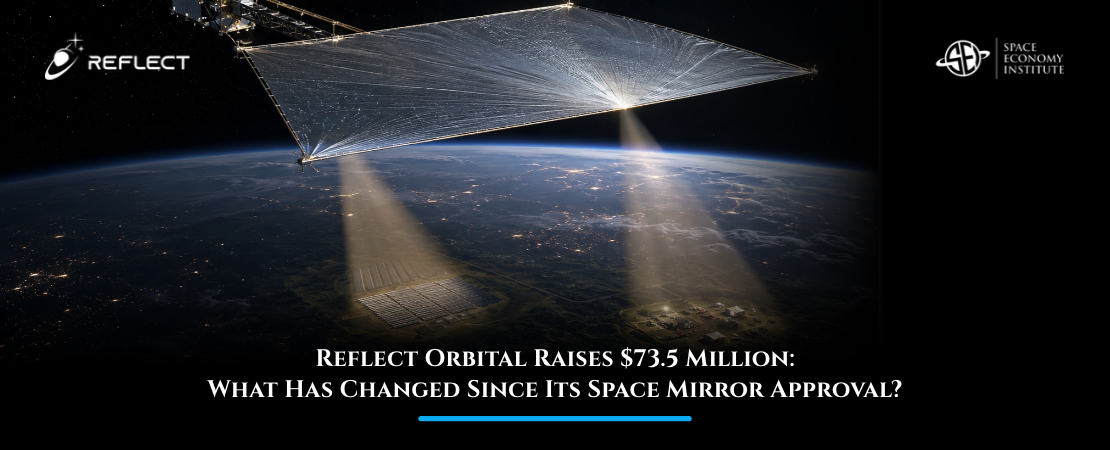
Four months after receiving regulatory approval for its first experimental space mirror, Reflect Orbital has secured $73.5 million in new funding, bringing its total capital raised to more than $100 million.
Announced on November 10, the investment represents a significant step toward transforming the company’s proposed sunlight-on-demand service into operational space infrastructure.
The technology, its potential applications and the environmental debate surrounding it were examined in our July article on Reflect Orbital’s space mirrors. The latest developments shift attention toward a more practical question: can the concept progress from an experimental idea to a commercially viable service?
New Funding to Accelerate Development
Reflect Orbital’s latest funding attracted both existing and new investors, including Sequoia Capital, Lux Capital, Starship Ventures and Salesforce Ventures.
According to the company’s November 10 announcement, the capital will support initial satellite launches, further development of its orbital reflector technology and expansion of commercial partnerships.
The funding also follows a significant operational development.
On October 14, Reflect Orbital announced the purchase of two dedicated launches from India’s Skyroot Aerospace, complementing its existing launch arrangements.
For an emerging infrastructure company, securing launch capacity is an important part of reducing execution risk. Satellites must be manufactured, tested and delivered to orbit before any commercial service can begin.
Nevertheless, the investment should not be interpreted as evidence that the underlying business model has already been validated. Reflect Orbital has yet to demonstrate sunlight redirection from orbit or establish a fully operational revenue-generating service.
From Regulatory Approval to Orbital Demonstration
The company’s development programme has also become more structured since July.
On October 30, Reflect Orbital filed an application with the Federal Communications Commission for a new developmental satellite called Eärendil-0, targeted for launch no earlier than April 2027.
Unlike the previously authorized Eärendil-1, this spacecraft will not carry an orbital mirror. Instead, it will test fundamental satellite-control and communications systems.
The approach introduces an intermediate technical milestone before attempting sunlight reflection.
Eärendil-1, which received FCC authorization in July, is now expected to launch in the second quarter of 2027. Its objective will be to test the deployment, positioning and performance of the reflector in orbit.
These demonstrations are essential because the commercial concept depends on considerably more than successfully launching a satellite.
Operators must demonstrate precise beam targeting, reliable spacecraft control and repeatable illumination under real orbital conditions.
The results will help determine whether the technology can support the larger infrastructure envisioned by the company.
Investment Is Growing, but the Business Case Remains Unproven
Reflect Orbital’s funding illustrates investor interest in emerging space infrastructure businesses that aim to deliver services directly to industries on Earth.
However, the distinction between technical feasibility and commercial viability remains fundamental.
Even if a satellite successfully redirects sunlight, customers must receive enough measurable value to justify paying for the service.
For solar-energy operators, this means comparing the value of additional electricity generation with the cost of orbital illumination and existing alternatives, including battery storage.
Reflect Orbital would also need to account for satellite manufacturing, launch, operations, replacement and the infrastructure required to deliver consistent service.
Commercial scalability would therefore depend on both technological performance and unit economics: the relationship between the cost of providing a service and the revenue generated from each customer.
The latest funding provides resources to test these assumptions. It does not resolve them.
Environmental Scrutiny Remains a Commercial Challenge
The regulatory and environmental concerns discussed in July have not disappeared.
Astronomers and environmental organizations continue to question the potential consequences of large constellations of highly reflective spacecraft, particularly for astronomical observations, natural darkness and nocturnal ecosystems.
Reflect Orbital has stated that it intends to engage with scientific stakeholders and study the environmental effects of its technology.
This introduces another requirement for commercial expansion.
Technical success and investor support alone may not be sufficient if larger deployments raise unresolved environmental or regulatory concerns.
The company’s ability to demonstrate responsible operations could therefore influence its long-term prospects as significantly as the performance of its satellites.
The Next Milestone for Sunlight-as-a-Service
Reflect Orbital has progressed from a regulatory milestone in July to a substantially funded development programme in November.
The next stage will be more decisive: demonstrating the technology in orbit, establishing credible commercial economics and addressing the conditions required for responsible deployment.
For investors, prospective customers and regulators, the 2027 missions will provide important evidence about whether sunlight-on-demand can progress toward a sustainable space-based service.
If this intersection between space technology, investment and emerging business models interests you, the Master in Space Economy by the Space Economy Institute explores how innovative technologies are evaluated, financed and transformed into commercial opportunities.
Discover more about the Master in Space Economy and the economic forces shaping the next generation of the space industry.