
Satellite Manufacturing Is Scaling Up: What Argotec’s €50 Million Raise Signals
- October 30, 2026
- Posted by: admin
- Category: Uncategorized
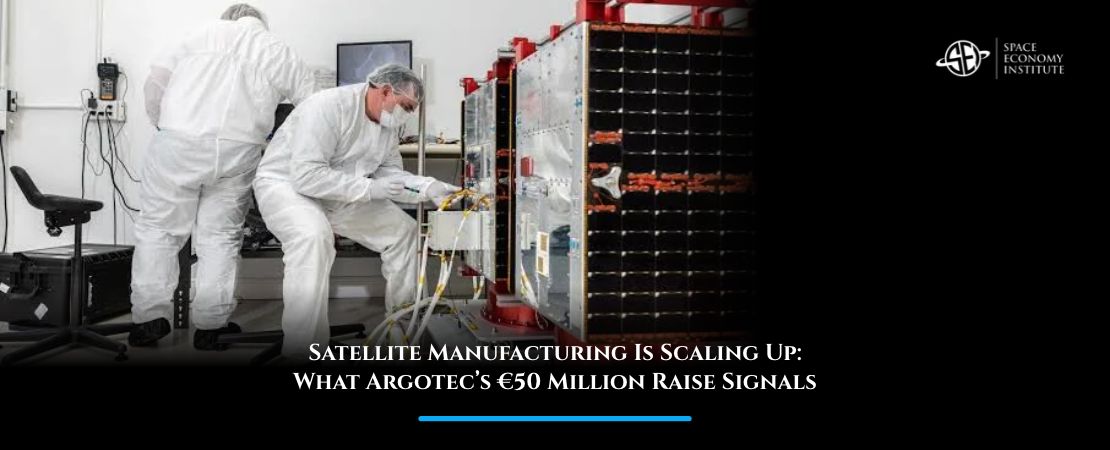
Building satellites has traditionally looked very different from manufacturing cars or smartphones. Spacecraft were expensive, highly customized machines, often designed individually for a specific mission.
That model is now changing.
On October 29, Italian satellite manufacturer Argotec announced a €50 million investment round led by NUO Space. The company plans to use the capital to expand internationally, develop more autonomous satellites and increase production capacity from 52 to 80 spacecraft per year.
The announcement reflects a broader transformation in the space economy: satellites are increasingly becoming industrial products manufactured in series rather than one-off engineering projects.
From Bespoke Spacecraft to Production Lines
For decades, most satellites were built in relatively small numbers.
A communications operator, government or scientific agency would define a mission, engineers would design a spacecraft around its requirements, and years could pass before launch.
Large satellite constellations work differently.
A network requiring hundreds of spacecraft cannot economically treat every satellite as an individual project. Manufacturers need common platforms, repeatable processes, parallel production lines and standardized components.
Argotec says standardizing its satellite platforms and introducing parallel production stations has already allowed it to reach capacity for 52 satellites annually, with the new investment supporting expansion toward 80.
This is what industrialisation means in the space sector: moving from designing individual spacecraft toward building reliable systems repeatedly, faster and at lower unit cost.
Why Constellations Are Changing the Economics
The main driver is scale.
Private operators now account for the large majority of active satellites, while broadband, Earth-observation, security and other constellations are increasing demand for spacecraft produced in significant volumes. OECD data shows that private operators accounted for 88% of satellites launched in 2025, compared with just 23% in 2010.
Europe is preparing for the same shift.
The EU’s IRIS² secure-connectivity programme, for example, is moving toward a constellation of hundreds of satellites. Eutelsat has also ordered hundreds of new OneWeb spacecraft from Airbus to maintain and expand its LEO network.
These programmes create a very different commercial requirement.
Customers no longer need manufacturers capable only of building excellent satellites. They need companies capable of delivering many excellent satellites on schedule.
That makes production speed, supply-chain resilience and manufacturing cost strategic competitive advantages.
Why Standardisation Can Lower Costs
Satellite manufacturing has historically involved extensive testing and qualification because failure after launch is extremely difficult to correct.
That requirement does not disappear with higher production volumes.
The challenge is therefore to standardize without sacrificing reliability.
One approach is to build a common satellite platform and adapt only the parts required for each mission. Components, software, testing procedures and production equipment can then be reused across multiple spacecraft.
The economics are powerful.
Engineering costs can be spread across more units. Suppliers receive larger and more predictable orders. Workers repeat the same processes, improving efficiency. Automation becomes easier to justify.
ESA has explicitly identified this transition as a priority for European competitiveness, arguing that constellation-scale demand requires serial production to reduce costs and shorten lead times.
In other words, the competitive question is shifting from “Can you build this satellite?” toward “How quickly and economically can you build the next fifty?”
Manufacturing Is Only Part of the Business
Argotec’s investment also illustrates another evolution.
The company does not intend to focus only on producing more hardware. Part of the funding will support satellites capable of processing information and making decisions autonomously, as well as services that turn satellite data into useful intelligence for customers.
This matters because margins and differentiation may increasingly sit beyond the spacecraft itself.
A manufacturer can sell a satellite once. But software, data processing and information services can generate value throughout the spacecraft’s operational life.
The emerging model therefore combines industrial-scale manufacturing with higher-value digital services.
When Space Manufacturing Becomes an Industrial Business
Argotec’s €50 million round is significant because it captures a broader change in the space economy.
As constellations expand, satellite companies increasingly need factories, standardized platforms, resilient supply chains and repeatable production—not only exceptional engineering.
The companies that successfully make this transition could help transform satellite manufacturing from a low-volume aerospace activity into a genuine industrial market.
If this topic interests you, the Master in Space Economy by the Space Economy Institute explores satellite markets, industrial strategy, investment, supply chains and emerging business models across the global space sector. Discover more about the Master and how industrialisation is reshaping the economics of space.