
Rendezvous Robotics Raises $20 Million: Why Satellites May Start Building Themselves in Space
- October 29, 2026
- Posted by: admin
- Category: Uncategorized
Satellites are becoming more capable—but the rockets carrying them still impose a basic physical constraint: everything has to fit inside the launcher.
On October 28, Rendezvous Robotics raised $20 million to develop spacecraft that can launch as separate modules and autonomously assemble once in orbit. The company plans a major free-flying demonstration in 2028.
The technology could address an increasingly important question for the space economy: what if spacecraft no longer had to be designed around the size of a rocket?
Why Rocket Size Still Shapes Satellite Design
During launch, a satellite sits inside the rocket’s payload fairing—the protective shell at the top of the vehicle.
That fairing limits how wide and tall the spacecraft can be.
This matters because many of the capabilities satellite operators want require increasingly large structures. More solar-panel area can provide greater electrical power. Larger communications antennas can increase capacity and performance. Larger apertures can improve some sensing applications.
Today, engineers often solve the problem by folding antennas, solar arrays and other structures for launch and deploying them once the satellite reaches orbit.
But deployment mechanisms introduce complexity. And ultimately, even folded hardware still has to fit inside a finite launch volume.
ESA has long identified in-orbit assembly as one potential way around this constraint: structures manufactured or assembled after launch can theoretically exceed the dimensions imposed by a rocket fairing.
From Folding Spacecraft to Assembling Them
Rendezvous Robotics is pursuing a more modular approach.
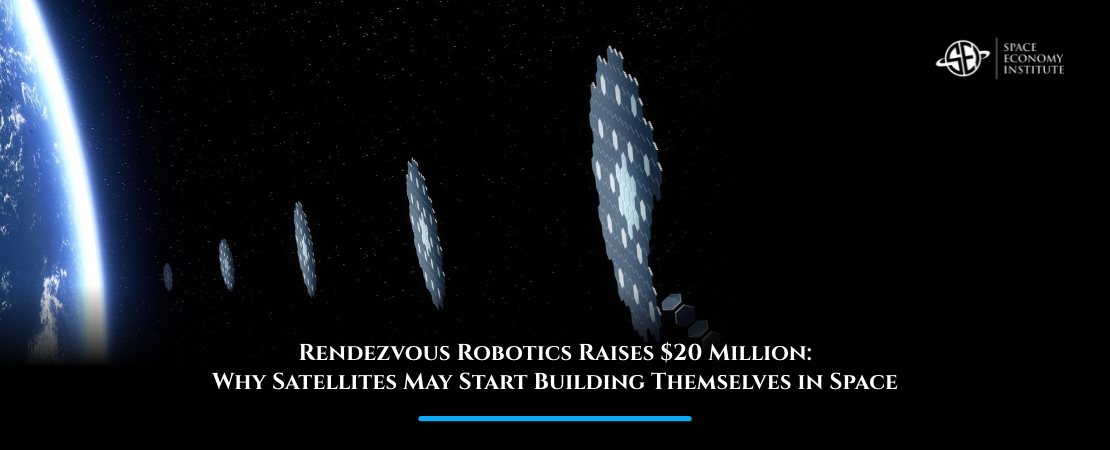
Its technology originates from TESSERAE, research developed at MIT around self-assembling space structures. Rather than launching one complete spacecraft, the concept uses individual tiles equipped with processors, sensors and electromagnetic actuators. Once released in microgravity, the modules can move toward one another, align and connect to form a larger structure.
The company now intends to take that concept beyond experimental structures.
A demonstration scheduled for December 2026 will test 32 tiles assembling into a three-dimensional structure aboard the International Space Station. More significantly, a mission planned no earlier than April 2028 will deploy seven independent spacecraft tiles in free space, where they are expected to assemble into one spacecraft, separate and then reassemble into another configuration.
If successful, the spacecraft itself would no longer be a completely fixed object after launch.
Why Larger and Reconfigurable Satellites Matter
The commercial value goes beyond simply building bigger structures.
Satellite communications depend heavily on antenna performance. High-powered spacecraft need large solar arrays. Some future orbital computing and sensing systems could require substantially more power, surface area and heat-management capability than conventional satellites.
Rendezvous Robotics argues that autonomous assembly could enable very large antennas and power-generating structures that would otherwise be difficult to launch as single spacecraft.
But modularity introduces another possibility: changing a spacecraft after it is already operating.
Today, if an important component becomes obsolete or fails, replacing the entire satellite can be the only practical solution. A modular architecture could eventually allow operators to add new sections, replace individual elements or reconfigure a spacecraft for changing mission requirements.
Economically, that changes the idea of a satellite from a finished product with a fixed configuration into something closer to upgradeable infrastructure.
A Different Model for Space Manufacturing
That could have implications across the satellite value chain.
Traditional spacecraft manufacturing concentrates enormous effort before launch: design, integration and testing must produce a finished system capable of surviving years in orbit.
In-space assembly moves some of that value creation beyond the launch itself.
Future companies could specialize in standardized modules, autonomous assembly systems, orbital construction software or components designed specifically to be added to existing spacecraft.
It could also change the relationship between spacecraft and launch vehicles. Instead of designing an entire mission around what fits within one fairing, operators could launch modules across one or several missions and combine them in orbit.
None of this is commercially proven yet. Autonomous assembly has to work reliably, and the additional hardware, launches and operational complexity must cost less than the value created by larger or more adaptable spacecraft.
But the $20 million investment from firms including MaC Venture Capital and Toyota Ventures shows that investors are willing to back the idea that future space infrastructure may increasingly be built where it will actually operate: in space.
When Launch Stops Defining the Size of Spacecraft
For decades, spacecraft have been engineered around one unavoidable requirement: they must fit inside a rocket.
Autonomous in-space assembly could begin to weaken that constraint, enabling satellites that are larger, reconfigurable and potentially easier to upgrade over time.
If the technology matures, the economic impact could extend beyond spacecraft design into launch, manufacturing, communications and future orbital infrastructure.
If this topic interests you, the Master in Space Economy by the Space Economy Institute explores how emerging technologies, investment and new business models are transforming the space value chain. Discover more about the Master and the economic forces shaping the next generation of the global space industry.